


Advertising legend Rory Sutherland argues that the biggest bottleneck for creative agencies isn’t production. It’s the “byzantine approval process”.
He has a point. Everyone’s fixated on AI speeding up production, but maybe that’s not the biggest pain agencies are facing. Perhaps the real efficiency vampire is having to fight tooth and nail to get that gut-feeling idea of yours past the creative police.
Creative ideas rely on intuition or probabilistic thinking. And that doesn’t always play nicely with the rational processes favored in approvals.
Just imagine pitching the idea of a gorilla playing the drums to advertise a chocolate bar. There’s no rational reason behind that idea. Yet, “Gorilla” is one of the most successful ads of all time.
Concepts like Automation Bias and Algorithmic Appreciation suggest we trust AI over gut feelings, even if its “reasoning” is opaque. That got me thinking:
What would that mean for creative agencies where you typically have to fight (or test) to the death to get intuition-based ideas approved? Could AI validate those seemingly crazy ideas?
Naturally, that led me down a rabbit hole. I started picturing how else AI would change the average day in a creative agency. Then, I asked 31 senior agency folks to weigh in.
Let’s take a trip to the future.
Is approval really the greatest source of inefficiency for agencies?
My first step was to see what the real efficiency vampire is for agencies. And I don’t think the response is going to blow anyone’s mind.
It’s the review and approval process.
Production and agreeing on a concept also suck their fair share of air out of the room.

It looks like approvals of all nature are the current gatekeepers of agencies’ time and sanity. But can AI change that? It’s time for the crystal ball part of this article. 🔮
Prediction one: An AI agent will help you choose which clients to chase
The debate on whether AI is killing or enhancing creativity rages on. But I think AI will work its way into agency life in more practical ways, like using data to choose the right accounts to pitch.
Over half of the creatives I spoke to agree, ranking this scenario as “likely” or “very likely”.

But what would that actually look like?
If there’s one thing we can all agree on, it’s that AI is unmatched at collecting data.
In the future, I think we’ll see AI agents pulling data from multiple sources:
- Internal data – past client performance, profitability, or success rates of similar products
- External data – market trends, competitor analysis, industry reports, or client financials
- Other relevant signals – social media activity, product launches, news about potential clients (funding rounds, mergers, etc.)
Your agency’s AI agent could be pulling data from your CRM, analyzing past interactions with prospective clients, and building a list of MVPs all before you’ve had breakfast.
Once it’s churned out a ranked list of prospects, highlighting the most promising ones, your team can allocate resources accordingly.
Andrew Gear is the Founder and Creative Director at HRZN, a future-focused branding agency. He already has a new model that analyzes potential market, environmental, and economic trends to help shape a company’s brand.
Andrew’s hopeful that AI will take over repetitive tasks, leaving more time to build stronger human relationships and think strategically.
Here’s how he thinks AI agents will impact the day-to-day life at a branding agency.

“I think there will be an ‘AI network’ that will need fostering. We’ve seen the impact SEO has on discovering content on the web. With AI on the rise, there will likely be a divide in content and brand awareness going forward. The AI content driving traffic through AI agents and search engines vs more organic content on human-only networks.”
Andrew Gear, Founder and Creative Director at HRZN
He reckons a typical day in a 2040 agency may see the senior creatives managing “AI specific” deliverables vs “human-first” ones. And maybe even managing AI-human hybrid teams.
“How crazy would it be to manage an AI workforce with multiple AI agents alongside a human team? That would be incredibly interesting and probably an inevitable truth!”
Could your next work bestie be an AI agent?
Prediction two: An AI assistant will attend all creative sessions
Picture this. An AI assistant attends your creative brainstorming sessions to record, categorize, and flag ideas that align with trends and brand guidelines.
77% of the agency folks I spoke to said this was “likely” or “very likely”.

Lucy Sambrook is a PR Specialist for Seed Marketing Agency. She painted a pretty epic picture of how AI assistants will change how we work in marketing and ad agencies.

“It’s 8:30 AM, and as I sip my coffee, my AI assistant, Echo, briefs me on the latest trends. Overnight, it’s scanned millions of data points – social media conversations, competitor moves, and emerging cultural shifts – to suggest new campaign angles. It even predicts which ad creatives will perform best, based on real-time audience sentiment.”
Lucy Sambrook, PR Specialist at Seed Marketing Agency
But that’s only the beginning.
“By 9:00 AM, I’m in a virtual strategy session. No need for slides – our AI co-pilot Synth generates interactive visuals, real-time audience heatmaps, and even drafts scripts for our upcoming holographic ad campaign. It’s like having a team of strategists, designers, and copywriters working at 10x speed.”
Here’s what else Lucy predicts AI assistants will do:
- Auto-generate personalized ad campaigns, tailoring content for different audience segments and adjusting in real time based on engagement
- Highlight performance insights and recommend budget reallocations
- Schedule content and line up the next wave of creative experiments
- AI brand ambassadors will host live Q&A sessions on socials (every response is driven by sentiment analysis and brand guidelines, making sure messaging stays sharp)
This is an exciting prospect for Lucy, knowing she can wrap up her workday with confidence.
“I head out confident that our marketing engine is running 24/7 – fueled by intelligence, automation, and a touch of creativity only humans can bring.”
Prediction three: You’ll present winning ideas to an AI approval system
We’ve already seen how challenging it can be for creatives to get gut-based ideas approved.
Now imagine your agency has its own AI approval system, let’s call it AAS. It will analyze concept ideas to offer instant feedback, suggest refinements, and flag potential compliance issues.
42% of creatives think this kind of approval system is “highly likely” to exist in the near future.
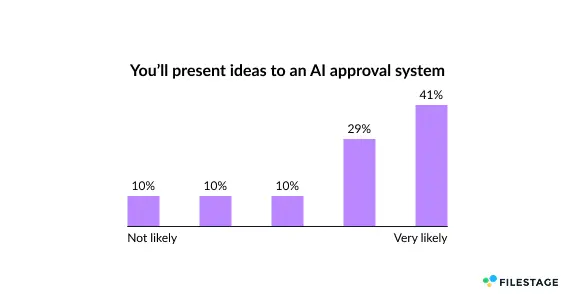
It seems inevitable that AI will take over a large portion of the creative review and approval process.
At Filestage, we’re already using AI-assisted reviews to speed up approvals. AI can flag mistakes and check content against brand guidelines or industry regulations.
But AAS would come in earlier in the process, assessing ideas for originality, alignment with brand guidelines, and audience appeal. All before you even pitch to clients.
That would allow your agency to confidently pitch concepts that will resonate with your client’s audience.
Now here’s a spanner in the works.
Nikola Baldikov, CEO of Inbound Blogging, argues that marketing could become fully automated. That means ads won’t be targeted directly at people, but at their AI assistants instead.

“These AI systems will filter vast amounts of content, selecting and presenting only the most relevant ads based on individual preferences and behaviors.”
Nikola Baldikov, CEO at InBound Blogging
Could we be living in a world where humans are creating ads and content for AI?
Prediction four: An AI mediator will break creative deadlocks
Let’s circle back to the intro for a moment. Rory Sutherland argues that the biggest creative bottleneck ad agencies face is the “byzantine approval process”.
Getting intuition-based (or seemingly wacky) ideas past the creative police is an age-old hurdle in agency life.
But could AI fix this? An AI mediator would potentially analyze the concept against market data and brand history.
39% of agency folks believe it’s “highly likely” that AI mediators could help break creative deadlocks over campaign ideas.

I admit that I was a bit skeptical about this one at the start. I mean, would an AI mediator have backed the “Gorilla” idea in a room full of skeptics?
Well, this was recently put to the test.
System1 exists to “make the rational case for emotion” by testing ads based on emotional responses. When it tested the “Gorilla” ad, it scored a maximum 5.9 stars and beat everything else.
With the right testing in place (one that uses emotional responses), AI mediators could actually help creative ideas that typically suffer under “rational” testing methods. Read: it gives clients the box-ticking evidence they need.
Prediction five: You’ll use an AI sentiment analyzer to gauge real-time reactions
You’re pitching a concept to a potential client. It’s a big deal. But you already know that the competition for the account is huge. Plus, the client is notoriously picky and has an unmatched poker face.
Luckily, you have an AI sentiment analyzer embedded in the presentation to gauge real-time reactions. It picks up on positive signals like nodding and flags them as engagement. The same goes for negative signals like frowning.
Based on these signals, it offers live prompts to adapt the pitch. It maps emotions and categorizes them in graphs or heatmaps, preparing a detailed report at the end of the presentation.
It’s a cool idea, but only 23% of creatives see this becoming a regular part of agency life in the future.

Prediction six: An AI project manager will do all the heavy lifting
Your client has approved the concept. Now it’s time for your AI project manager to step in to automatically track timelines, assign tasks, and notify relevant team members.
26% of the creatives I spoke to believe AI project managers are “highly likely” in the near future.

But could AI really go from being an assistant to a project manager running complex campaigns? This made me think about the implications for junior creatives.
JM Littman is the owner of Webheads, an award-winning agency. He raises concerns about how the next generation of creatives will learn the basics of the craft.
AI is gobbling up the lion’s share of foundational tasks like research, first drafts, and general grunt work – the stuff that interns and juniors typically cut their teeth on. So if AI takes over entry-level responsibilities, where does that leave young professionals?

“There’s a real risk that in a few years, we’ll have a huge skills gap and fewer people with practical experience because they never had a chance to start at the bottom and work their way up. Businesses need to be smart about how they integrate AI.”
JM Littman, Owner at Webheads – WDC Agency Limited
Prediction seven: AI will take over the review process
And we have a winner. A whopping 58% of the creatives I interviewed think AI-assisted reviews are “very likely” to be the new normal for ad agencies.

Let’s be honest, creatives should be doing big-picture work. But too much agency time is wasted on painstakingly dull and repetitive reviews of assets. I believe AI will take over that process (with human supervision).
In fact, we’re already seeing this.
Filestage’s AI-assisted reviews now auto-flag typos, misaligned branding, and design issues. You can train AI on your brand guidelines, industry regulations, and other style guides to cut the time wasted on manual review tasks.

A caveat: I’m a firm believer in some friction in the creative process. AI is democratizing creative production, but sometimes those inefficient human processes are actually necessary to reach really good ideas.
That said, I don’t believe the review and approval process is the place for friction. It should come much earlier in the ideation phase.
Prediction eight: Virtual brand ambassadors will replace celebrities and influencers
Remember when celebrities were the go-to choice for brands looking to influence an audience? Then, social media influencers became the new silver bullet.
The problem is that it can be risky for companies to rely on a person to reflect their brand. One misstep by your ambassador of choice, and your carefully constructed brand reputation can topple like a deck of cards.
But what if you could guarantee that your influencer would never mess up? AI influencers may be the solution.
Interestingly, just 6% think we’re going to be using AI models, influencers, and brand ambassadors to promote creative work to the masses.

That said, we’re already seeing AI influencers and virtual brand ambassadors flood social media.
Take Laila Khadraa, PUMA’s very first virtual ambassador. In the words of PUMA, she’s revolutionizing brand storytelling and engaging Gen Z in ways we’ve never seen before.
Sure, I get the appeal. Laila is always available, she’ll never miss a shoot, and she’s affordable. But is “perfect” really what the people want?
Not according to the Founder of Modeva, Victor André Enselmann,

“By 2040, marketing won’t be something businesses “do” – it’ll be something that’s happening all the time, automatically, and invisibly. […] The brands that win won’t just rely on automation – they’ll be the ones that find ways to be authentic, creative, and genuinely human in a sea of algorithmic perfection.”
Victor André Enselmann, Founder at Modeva
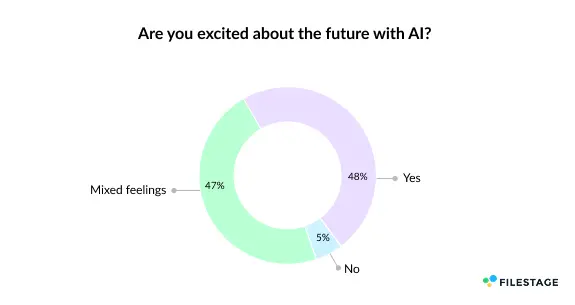
48% of respondents are excited about the future
I finished this fun little experiment by asking if agency folks are optimistic about the future of the industry with AI.
Interestingly, 48% said they’re excited, and 47% have mixed feelings.
While some are cautiously optimistic, Tj Bitter, the Managing Partner at Oddbeast, is apprehensive about the future.

“It’s not hard to squint and see what’s coming for us all. Deregulated AI platforms and fully prompted fake ads aimed to cut out every worker it takes to maximize profit and minimize overhead. There are peers that are excited for the latest AI bullshit but if left to bloat and eat what it wants, AI will take us all.”
Tj Bitter, Director of Video Operations – Managing Partner at OddBeast
Despite his concerns, Tj has faith in the future of human-led advertising,
“There are studies showing a majority of consumers also dislike AI in advertising. While I do think we’re in for a bumpy ride, all humans will eventually prefer a more human-centered experience with their advertising/art/entertainment. At least I hope so.”
Could AI be the key to getting human ideas past the creative police?
There’s not enough research to prove there’s such a thing as an “AI placebo effect” that makes us trust AI-backed ideas over a human hunch. But there’s certainly a strong case.
AI is already democratizing creative processes and building a real-time playground to test ideas faster. But that’s not where I believe it shines.
Only a human could come up with that “Gorilla” campaign. That said, AI could use real-time testing and perceived “authority” to validate gut-feeling ideas so more Gorillas get past the creative police. I believe that’s the future. Convince me I’m wrong.
Here’s to more Gorillas playing drums and less AI slop.


