

There’s an ongoing myth claiming that people are done with print media. That would mean there’s no future for print marketing. But the statistics tell a different story.
Did you know that four out of five consumers trust print ads the most when making a purchasing decision?
On top of that, another study shows that 75% of people feel more special when they receive a brand advertisement in the mail – proving that print marketing can be an extremely effective promotional tool.
So what’s the truth behind print marketing? And, more importantly, how can you use print advertising to maximize the success of your marketing efforts?
Let’s find out in this 10-step guide for setting up a print marketing strategy!
Step 1: Define your marketing goals
No marketing strategy can ever work without a clear definition of goals and objectives. Only once you know what you’re trying to achieve with your marketing can you confidently build an effective strategy.
Are you aiming to increase brand awareness, generate leads, boost sales, promote a special event, or encourage repeat business?
Once you know the answer to that question, you can decide how you’ll measure the success of your print marketing materials.
Here are some metrics you can track for your print advertisement:
- Response rates
- Sales conversions
- Customer engagement
- Return on investment (ROI)
- Lead generation
Supercharge your marketing reviews
Share, review, and approve all your content in one place with Filestage.
Step 2: Identify your target audience
When it comes to defining the target audience of your print ads, it’s important to overcome your biases. For example, if you think that print ads are reserved for an older middle class audience, you could be in for a surprise!
As one study showed, 62% of Millennials say they visited a store in the past month based on information received in direct mail marketing. And this is an audience that’s grown up with the internet and digital devices.
Another study claims that 70% of US households with an income above $100,000 are newspaper readers.
So, instead of making assumptions, make sure to do your research properly!
Here’s everything you should know about your audience before crafting your print collateral:
- Demographics – Understand who your ideal customers are, including their age, gender, location, occupation, and income level.
- Psychographics – Focus on their interests, needs, pain points, and behaviors. Knowing this helps tailor your message to resonate with them.
Step 3: Develop your core message
Every channel is different. If you’re writing copy for billboards, you’ll focus on short, straightforward print piece. But if you’re crafting an email advertisement, you’ll take a more personal approach, tailoring your message to different segments of your audience.
Well, print advertising also has its specifics. When crafting your print ad, you can be more detail oriented, focus on great storytelling, and even play with the layout to make your message come alive.
Here’s an amazing example of how Adidas played with the magazine layout for their print campaign:

Source: magnetic.media
Want to see more great examples? Check out our selection of best print ads.
Here’s a checklist of everything you need to include as part of your print ad messaging:
- Clear value proposition – Communicate the key benefit or unique selling point (USP) of your product or service right away. The message should clearly explain what makes your offer different or better than competitors.
- Strong call-to-action (CTA) – Directly tell your audience what to do next, like “Call Now”, “Visit Our Website”, “Claim Your Discount”, or “Shop Today”. A clear CTA motivates readers to take immediate action and engage with your brand.
- Concise and engaging headlines – Use a headline that grabs attention instantly. It should be concise, relevant, and compelling enough to make the reader want to learn more.
- Customer-centric language – Focus on the customer’s needs, pain points, and how your product or service provides a solution. Highlight the benefits rather than just the features, showing how it will improve their life or solve a problem.
- Sense of urgency or scarcity – Incorporate time-sensitive language like “Limited Offer”, “Exclusive Deal”, or “While Supplies Last” to create a sense of urgency, encouraging immediate action and reducing hesitation.
- Consistent branding – Make sure that your messaging aligns with your brand’s message, tone, and values to reinforce brand identity and build trust with your audience.
Step 4: Include all relevant stakeholders in the process
Designing and publishing a print ad that will stand out in the marketplace requires involvement from various stakeholders.
You have your marketing and design teams working together on creating something special, then your client or the management has to approve the ad. Finally, someone from the newspapers in charge of publishing your ad needs to be involved in the process. And every one of these stakeholders is an equally important piece of the puzzle.
To avoid miscommunication over email and going back and forth numerous times before getting your print ad approved, you should find a way to streamline and simplify this process. One great way to do this is by implementing a review and approval tool like Filestage.
Here’s what Donald Chen, Founder of IMPACT Communications Agency, says about Filestage:
“Filestage allowed us to create a more efficient and effective workflow. I would say that we save 20% of our time on a day to day basis simply by reducing the time we spend on emailing back and forth with the clients.”
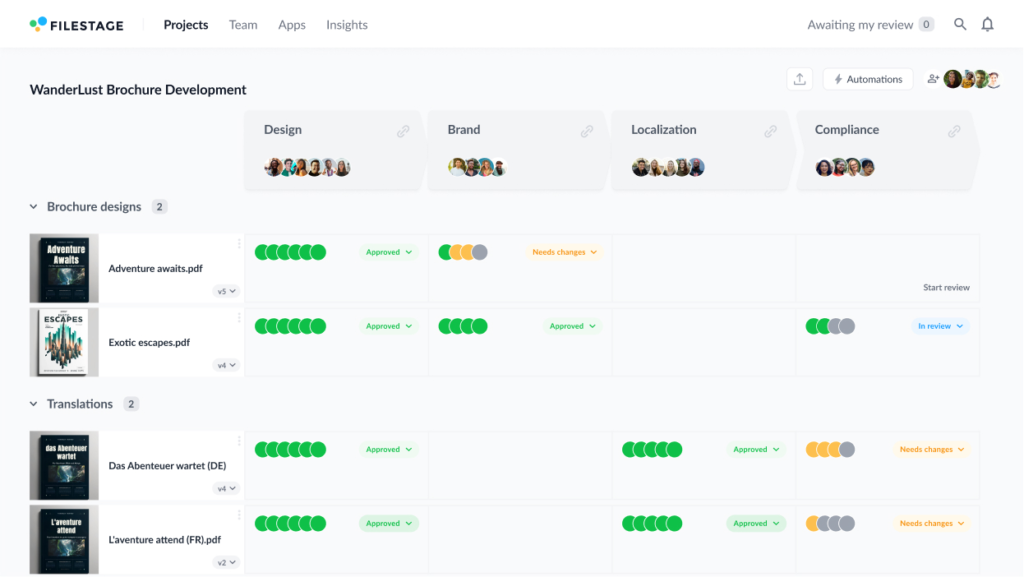
In Filestage, you can invite as many different stakeholders as you need to your ad review process. They can pinpoint what exactly their feedback refers to, leave comments, and engage in relevant discussions to make sure you deliver a relevant message to your potential customers.
Step 5: Develop an efficient review and approval process
Once you have all your stakeholders in one place, it’s time to streamline their feedback according to your needs. Unlike with digital marketing, print marketing can cause some pretty costly mistakes if the wrong thing goes to print. That’s why it’s important to create an efficient and transparent approval process.
With Filestage, you can divide different groups of stakeholders into reviewer groups and make sure your feedback discussions stay focused.
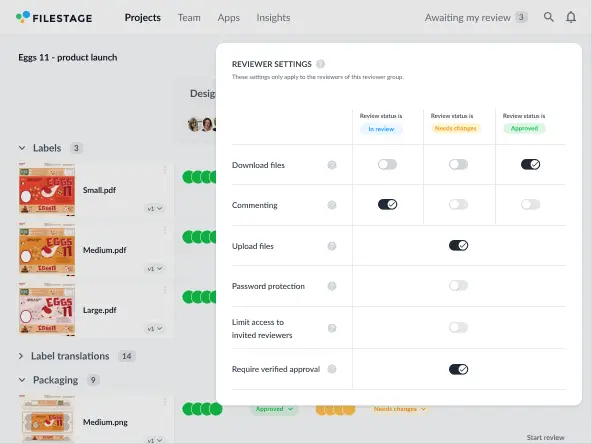
The tool also allows you to tailor your reviewer settings depending on the type of feedback you’re looking to get from each reviewer group. For example, your designers can have comment access on your files without needing to give final approval.
On the other hand, the publishing company might only be able to give their approval without engaging in detailed feedback discussions.
Step 6: Choose the right print media
Though most of us usually think of newspapers and magazines when thinking about print ads, there are actually quite a few different print media formats you can choose from. So what is the right print media for your ad?
Well that highly depends on the audience you’re trying to reach. And if you did the second step from this guide right, you should be in no trouble!
Here are the top five types of print advertisements you can choose from:
- Brochures – great for providing detailed information about your product
- Flyers – ideal for mass distribution
- Postcards – effective for targeted offers
- Direct mail – personalized mailers that create a direct touchpoint
- Catalogs or magazines – best for showcasing a range of products
Consider how each material will be distributed. Will you hand them out, mail them, or place them in strategic locations?
Step 7: Design and branding
When making a brochure, designing an ad, or creating any other type of print marketing, it’s important to follow some common rules. First of all, you need to have visual consistency across all your print materials. This means that each print ad that you design needs to align with your brand colors, fonts, logo, and style.
On top of that, investing in a high-quality design that stands out will help you create a more attractive and professional looking brand, giving it more credibility among your target audience. For example, if you’re inserting a QR code withing your print ad, you’ll want to make this element as visible as possible without it overtaking the whole ad. And a smart layout design will achieve just that.
Finally, consider the layout of your ad to make sure your message resonates with your audience.
Here are the three things to keep in mind when designing the layout of your print ad:
- Keep your message concise and on point
- Use compelling headlines to attract more attention
- Make sure your message has a logical flow of information
Supercharge your marketing reviews
Share, review, and approve all your content in one place with Filestage.
Step 8: Print quality and production
This step comes into play when creating different types of brochures, flyers, and direct mail campaigns.
Obviously, when placing your print ads into existing newspapers and magazines, there’s less choices to be made, and you have to adapt to the existing printing press quality. But this can also serve as a good criteria when deciding in which papers you want to place your ads.
Whether you’re developing your own print ad materials or placing your ads in existing print media, the goal is to choose the right paper quality and finish (glossy, matte, etc.) that aligns with your brand image and budget.
It’s definitely worth spending some extra money to make sure you’re having a reputable printing partner. This can help you find the right balance between time, quality, and costs.
Step 9: Distribution plan
A big part of the success of your print ad comes from making the right distribution decisions. This means knowing when, where, and how to distribute your ad.
Here are the three most important aspects of building a successful distribution plan:
- Timing is everything – Schedule the distribution of your print materials strategically to align with your promotional calendar. Whether you decide to distribute your print ads as part of a new product launch or a seasonal offer, make sure you have the right timing!
- Know your channels – Use a range of distribution methods, like direct mail, trade shows, retail locations, or inserts in newspapers or magazines. Pretty soon, you’ll figure out what works best for your brand.
- Consider geographic targeting – If your business is location-specific, focus on finding ways to distribute materials in your target markets.
Step 10: Analyze and optimize
The final step in any type of advertising strategy is analyzing and optimizing your content. This is true whether you’re producing a product catalog or a national out-of-home (OOH) campaign.
Here are a few ways you can track the performance of your print advertising:
- Promo codes
- QR codes
- Unique URLs
- Phone numbers
You can also use these channels to collect feedback from your audience and understand what worked and what didn’t. Once you have all this information, you can adjust your approach to improve future print marketing efforts.
Final thoughts
One thing is clear – print marketing is much more alive than many of us thought! A good print marketing strategy can help you attract a wider audience and build trust with your customers.
So if you’re ready to kickstart your print marketing efforts, hopefully this 10-step guide helps you along the way. And if you need a simpler way of tracking reviews and approvals for your print and digital adverts, try Filestage for free →