


For issue #8 of The Fine Line newsletter, Nneka Etoniru, EVP of Global Brand Strategy at Avenue Z, shares some essential rebranding advice.
Expect hot takes on everything from the Jaguar rebrand to Mark Zuckerberg’s villain era to managing client expectations as a brand strategist.
Let’s get stuck in.
How do you know if a rebrand is the right call? Are there any instances when it’s not the best way forward?
A rebrand makes sense when your current identity no longer aligns with your values, audience, or market positioning. If your brand feels outdated, disconnected from your audience(s), or isn’t supporting your long-term goals, that’s the time to consider.
That being said, rebranding isn’t a magic fix. If the core problem is product quality, service issues, or internal misalignment, a rebrand may only paper over deeper issues.
Fortunately, you don’t have to throw the baby out with the bathwater. You can make changes for a specific market without overhauling your entire brand (think Audi’s recent logo change to appeal to younger, tech-savvy buyers).

2024 was the year of big branding bets in the automotive industry. Does heritage still matter?
You can’t rest on the laurels of nostalgia, but it’s a great storytelling tool. In 2024, brands like Porsche, Volvo, and Ford showed how to use heritage as a foundation for innovation.
Porsche tied its iconic sports car history to the electric Taycan with Soul, Electrified. Volvo blended nostalgia and modernity with the Route EX90 campaign, taking viewers on an epic road trip. Ford leaned into its legacy with the Mustang, proving American muscle could conquer Germany’s Nürburgring.
Ultimately, it’s not about choosing between heritage and innovation – it’s about telling a consistent narrative that resonates emotionally with your audience.
Everyone has an opinion on Jaguar’s rebrand. But how long does it take to know if your rebranding is actually a success? Are there any early signals (or warning signs)?
Everyone jumped in to hate on the Jaguar rebrand, but here we are talking about it – so that’s probably a good sign, right?
It’ll take six to 12 months of tracking sentiment, engagement, and revenue to know if it’s truly a success. Early signals like positive media coverage, strong social media buzz, or increased brand searches can hint that it’s resonating.
On the flip side, customer confusion, negative sentiment, or flat sales are red flags. One of the biggest critiques has been that it seemed out of left field, misaligned with who Jaguar is as a company. Everything always comes back to authenticity. For Jaguar, the challenge will be turning this initial buzz into sustained momentum.
What’s something most people don’t realize about nailing a rebrand?
It’s not about projecting a perfect version of your company. Richard Branson probably said it best:
“Too many companies want their brands to reflect some idealized, perfected image of themselves… their brands acquire no texture, no character, and no public trust.”
Authenticity is key – embrace your brand’s character and UVP because that’s what builds connection and trust with your audience.
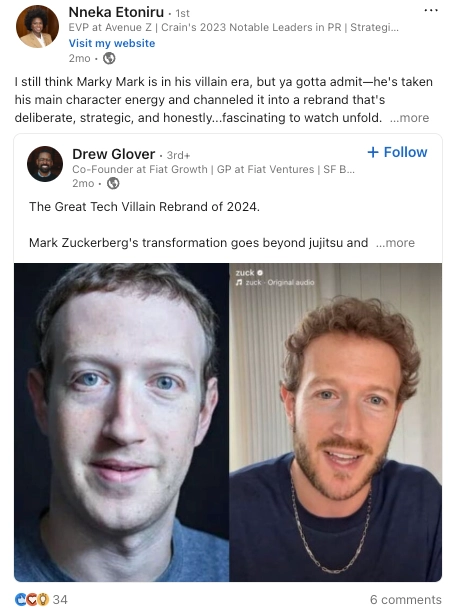
I loved your breakdown of Mark Zuckerberg’s “villain rebrand”. Talk us through what he’s doing right and his areas for growth.
This is the story that never ends. Since my last post about Zuck, he’s leaned harder into his “villain era,” flexing on Joe Rogan, hyping “masculine energy,” and stoking controversy with Meta’s free speech policies. Then, he recently announced that Meta will lay off 5% of the company.
Since brand stories don’t happen in a vacuum, the news sparked social media to wonder whether employees without that “masculine energy” might be subconsciously targeted in the layoffs.
- What he’s doing right: Owning the narrative and shifting focus to free speech, keeping him in control of the conversation and out of the chaos narrative dominating others.
- Areas for growth: Balancing spectacle with substance – his bold moves risk alienating key audiences without stronger alignment to Meta’s values, like privacy and inclusivity.
Zuckerberg’s rebrand may be strategic, but it’s riddled with contradictions that could undermine its long-term success.
How do you manage client expectations during the rebranding process?
A rebrand isn’t a quick fix—it’s a strategic investment that takes time to deliver results (assuming you’ve done your research). I like to prepare clients with the expectation that:
- Results are not instant. Changes in perception, audience engagement, or revenue won’t happen overnight. Results typically unfold over months, not weeks.
- Rebrands are not a cure-all. A great rebrand does not fix poor product quality, operational inefficiencies, or misaligned internal culture. Sad but true.
- It won’t please everyone: Rebrands, by definition, will not be everyone’s cup of tea. The goal is to resonate with the target audience, not to gain universal approval.
Thanks for reading!
Stay tuned for next month’s issue. And don’t forget to follow Nneka on LinkedIn for more fun and engaging branding content.
