

TL;DR
This article covers the top online proofing tools that help creative and marketing teams centralize feedback, streamline reviews, and speed up approvals on videos, documents, images, and web content.
We’ve updated the tool list for 2026, added pricing and integration details for each platform, and included insights on security features, collaboration benefits, and how to choose the right tool for your team size and workflow.
Why you need an online proofing tool in 2026
Tired of chasing feedback through endless email chains and confusing spreadsheets? Getting feedback on your creative work shouldn’t take up all your time and energy. With an online proofing tool, you can get feedback in minutes, not days.
Online proofing software helps your team share files, collect clear feedback, and get approvals faster. It allows you to take control of your review process, so you can spend less time managing feedback and more time creating amazing work.
Let’s take a closer look at our top 15 online proofing tools that can help you speed up your workflow.
How we evaluated these tools
Choosing the right online proofing tool means comparing a few different factors, beyond just looking at the price point (though that’s important too).
Here’s what we evaluated to build this list.
Main features
We looked for things like markup and annotation, version comparison, and multi-stage approval workflows. Basically all of the key features needed to keep your review process running smoothly.
Pricing
Online proofing tools range from flat-rate plans to per-seat models. We noted which tools offer a free plan or trial, what the entry-level paid plan costs, and whether the pricing structure makes sense for the size of your team.
Integrations
The best online proofing tools should slot into your existing workflow. We looked at how well each platform connects with the tools creative and marketing teams rely on most, like Slack, Asana, Adobe Creative Cloud, Google Drive, and Microsoft Teams.
We assessed each tool using hands-on experience where possible, plus verified vendor pricing pages, user reviews on G2, and product documentation for the rest.
Filestage is our product. We’ve included it in this list because it genuinely fits the described review and approval use case, and we’ve positioned it accordingly. Where a competitor is the better choice for your use case, we say so.
All pricing was verified in July 2026 and may change. Check the vendor’s pricing page before you buy.
Quick comparison of the top online proofing tools
| Tool | Best for | Free plan | Key differentiator | Starting price |
|---|---|---|---|---|
| Filestage | Big brands and agencies | Yes | Custom approval workflows and automated checks with Review Agents | $199/month |
| Ziflow | Large marketing departments | Yes | Automated multi-stage routing with full audit trail | $199/month |
| Frame.io | Video production and Adobe users | Yes | Camera to Cloud — footage syncs from set in real time | $15/user |
| PageProof | Design teams with high security needs | No | Full security stack + data-residency choice on every plan | $249/month |
| ProofHub | Small to mid-size teams | No | Flat-rate pricing for unlimited users, PM + review combined | $45/month |
| GoVisually | Freelancers and small teams | No | Low-cost point-and-click video/PDF markup for freelancers | $16/user |
| Adobe Workfront | Enterprise campaign management | No | Native GenStudio + AEM Assets integration | Custom |
| Approval Studio | Packaging and print agencies | No | AI version comparison + barcode verification for packaging | $60/month |
| Ashore | Freelancers (white-label) | Yes | Branded, white-labeled client review portals | $46/month |
| Lytho | In-house creative operations | No | Combines DAM, intake forms, and proofing in one platform | Custom |
| Frankie | Short-form video review | No | Single-link browser reviews with auto-generated PDF summaries | $49/month |
| Edoro | Budget agencies | Yes | Google Drive-style interface that’s quick to learn | $66/month |
| Aproove | Regulated industries | No | AI-powered risk detection for regulated-industry approvals | Custom |
| ReviewStudio | Creative teams (simple) | Yes | Free plan allows unlimited users | $12/user |
| Markup.io | Web design teams | No | Chrome extension annotates live websites directly | $79/month |
1. Filestage – best for big brands and agencies

Filestage is an online proofing platform built specifically for brands and agencies. It supports video, documents, images, audio, live websites, and interactive HTML in a single workspace, removing the need to switch between tools to share or approve files.
Filestage offers teams a better way to manage creative projects, add contextual comments directly on files, compare versions side-by-side, and follow structured review and approval processes.
Why we chose it
We recommend Filestage for brands and agencies that need to centralize feedback and review a wide range of files with a single structured approval tool.
One example could be a marketing team managing a product launch. They can use Filestage to share video ads, landing page designs, and print assets with their stakeholders in one place. They can then collect feedback, track who has approved what, and move to the next version confidently.
Pros
- Multiple file formats – Supports video, documents, images, audio, live websites, and interactive HTML in a single workspace
- Custom workflows – Take full control over your review process and keep your team on the same page across every project.
- Review Agents – Get instant feedback on your team’s work – all based on your custom guidelines and regulations.
- Version control – Steer clear of file version confusion and track progress easily.
- Automation – Save time on manual tasks with custom triggers and actions.
Cons
- Automation and Review Agents capabilities are only available in the Business and Enterprise plan
Pricing
Filestage has a free plan plus paid tiers, with the difference coming down to features rather than team size. The free plan covers one active project, two reviewer groups, and unlimited reviewers, enough to run a full review from start to finish at small scale. Paid plans start at $199/month, unlocking unlimited projects and files, more review steps, and automations, while Enterprise (custom pricing) adds SSO, verified audit-ready approvals, and advanced security for regulated teams.
Integrations
Filestage integrates with tools like Slack, Asana, and Microsoft Teams. It also offers plugins for Adobe Premiere Pro and After Effects. If you prefer to create your own integrations, you can connect Filestage using Zapier, Make, and other integration platforms.
Security
ISO 27001 certified, AES-256 encryption, GDPR compliant, full audit trails, SSO, and role-based access controls.

“Filestage has reduced our team’s daily email inbox by roughly 25-30% [so now] we can focus on other important tasks for the day.”
See how Filestage can speed up your approvals
Enjoy a free, 30 minute consultation with our experts, tailored to your team and use cases.
2. Ziflow – best for large marketing departments needing automated workflows
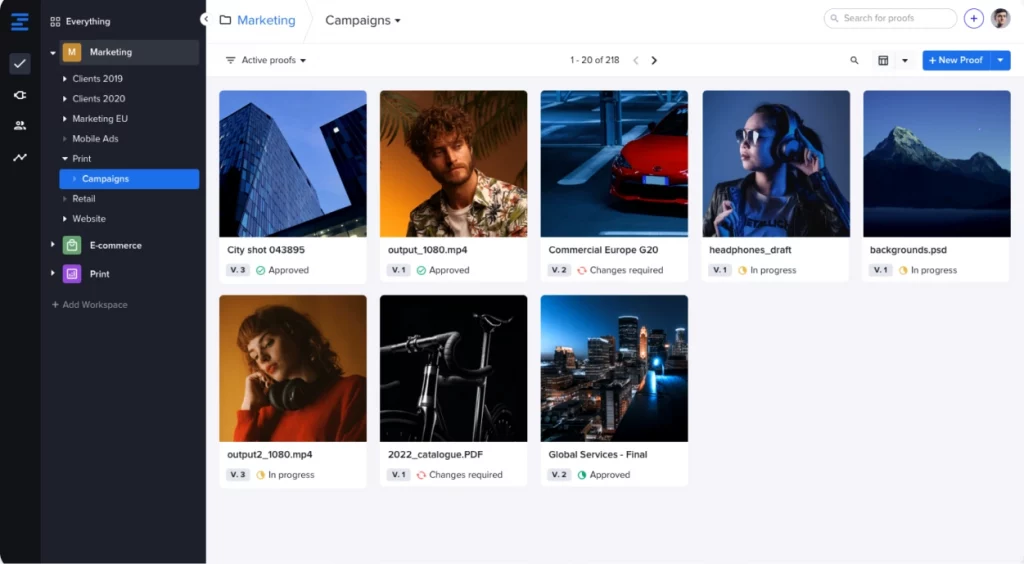
Ziflow is a robust online proofing platform positioned for marketing teams at larger organizations that need to manage media-rich approval processes.
Why we chose it
Ziflow is the best option if workflow power and compliance tracking are top priorities, but user reviews report a steeper learning curve than simpler proofing tools on this list.
As an example, a retail marketing team launching a seasonal campaign could use Ziflow to route 50+ banner ads through legal, brand, and regional teams in a set sequence, with automated reminders and a full audit trail capturing every approval decision.
Pros
- Automated multi-stage workflows route files to the next reviewer once a stage clears – no manual hand-off
- Wide file format support: video, images, PDFs, live websites, and HTML5 ads
- Full compliance audit trail on every comment, approval, and version upload
Cons
- Steeper learning curve than simpler tools on this list, per user reviews
Pricing
Ziflow’s free Personal plan covers 2 users, 2 GB storage, and single-stage workflows — enough to trial basic proofing. Paid plans are billed yearly: Standard ($199/month) adds 15 users, 1 TB storage, two-stage workflows, and a 90-day audit trail; Pro ($329/month) steps up to 20 users, three-stage workflows, and integrations with Asana, monday.com, Slack, and Teams. Enterprise (custom) unlocks unlimited workflow stages, ReviewAI, e-signatures, SSO, and a lifetime audit trail.
Integrations
Ziflow integrates with monday.com, Asana, Slack, Dropbox, Box, and 1,000+ more apps via Zapier. API access on higher plans.
Security
SOC 2 Type II, electronic signatures, SSO, 2FA, and IP-based access controls.
3. Frame.io – best for video production and post-production teams in the Adobe ecosystem

Frame.io is a video-first review platform, widely used by filmmakers and post-production studio teams embedded in the Adobe ecosystem.
Why we chose it
Frame.io is the ideal tool for video production companies, post-production studios, and content teams working primarily within the Adobe ecosystem.
One feature we particularly liked is Camera to Cloud – footage uploads straight from the camera while a shoot is still running, so editors can start cutting before the crew has even wrapped.
It’s a genuinely different kind of speed from the frame-accurate commenting most tools on this list offer.
Pros
- Camera to Cloud uploads footage from set in near real-time, so editing can start before a shoot wraps
- Frame-accurate comments with native integration inside Premiere Pro and After Effects
- Watermarking and enterprise SSO built for protecting unreleased creative content
Cons
- Integrations outside Adobe are limited
- Purpose-built for video – documents, designs, and multi-format campaigns are a secondary use case
Pricing
Free plan includes 2 members and 2 GB. Pro ($15/member/month, 5 members) adds more storage, Camera to Cloud, and version stacking. Team and Enterprise tiers scale up storage and admin controls and add SSO and advanced security for protecting unreleased footage.
Integrations
Integrates with Adobe Premiere Pro, After Effects, Final Cut Pro, DaVinci Resolve, Slack. Integrations outside Adobe are limited.
Security
Watermarking, passcode-protected sharing, access controls, and enterprise SSO.
4. PageProof – best for teams handling confidential digital content
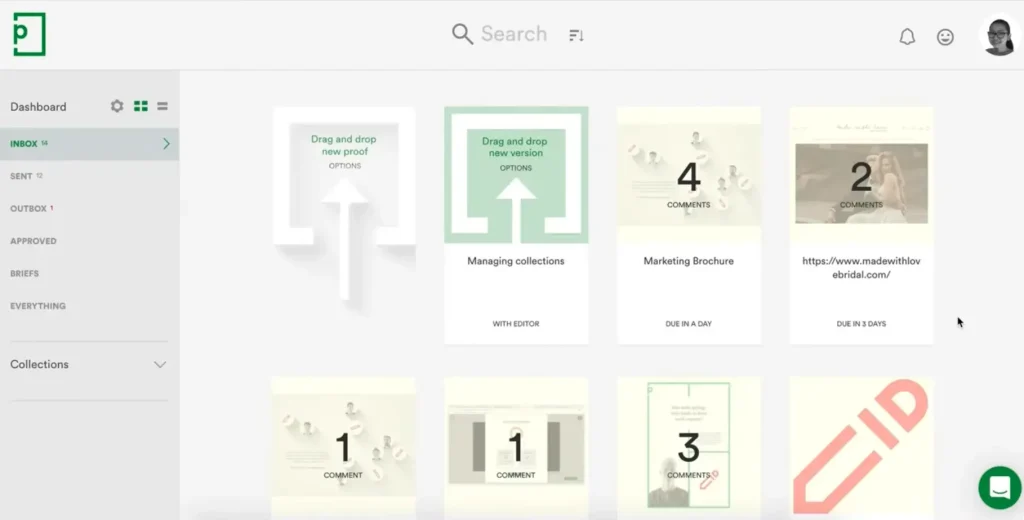
PageProof is an online proofing platform designed for creatives and marketing teams looking to automate workflows and speed up approvals. It supports multiple file types and offers advanced proofing features.
Why we chose it
PageProof earns its spot for marketing and design teams that handle confidential digital content and need the highest available encryption standard.
You can also choose where you want your data to be stored – EU or US, for example.
If your team is in a highly regulated market, Pageproof might be a good option.
Pros
- AES-256 encryption on every plan, not held back for the top tier
- Choice of global data-residency locations
- Deep Adobe Creative Cloud integration across design and video tools
Cons
- Starting price ($249/month) is one of the higher flat rates on this list
- User reviews report the external-reviewer login flow can be confusing – worth checking if you work with many outside partners
- No free plan (trial only)
Pricing
No free plan, but a free trial is available. Paid plans start at $249/month for unlimited users — and the full security stack (SSO, MFA, encryption, data-residency choice) is included on every tier rather than gated to the top plan, which is the point of difference from most tools here. Higher tiers scale up proof volume and support.
Integrations
PageProof integrates with a range of project management software, Adobe Creative Cloud, and Microsoft Teams.
Security
PageProof is ISO 27001 certified and offers AES-256 encryption on all plans.
Check out this page for a detailed comparison of Filestage vs PageProof.
5. ProofHub – best for small to mid-sized teams wanting PM and review combined

ProofHub is an online proofing software that helps creative teams streamline their review and approval process. It provides a central place to share files, review them, add annotations, and approve work.
Why we chose it
ProofHub mixes project management and creative review in a single flat-rate tool.
That combination is the point: a team can assign a design task, track it to a deadline on the timeline, then mark up and approve the finished file without leaving the tool.
It’s the natural pick if you’d rather have proofing live inside your project management setup than run a separate, dedicated review platform.
Pros
- Combines project management (lists, calendars, Kanban, timelines) with creative review in one tool
- Flat-rate pricing regardless of team size – no per-seat costs
- Reusable templates cut down setup time on repeat projects
Cons
- No free plan (14-day free trial only)
- Complex approval workflows and detailed annotation needs may feel limited compared to dedicated proofing tools
Pricing
No free plan, but a 14-day free trial. Essential ($45/month flat, unlimited users) caps you at 40 projects and 15 GB of storage. Ultimate Control ($135/month, or $89 as a limited-time offer) removes those limits and adds white labeling, custom roles, and advanced management. The jump between plans is about scale and control instead of seats.
Integrations
ProofHub integrates with third-party apps like Google Drive, OneDrive, Dropbox, and Box.
Security
Security capabilities include SSL encryption, role-based access control, IP restriction, and activity logs.
6. GoVisually – best for freelancers and small marketing teams
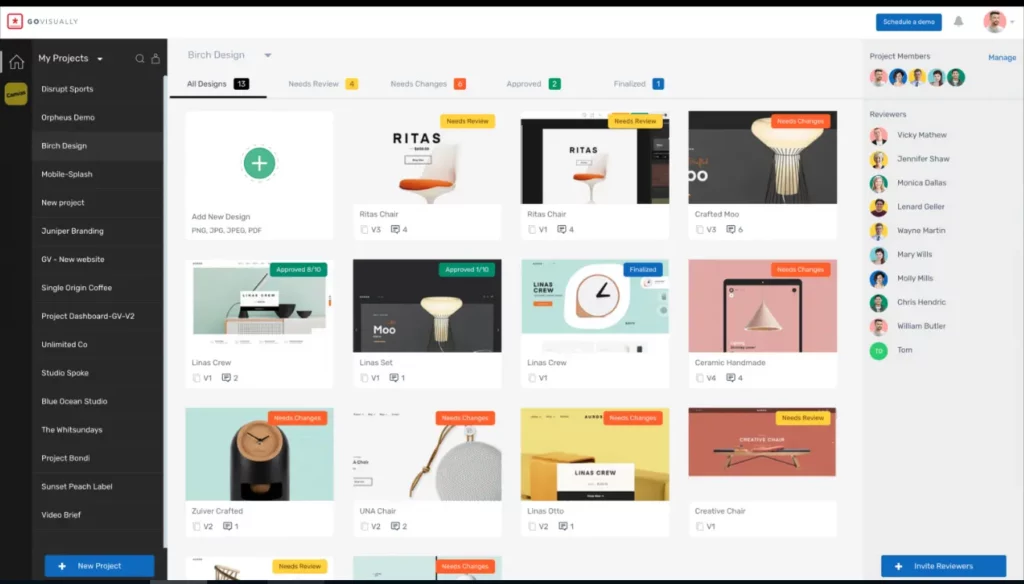
GoVisually is an online proofing tool designed to streamline the creative review process for freelance designers and marketing teams. It offers real-time collaboration so team members can work on creative projects simultaneously.
Why we chose it
GoVisually seemed like a good choice for freelancers and small marketing teams that need a simple, affordable tool for collecting visual feedback on designs and videos.
What we liked most in practice is how little there is to learn — you drop a pin, drag a box, or draw straight onto a design, PDF, or video frame, and the comment’s attached.
For a freelancer sending a first review link to a client who’s never used a proofing tool, that low friction matters more than any advanced feature.
Pros
- Real-time collaboration with live updates so stakeholders never miss a change
- Point-and-click annotation tools (drawing, box, arrow) across video, PDFs, and images
- Competitive entry price for a dedicated proofing tool ($20/user/month for up to 5 users)
Cons
- Version handling is basic — less structured than tools built for multi-stage approval workflows
- Leans on Zapier for automation rather than native integrations, so it connects to fewer tools out of the box than enterprise options here
Pricing
No free plan, but a free trial. Lite ($20/user/month, 1–5 users) covers core point-and-click annotation and review. The Team plan ($33/user/month) adds more collaborators, folder organization, and workflow features for growing teams.
Integrations
GoVisually integrates with a range of apps, including Slack, Asana, Trello, Zapier, and Adobe Creative Cloud.
Security
SSL encryption, role-based access controls, version history with audit trails, and AI-powered compliance checks.
7. Adobe Workfront – best for large enterprise organizations
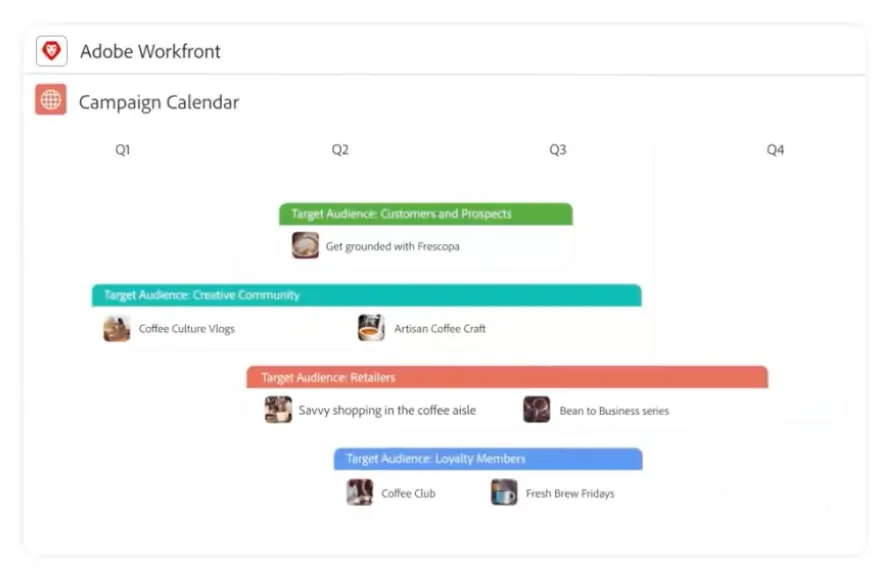
Adobe Workfront is an enterprise project management tool designed to help large, multidisciplinary teams collaborate. While the setup can take weeks, it allows marketing teams to build strategies and launch campaigns at scale.
Why we chose it
We recommend Workfront for large enterprise organizations that need to connect proofing with campaign planning and resource management across multiple teams.
Once you have it configured, what stands out is seeing proofing, campaign timelines, and resourcing all update in one view, so there’s no jumping between a review tool and a separate planner.
Pros
- Connects proofing directly to campaign planning, budget tracking, and resource management
- Deepest Adobe ecosystem integration on this list, plus Slack, Teams, and Jira
- Enterprise-grade admin controls built for large, multi-team organizations
Cons
- Setup can take weeks — slower to roll out than more agile tools on this list
- No publicly listed pricing, free plan, or trial; enterprise sales process required
Pricing
Enterprise-only, with custom quote-based pricing and no public free plan or trial. Adobe splits Workfront into tiers (Select, Prime, and Ultimate) that scale up automation, goal alignment, and admin controls. You’ll need to go through Adobe sales to get pricing.
Integrations
Workfront integrates with the full Adobe Creative Cloud suite, Slack, Microsoft Teams, Jira, and many enterprise tools.
Security
Enterprise-grade SSO, role-based permissions, audit trails, and compliance controls.
8. Approval Studio – best for packaging and print agencies
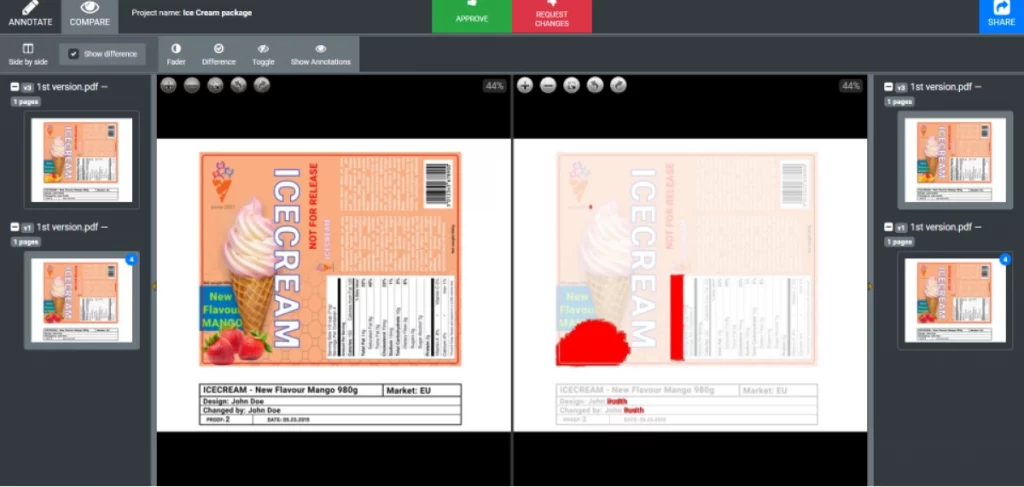
Approval Studio is an online proofing tool built for artwork and design approval, with strong support for packaging, print, and graphic design workflows.
Why we chose it
Approval Studio is a unique tool for packaging agencies, print studios, and graphic design teams that need precise artwork review with barcode verification and AI-powered version comparison.
A packaging agency working on a supermarket own-brand product range, for example, could use Approval Studio to compare new label versions against the master artwork, verify barcodes are scannable, and get sign-off before sending files to print.
Pros
- AI-powered difference finder catches version changes automatically
- Barcode scanner verifies scannability before packaging goes to print
- On-screen ruler for checking measurements directly in the review
Cons
- It’s purpose-built for print and packaging sign-off, so teams reviewing a mix of video, documents, and web content may find it narrower than a multi-format tool
- Workflow automation isn’t available until Enterprise
Pricing
No free plan, but a 14-day free trial. Lite ($60/month, 5 users, 5 GB) covers unlimited projects and reviews, though the barcode scanner, on-screen ruler, and spellchecker are paid add-ons at this tier. Pro ($160/month, 5 users) includes those tools plus user tagging and external uploads; Pro XL ($300/month) raises the limit to 15 users and 30 GB with live-chat support. Enterprise (custom) adds unlimited users and built-in workflow automation.
Integrations
Approval Studio integrates with Adobe Creative Cloud (Photoshop, Illustrator, InDesign), Slack, Zapier (5,000+ apps), Shopify, and custom API.
Security
Password protection, GDPR compliant, SSO supported, and data handled in line with ISO/IEC 27001:2013 best practices.
9. Ashore – best for freelancers and small agencies wanting branded client portals
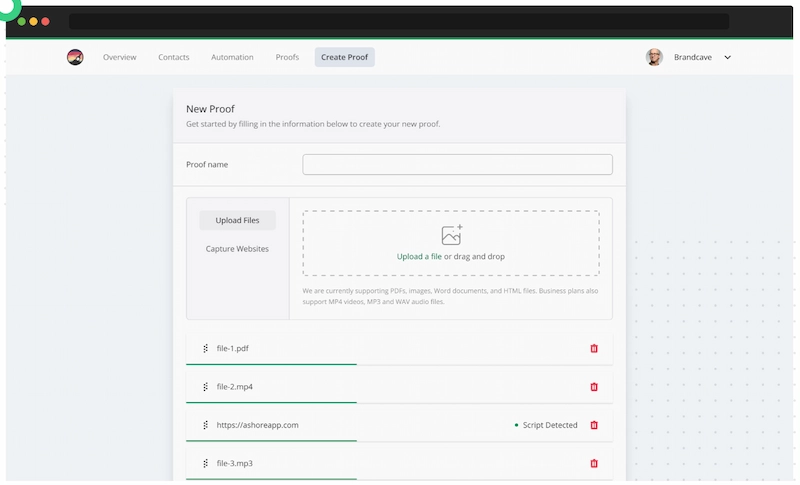
Ashore offers online proofing for creatives, designed for client-facing approval automation for agencies and studios.
Why we chose it
Ashore allows your review process to look like your own product. You can send clients an approval page styled in the agency’s own branding, so the whole review feels like part of the service rather than a third-party tool.
Pros
- Review pages and approval emails carry your own logo, colors, and domain. Clients never see “Ashore”
- No account needed for reviewers. Secure links work for anyone
- Free version available for 1 user and up to 30 files/month
Cons
- Less suited to complex, multi-stakeholder internal workflows
- Narrower integration range than other tools on this list
Pricing
Ashore’s free plan covers 1 user and 30 files a month. Paid plans (shown here at annual billing) start with Starter ($15/month, 1 user) with full automation and Adobe plugins, then Standard ($46/month, 3 users) adds Smart Review, artwork intake forms, and watermarking. Full white-label branding — custom domains and removing Ashore from emails — comes with Premium ($199/month, 5 users), along with API access and job management. Additional users run $15–23/month depending on plan.
Integrations
Ashore integrates with Zapier, Adobe, and major cloud storage providers.
Security
SSL encryption, password-protected proof sharing, and audit trails with version history.
10. Lytho – best for in-house creative teams

Lytho is a creative operations platform that helps teams build stronger collaborations with clients and stakeholders by building creative workflows for reviews and resource management.
Why we chose it
Lytho combines digital asset management (DAM), project management, and online proofing in a single tool.
One feature worth calling out is Lytho’s intake forms: instead of briefs arriving as scattered emails and Slack messages, requesters fill out a structured form, and each submission becomes a trackable project routed to the right team automatically.
For a busy in-house team, that turns messy inbound requests into a managed queue.
Pros
- Combines DAM, project management, intake forms, and proofing in one platform
- Structured approval paths route projects automatically by content, team, or risk level
- Audit-ready history captures every decision, timestamp, and approval
Cons
- More complex to onboard and configure than lighter tools on this list
- Custom pricing only — no published starting price to compare against other tools
Pricing
Custom pricing only, scaled to team size and which modules you need (DAM, workflow, intake, proofing). There’s no public plan or free tier, so you’ll need a demo to get a quote.
Integrations
Lytho integrates with Adobe Creative Cloud, Google Drive, Zapier, and various project management tools.
Security
Offers security features like secure review links, access controls, and audit trails.
11. Frankie by Cospective – best for ad agencies reviewing short-form video

Frankie by Cospective is a browser-based video review and approval platform built for short-form content produced by ad agencies and production companies.
Why we chose it
We recommend Frankie for ad agencies, production companies, and post houses that need a fast way to review short-form video with clients.
While testing, we could easily share a 30-second cut via a single link, the collaborator leaving frame-accurate annotations directly in the browser, and the editor exporting all notes as a PDF to action before the next cut.
Pros
- Single-link reviews. No sign-up required for clients or reviewers
- Frame-accurate annotations built specifically for short-form video feedback
- Auto-generates a PDF summary of every review session
Cons
- Doesn’t support documents, designs, or multi-format campaigns
- Narrow integration ecosystem compared to other tools on this list
Pricing
A 30-day free trial gives you a full Pro account with one project. Paid plans start at Basic ($49/month) for 2 reviewers and 1 project; Plus ($99/month) adds 5 reviewers, 3 projects, and the PDF review summary; and Pro ($249/month) covers 10 reviewers, 10 projects, unlimited file sizes, guest uploads, and presentation mode.
Integrations
cineSync, ftrack. Browser support across Chrome, Safari, Firefox, and Edge. iOS app available for iPad and iPhone.
Security
Browser-based delivery with secure server communication and controlled session access – links required to join reviews.
12. Edoro – best for budget-conscious creative agencies and startups
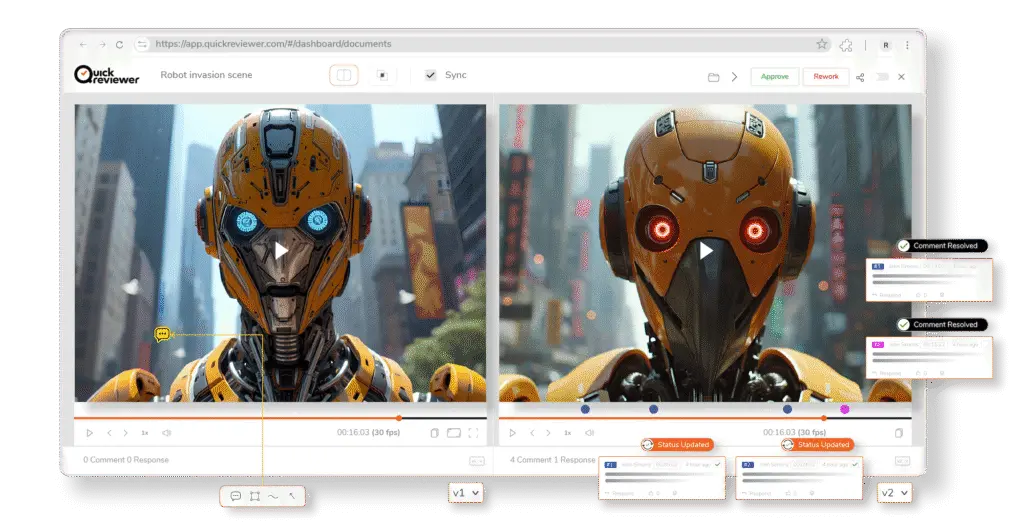
Edoro (formerly QuickReviewer) is a cloud-based proofing platform built for fast, centralized feedback across almost any format: video, images, PDFs, live websites, HTML5 banners, and audio.
Why we chose it
Edoro allows you to review multiple file types with an affordable, easy-to-use solution.
What stood out to us is the interface: it’s laid out like Google Drive, so anyone who’s opened a shared folder can find a file, open it, and leave a comment without a walkthrough.
Pros
- Google Drive-style interface that’s quick to learn
- Side-by-side version comparison and drag-and-drop uploads
- Color-coded reviewers make it easy to see who left which feedback
Cons
- Fewer integration options than some other tools on this list, per this article
- No free trial (free plan only)
Pricing
Free plan available, no free trial. Paid plans start at $66/month for up to 10 users, adding more projects, storage, and reviewers as you move up tiers.
Integrations
Adobe Creative Suite, Google Drive, Dropbox, Box, Zapier, and more.
Security
SOC 2 Type II certified and GDPR compliant, password protection, and granular role-based permissions control.
13. Aproove – best for enterprise teams in regulated industries
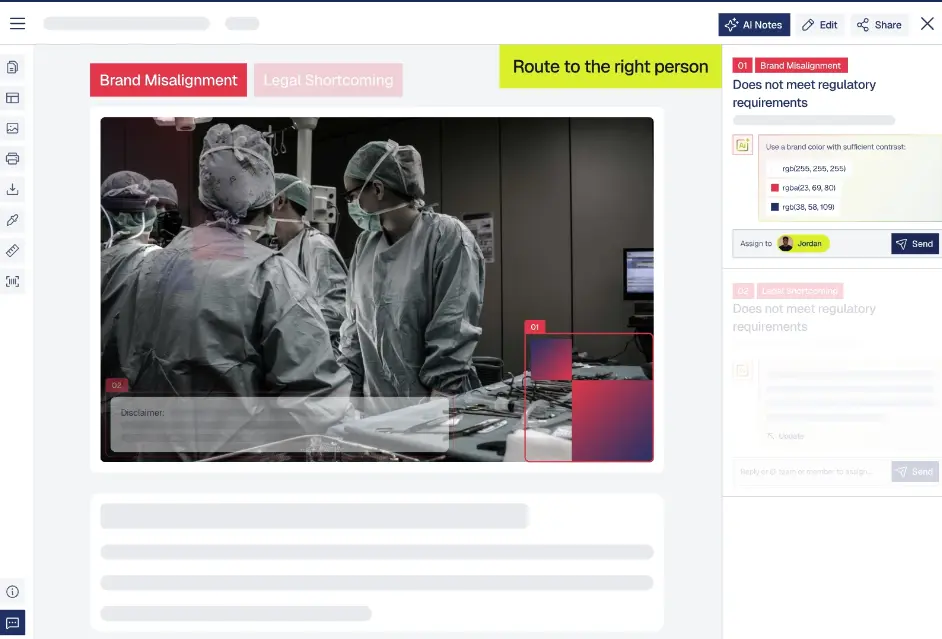
Aproove is a web-based work management and online proofing platform designed for larger organizations and regulated industries where compliance, governance, and automated approval workflows are top priorities.
Why we chose it
We recommend Aproove for enterprise teams in regulated industries that need compliance-grade audit trails, advanced automated workflows, and governance controls.
A pharmaceutical company, for example, could use Aproove to route promotional materials through a medical, legal, and regulatory review process, with e-signatures capturing final approvals in line with FDA requirements.
Pros
- Decision-based workflow routing reflects how approvals actually run
- Compliance-grade audit trails record every action, version, and sign-off automatically
- AI-powered risk detection flags compliance and brand risks before a human reviews — backed by SOC 2, HIPAA, and ISO-27001 certification
Cons
- One of the more expensive options on this list
- Requires significant configuration — not ideal without a dedicated IT resource
Pricing:
Enterprise pricing on request (no public plans or free tier). Cost scales with users, the modules you enable (work management vs. proofing), and compliance requirements, so expect an enterprise sales process rather than self-serve signup.
Integrations
API-based integration with most enterprise applications via Aproove Concoord iPaaS.
Security
SOC2, HIPAA compliant, ISO-27001 certified, and enterprise-grade audit trails.
14. ReviewStudio – best for creative teams wanting an easy-to-use proofing tool
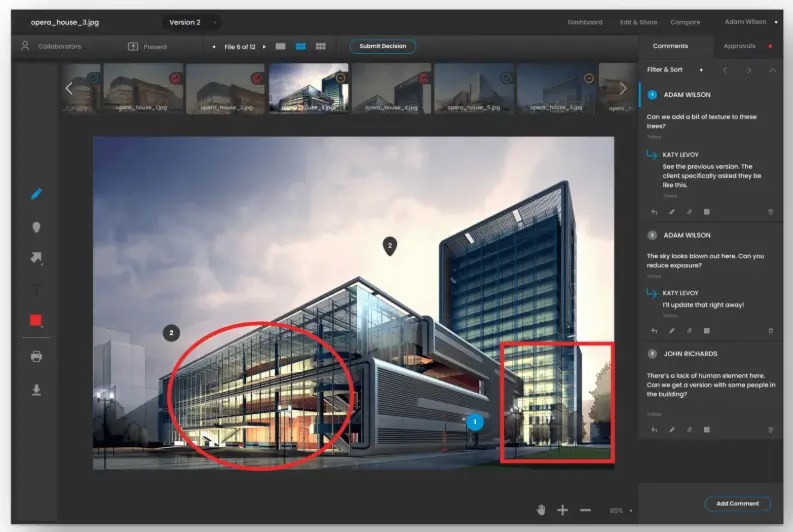
Review Studio is an online proofing tool built for creative teams that need a simple way to review, annotate, and approve visual content – images, videos, PDFs, and live websites.
The platform is accessible for both internal teams and external stakeholders.
Why we chose it
We recommend ReviewStudio for creative teams that want an easy-to-use proofing tool for visual content.
What stood out was how directly feedback turns into action – any comment can become an assignable task, so notes don’t get stranded between the review and the redo.
Setting up a review of a few website mockups takes minutes, and when you share the link, reviewers can leave annotations across multiple pages easily.
Pros
- Frame-level video comments, PDF markup, and live website review in one simple tool
- Turns any comment directly into an assignable task
- Free version available with unlimited users (three active reviews)
Cons
- Workflow automation and integrations are less advanced for larger teams, according to reviews
Pricing
ReviewStudio’s free plan supports unlimited users but caps you at 3 active reviews at a time. Pro ($12/user/month) raises that to 10 active reviews per user and adds custom branding, reporting, and integrations. Advanced ($20/user/month, 5-user minimum) unlocks unlimited reviews, workflow automation, API access, and comment privacy, while Enterprise adds SSO, a custom domain, and an SLA.
Integrations
ReviewStudio integrates with tools like Slack and offers connections via Zapier for additional apps.
Security
Security capabilities include SSL encryption, password-protected sharing, and access controls.
15. Markup.io – best for web design and development teams

Markup.io is a visual commenting platform that excels at collecting feedback on live websites and digital assets.
Why we chose it
We recommend Markup.io for web design and development teams that need precise feedback on live websites, landing pages, and digital campaigns.
What we liked in testing is that you comment on the real, live page rather than a flattened screenshot – click any element and the note pins exactly to it, so a client can drop feedback straight onto a headline or a button without having to describe where they mean.
Pros
- Contextual commenting directly on live websites – click any element to leave a pinned comment
- Chrome extension annotates any live webpage without taking a screenshot first
- Supports 30+ file types beyond websites, including images, PDFs, and video
Cons
- Integration depth is limited compared to other multi-format proofing platforms
- No free plan; Pro plan requires annual billing
Pricing
No free plan, but a 14-day free trial (no credit card required). The Pro plan is a flat $79/month for unlimited users, one workspace, and 500 GB of storage. Enterprise (custom) adds unlimited workspaces and storage, SSO (SAML), and SOC 2 documentation.
Integrations
Integrates with a range of tools, including Figma, WordPress, HubSpot, and ClickUp.
Security
SOC-2 documentation and SSO (SAML) are available on the Enterprise plan.
Five core features to look for in an online proofing tool

With so many options available, it can be challenging to find the best proofing solution for your use case. When choosing an online proofing tool, I recommend focusing on these five core features:
1. Markup and annotation tools
The ability to add comments, draw, highlight, and strike out text directly on a file is essential. Visual markup tools like arrows, shapes, and color-coding make feedback clear and actionable. This makes sure all feedback is contextual, reducing frustrating back-and-forths or reworks.

2. Version comparison
Look for tools that let you compare versions side-by-side. This makes it easy to check that all requested changes have been made correctly. Some tools offer overlay and pixel comparison modes to spot subtle differences.
In Filestage, you can compare two versions of images, documents, and even videos. Changes are automatically highlighted to speed up reviews and save reviewers time.

3. Workflow automation
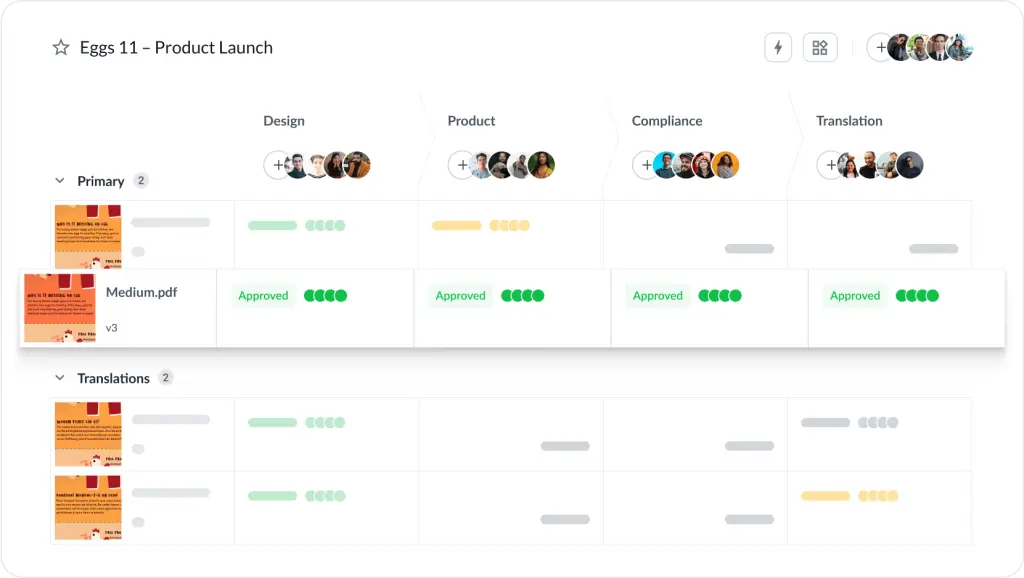
This is a big one if you’re producing high volumes of content. Ideally, you should be able to create automated review workflows that direct files to the right stakeholders in the right order. This saves time and makes sure no one is missed.
Let’s take Filestage as an example here.
You can set up automations so assets move to the next reviewer group once everyone in the previous group has sign-off. Automated due dates and reminders keep projects on track, and project managers can monitor progress from a central dashboard.
4. Integrations
You’re trying to streamline your creative operations, not add more tools to toggle between. So, make sure your tool of choice integrates with the software you already use.
5. File format support
The best online proofing tools support a wide range of file formats, including documents, images, videos, audio files, and even interactive web content.
Six security features Enterprise Teams should look for in an online proofing tool

If your team handles sensitive creative assets (think confidential campaign materials, pharmaceutical packaging, financial advertising, or regulated digital content), security is a non-negotiable when evaluating online proofing tools.
Here are the key security features I’d recommend looking for:
1. Audit trails and approval logs
Every version upload, comment, and approval decision should be logged, giving your team complete visibility and accountability across the entire review process. This is essential for compliance in regulated industries and for resolving disputes.
A strong audit trail should show:
- Who viewed what
- Who commented or approved
- When decisions were made
2. Role-based permissions
Your platform should allow admins to control who can view, comment on, download, or approve files. Enterprise-ready tools like Filestage offer granular permission settings across internal teams and external reviewers for added security. This ensures your sensitive files aren’t exposed to the wrong reviewers.
3. Password-protected review links
Opt for a platform where you have the option to send password-protected review links and restrict reviewers’ access to sensitive content. This adds an extra layer of security to your creative operations.
4. SSO and access controls
Look for software that supports authentication via Google SSO, SAML, OpenID Connect, and other federated SSO providers. SSO (Okta, Azure AD, Google Workspace). This gives enterprise IT teams centralized control and reduces risk when employees join or leave your organization.
5. Electronic signatures
If you need to add verifiable, documented sign-off to the automated approval workflow, look for a tool that provides legally recognized e-signatures for approvals.
6. Compliance certifications
Most enterprise procurement teams won’t consider a vendor unless they meet strict data governance and compliance requirements.
If your enterprise is in a regulated industry, look for a platform with:
- Choice of data hosting region (EU, US, etc.)
- Clear data segregation between customers
- Backup and disaster recovery policies
- ISO 27001
- SOC 2 Type II
Four ways online proofing tools make feedback easier

Getting feedback on your content can be a headache. But online proofing makes life easier for everyone involved – from content creators to C-level stakeholders.
Here are four ways proofing software makes feedback easier:
- See what’s happening across all your projects
- Get crystal clear feedback with full context
- Make sure everyone’s on the same page
- Manage versions and review rounds with ease
1. See what’s happening across all your projects
Imagine if you could answer any question about the status of your content within 10 seconds. Maybe even five. With Filestage, you can.
The problem
Checking the status of your content takes some serious detective work. And not the fun kind. The very, very boring kind where you have to pour through email chains, chat threads, in-app comments, and spreadsheets just to work out if a piece of work is approved or not.
In fact, you would probably struggle to answer any of these questions quickly:
- Is this version approved and ready to be published?
- Who still needs to give feedback?
- Which images has the client approved?
- When can we expect feedback from the product team?
- Has the latest version been shared with Jane in Legal?
How proofing tools help
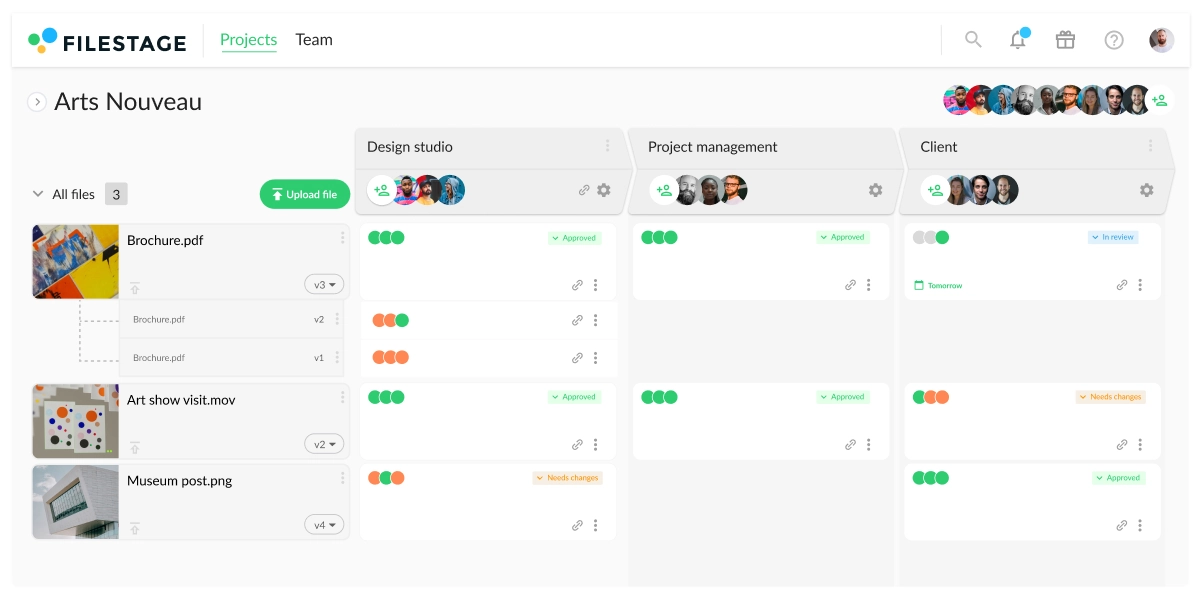
With free online proofing software like Filestage, you can see the status of all your content from your project dashboard. This gives you a bunch of important information at a glance, including:
- Approval status – see which stakeholder groups have approved your content (e.g. Creative) and which ones still need to give feedback (e.g. Product)
- Review decisions – see whether each reviewer has given their approval, requested changes, or still needs to take a look
- File status – see which files are in review, approved, or ready to be worked on
- Due dates – see when feedback is due and find out who is holding up the review process
- Version management – see which version is the latest and check who approved previous versions
And because Filestage supports all the most popular file formats, it’s like a video proofing tool and document review system all rolled into one.
The cherry on top
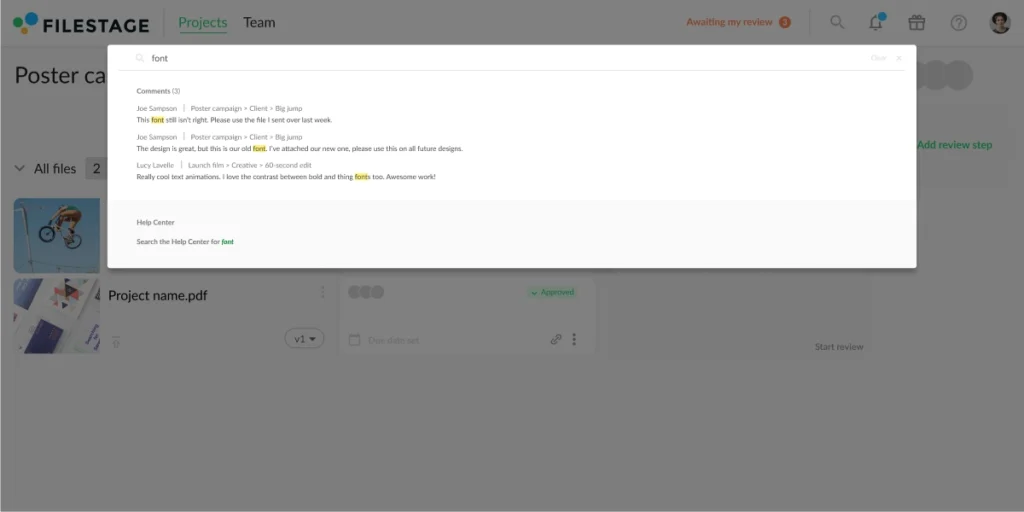
With Filestage, you can tap “F” to search every project, file, reviewer, version, and comment. So if you remember an important piece of feedback but can’t remember where you saw it, you can track it down in no time.
2. Get crystal clear feedback with full context
Rumor has it that if you add up all the hours people in your company waste capturing screenshots, copying out timecodes, writing out long descriptions that make no sense to anyone but themselves, and attending meetings to explain what they meant … Well, safe to say you’d have a very big number!
The problem
Separating files and feedback is a recipe for disaster. Here are three reasons why:
- It wastes time for stakeholders – there’s no simple way for your reviewers to give feedback, so they have to explain which parts of your content they’re talking about
- It creates a huge margin for error – it’s easy to misinterpret the feedback and make the wrong edits, leading to more work later in the process
- It leads to conflicts and confusion – feedback is rarely consolidated between stakeholders, so meetings need to be called to resolve things
How online proofing tools help
Review software for videos and other file formats makes it easy to give and receive feedback with pinpoint accuracy – down to the frame, letter, or pixel.
Here are five Filestage features that help make comments clear:
- Markers – tap anywhere on your content to create a marker, even if it’s a video
- Annotations – draw on top of your content to perfectly illustrate your point
- Highlights – select a word or sentence you want to comment on
- Strikeouts – select a word or sentence you want to delete
- Attachments – add a reference or asset to your comment
The cherry on top
In Filestage, you can get clearer feedback on all your content. That includes documents, PDFs, videos, images, live websites, interactive HTML, and audio. So you can also save your team time bouncing between tools!
See how Filestage can speed up your approvals
Enjoy a free, 30 minute consultation with our experts, tailored to your team and use cases.
3. Make sure everyone’s on the same page
If you’ve ever wondered why stakeholders often share feedback with so many conflicts, this one’s for you. You may not like to hear this, but it’s true. It isn’t your stakeholders’ job to consolidate their feedback.
The problem
Your stakeholders don’t have time to read and understand everyone else’s feedback. They barely have time to give feedback themselves. And even if they want to see what other people have said, they’re sure to have trouble finding it.
Here’s why:
- You don’t have a standardized process for collecting feedback
- Stakeholders share feedback in the way that best suits them
- Comments end up scattered across lots of tools and email chains
How online proofing tools help
Online proofing puts transparency and collaboration at the heart of your feedback process.
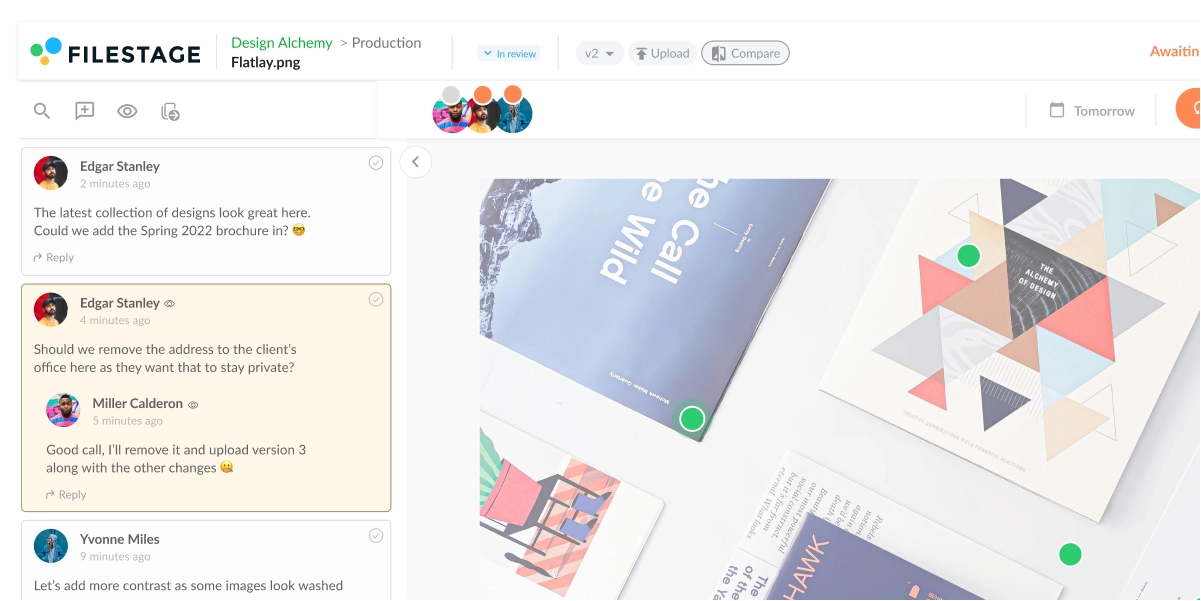
In Filestage, all your stakeholders give feedback in the same place. So as they’re watching your latest edit or reading your brochure, they’ll see exactly which points other people have commented on.
So if they agree with something, all they have to do is give a thumbs up And if they don’t, they can add a comment and @ the other person to kick off a discussion in real time.
The cherry on top
Filestage also includes team-only comments. This lets you post a comment or reply that only your teammates can see, helping to keep discussions in context. So if a client posts an outlandish suggestion in the comments, you can tag a teammate to check you’re not the only one who thinks it’s crazy.
4. Manage versions and review rounds with ease
Versions are like relationships. When it’s clear things aren’t working, you need to draw a line in the sand and reflect on what went wrong. Only then are you truly ready to move on.
The problem
Version control is, well, out of control. And modern collaboration tools are only making things worse. Documents and designs are in a constant state of flux, changing every time a new comment appears. Then, once the edits are done, the comments are ticked off or resolved. Almost as if nothing happened.
Here’s why that’s a problem:
- There’s no record of where your content began and how it developed
- There’s no history of who said what and how it impacted your work
- Your versions all blend into one endless feedback loop
Even without these tools, you’ve still probably faced your fair share of version woes. Like getting feedback on an old version, or having your client edit your copy directly.
How. Dare. They.
How online proofing tools help
Software proofing tools automatically manage your versions so everyone knows which one is the latest.
Here are three ways Filestage helps with version management:
- Version history – use the drop-down menu on your dashboard to revisit previous versions and check the content or comments
- New version available – if anyone opens an old version of a file, a message appears to make it clear that there’s a newer version
- Auto-versioning – if you upload multiple new versions at once, they’re automatically matched with files of the same name
The cherry on top
With Filestage, you can compare two versions of your content side by side. So if you need to check the new version against what you and your teammates said last time, your feedback is only a click away.

Final thoughts
Everyone faces challenges in the feedback process, but few choose to do anything about it.
I hope I’ve helped to shine a light on these problems and identify some solutions that work for you, your team, and your stakeholders. If you’d like to take a closer look at Filestage’s online proofing solution, start a free trial.
FAQ
What is an online proofing tool?
An online proofing tool is a platform that streamlines how you review and approve creative assets. Think of it as a central hub for all your feedback on videos, documents, images, websites, and more. Instead of sending files back and forth over email, you can share a single link.
Your team and clients can then add comments directly on the file, making their feedback clear. This is essential for teams with complex review processes with multiple stakeholders or high volumes of content, like marketing departments and creative agencies. Also known as a client feedback tool, it’s the best way for creative teams to get visual feedback.
Not only is every feedback comment in one dashboard, but you can easily create a comprehensive audit trail to track the progress of creative projects.
Who uses online proofing software?
Online proofing software is used by a wide range of professionals and teams who need to collaborate on creative content. This includes:
– Marketing teams reviewing campaigns, ads, and social media content.
– Creative agencies managing feedback from multiple clients.
– Video production companies collaborating on edits and post-production.
– Graphic designers sharing designs for review.
– Publishing houses proofing documents and layouts.
What file formats can you proof online?
Online proofing tools generally support a variety of file formats to accommodate different types of content.
Here’s what file formats are supported in Filestage:
– Documents: PDF, PDF/X, DOC (Microsoft Word), DOCX (Microsoft Word Open XML), XLSX (Microsoft Excel Open XML), PPTX (Microsoft PowerPoint Open XML)
– Images: JPG, PNG, TIF/TIFF, AI, PSD, SVG, GIF, EPS, WEBP, NEF, CR2, DNG, ARW, HEIC ,TTF, PSB
– Design files: Adobe Photoshop (PSD), Adobe Illustrator (AI), Adobe InDesign (INDD), Sketch (SKETCH), CorelDRAW (CDR), Scalable Vector Graphics (SVG)
– Video: MOV (h.264, Apple ProRes, Avid DNxHD, DVCPro etc.), MP4, 3GP, AAC, AVI, FLC, MPEG-2, WMV, MXF
– Audio: MP3, AAC, WAV (browser-dependent). In the Internet Explorer, audio waveform visualization and WAV files are only supported in version 13 (Edge) or higher
– Web content: TTPS sites, HTML (files need to be uploaded in a Zip file)
What software do online proofing tools integrate with?
Online proofing tools often integrate with a variety of software applications and platforms to improve collaboration, streamline workflows, and facilitate the review and approval process.
These integrations help you connect the review process with your existing systems without having to switch between different platforms.
When considering an online proofing tool, it’s important to check its list of supported integrations to ensure that it aligns with the software your team is already using.
Here are some common types of software that online proofing tools mostly integrate with:
Project management and collaboration tools – Asana, Trello, Monday.com, Basecamp, Jira, Slack
Creative software and design tools – Adobe Creative Cloud (Photoshop, Illustrator, InDesign, etc.), Sketch, Figma, Canva
Content management systems (CMS) – WordPress, Drupal, Joomla, HubSpot
Cloud storage and file sharing services – Google Drive, Dropbox, Box, OneDrive
Video collaboration tools – Frame.io, Wistia, Vimeo
Marketing automation and email marketing platforms – HubSpot, Marketo, MailChimp
Customer relationship management (CRM) software – Salesforce, HubSpot CRM
Productivity suites – Microsoft Office 365, Google Workspace
Web development platforms – WordPress, Wix, Squarespace
Analytics and reporting tools – Google Analytics, Adobe Analytics
Social media management tools – Hootsuite, Buffer
What are the key benefits of using an online proofing tool?
Getting feedback on your content can be a headache. But an online proofing tool makes life easier for everyone involved – from content creators to C-level stakeholders. This leads to improved collaboration, faster project completion, and higher quality of your projects.
Here are the five key advantages of using an online proofing platform:
1. Efficient collaboration – Team members, clients, and stakeholders can collaborate in real-time, no matter where they are. Users can easily provide feedback, comments, and annotations directly on the content, eliminating the need for lengthy email chains or in-person meetings.
2. Faster review cycles – By centralizing feedback, you cut down on back-and-forth communication and misunderstandings. This helps you get work approved and delivered faster.
3. Clear version control and audit trail – Online proofing tools often include version tracking and maintain a detailed history of changes made to the content. This helps users keep track of different iterations, compare changes over time, and maintain a clear audit trail of feedback and approvals.
4. Improved visual communication – Annotation and mark-up features in online proofing tools make it easier to communicate visual feedback. Reviewers can pinpoint specific areas for improvement directly on files, leading to clearer communication and a better understanding of required changes.
5. Improved accuracy and consistency – Online proofing helps reduce errors and inconsistencies in the final content. By capturing feedback and changes directly on the content itself, there is less chance of misinterpretation or miscommunication.