We’ve all seen “The Bear”. The restaurant business is hard work. High staff turnover, crowded markets, and hefty operating costs make it a tough nut to crack.
But despite these hurdles, the industry continues to grow. Sales are forecast to top $1 trillion for the first time.
Strategic restaurant advertising plays a pivotal role in the ongoing success of your business. It’s the engine that gets your brand in front of your target audience and tells your story.
So restaurant owners, ad agencies, and anyone else in the industry, grab a spoon. We’re going to dig into:
- Eight battle-tested advertising strategies to try in 2024
- The top marketing trends in the industry right now (from an expert)
- The “Five Ps” behind Chipotle’s success
- The tools of the trade
1. Tailor your restaurant marketing strategy
One of the biggest mistakes restaurant owners and marketers make is using a “one-size-fits-all” strategy. It doesn’t work. You need to tailor your restaurant marketing plan to your specific needs, goals, and context.
Let’s say you run a chain of fast-food restaurants with a strong value prop.
Your marketing approach will be very different from that of a trendy new gourmet restaurant.
The fast-food restaurant will likely see excellent results with:
- Direct marketing
- Signage in the local area
- Above-the-line (ATL) advertising e.g., TV, radio, billboards
- Location-based social ads
But this may actually hurt your advertising efforts for a hip new restaurant. Instead, you’ll want to opt for less direct approaches like influencer marketing campaigns and guerrilla tactics.
Inspiration
Think about your differentiator. How can you promote this in your advertising campaigns? It could be anything from a disco ball in your bathroom to a signature dish that will photograph well for social media channels.
This disco-inspired bathroom from Giorgio Paris is sure to get people talking.

Source: Basque Magazine
Supercharge your marketing reviews
Share, review, and approve all your content in one place with Filestage.
2. Develop a strong brand story
The restaurant industry is crowded. So, your business needs a clear brand identity to stand out from the rest.
Take time to define your brand’s:
- Personality – Are you friendly? Quirky? Sarcastic? Premium?
- Tone of voice – Do you speak in a conversational way? Are you more formal?
- Core values – What does your brand stand for? Are you passionate about sustainability? Community? (Remember that authenticity is key here)
- Brand promise – What do you offer your consumers? Chipotle is a great example of a brand with a solid promise. More on that later
- Market positioning – Where do you fit in the industry? How are you different from the competition?
Once you have this clearly defined, use your brand story to connect with consumers at every opportunity you get.
3. Invest in paid ads
When it comes to promoting your restaurant, you have two main strategies to consider: organic and paid advertising.
As the name suggests, paid ad campaigns (also known as pay-per-click or PPC) mean you pay every time someone clicks on your ad. They allow you to target a specific audience and tend to offer quick results as you get visibility.
Here are some of the most effective paid advertising ideas:
- Facebook location ads – handy for targeting nearby customers
- Instagram ads – boost visibility and brand awareness
- Google ads – get your restaurant to appear on search engines
- Waze ads – great for reaching customers in your area
- Digital billboards – get your restaurant noticed by passersby
Inspiration
I love this Instagram ad from Domino’s.
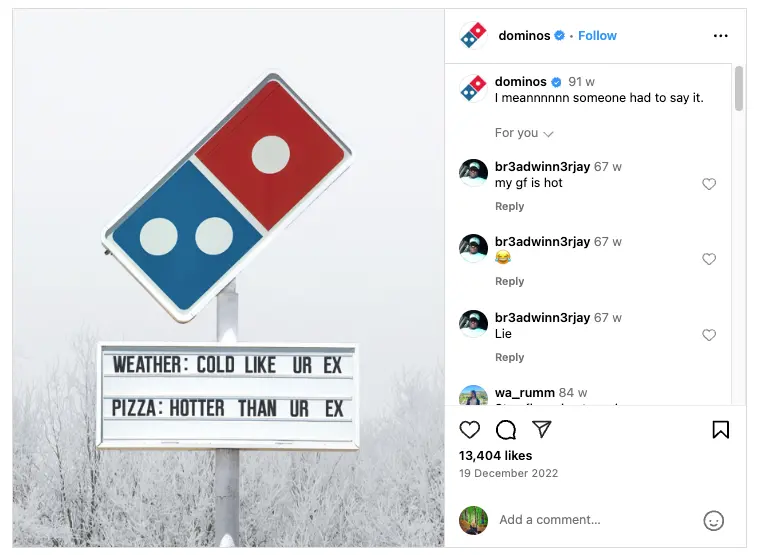
Source: Instagram
Check out our roundup of the best food ads for more inspiration.
4. Build an organic advertising strategy
When it comes to restaurant marketing strategies, combis work best. By that, I mean blending paid and organic (free) advertising.
Here are some tried-and-tested organic advertising ideas:
- Word of mouth – the most powerful advertising tool (made even more formidable by social media)
- Website SEO and local directories – excellent for getting your restaurant noticed on search engines (Google, Yelp, and Facebook are great places to start)
- Reputation marketing – responding to online reviews and customer queries is an effective way to maintain your brand reputation
- Local community engagement – participating in local events, food festivals, and fundraisers is great for getting noticed
Inspiration
Wendy’s is a prime example. It participates in local community events and fundraisers to raise awareness and promote its values.

Source: Wendy’s
For more Wendy’s appreciation, take a look at our list of the best restaurant marketing campaigns of all time.
5. Segment your audience
Segmenting your target market allows you to drill down into their specific behaviors and preferences.
Ideally, you’ll segment your audience by both demographics and psychographics:
- Age, income, geographical location
- Lifestyle, cultural values, eating preferences
From there, you’ll have a clearer picture of when different segments of your target audience like to eat and how values or tastes change between age groups.
The more you know …
Inspiration
McDonald’s is a tasty example of audience segmentation. The fast-food giant targets children, students, and businessmen with clever product branding and targeted campaigns.
While Happy Meals draws in the kids, the classic Egg McMuffin is targeted toward working business professionals.

Source: McDonald’s
6. Benchmark your competitors
I’ll keep this one short. It’s always smart to benchmark the competition.
Start by defining your direct competitors (whether that’s restaurants in a similar category or location).
Next, analyze the following factors:
- Brand values and market positioning
- Marketing efforts
- Social media marketing performance
- Online reviews on their Google Business profile
- Website and search engine rankings
- Menu, price points, and promotional offers
- Special events
Once you’ve run your analysis, look for lessons on what you can do better or where you’re ahead of the game.
7. Build a stellar social media strategy
A social media strategy is about more than just posting on your accounts regularly. You need … well, a strategy.
Start with the basics. Are you going to invest in:
- Paid advertising
- Organic content
- Email marketing
- Local collaborations
Then, dig a little deeper:
- Would an influencer campaign make sense for your brand? If so, what type of creators would align with your brand identity and values? Food bloggers? TikTokers?
- How can you leverage user-generated content (UGC) to raise brand awareness? Are there incentives you can offer to encourage people to participate?
- What success metrics will you track to see if these initiatives are paying off?
At the end of the day, it really boils down to one thing.
Authenticity.
So, don’t be afraid to keep things simple and focus on telling your brand story in an honest way that aligns with your values. No bells and whistles necessary.
Inspiration
Purezza is a vegan pizza place based in the UK. The brand does a great mix of original and UGC content to show off its very photogenic sourdough pizzas.
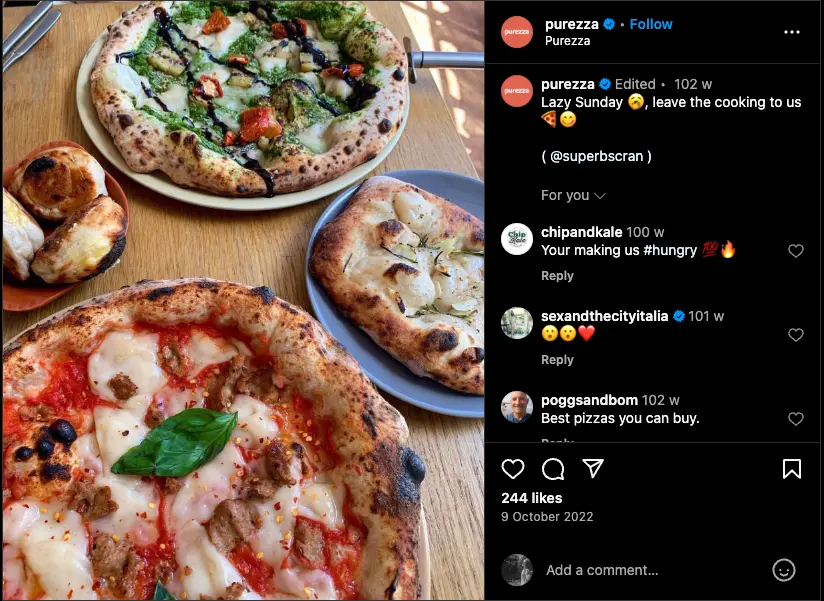
Source: instagram.com
Supercharge your marketing reviews
Share, review, and approve all your content in one place with Filestage.
8. Run multi-channel promotions
Your consumers need to see your branding across multiple touchpoints if you’re going to stay top of mind.
And the advantages of multi-channel marketing are significant:
- Connect with a more diverse audience and expand your reach
- Offer customers different ways to interact with your brand (leading to more engagement and a better experience)
- Access to more detailed consumer data so you can see which strategies are working and which need optimization
However, multi-marketing also presents a big challenge: brand governance.
The more platforms you advertise on, the harder it is to maintain a consistent brand. Especially when you’re working across digital and print channels.
And when we consider that consistent branding can lead to a 23% rise in revenue, this is a pretty big concern.
The solution is to invest in online proofing software.
Online proofing tools allow you to centralize all your ad assets, streamline the creative review process, and maintain brand consistency across all your content.
Inspiration
Filestage is a great example. It’s an award-winning tool that helps businesses manage all advertising assets in one central hub.
With Filestage, you can:
- Manage all creative assets in a single platform
- Leave contextual feedback directly on ad menus
- Maintain brand consistency across different asset formats (from artwork to promo videos)
- Streamline review processes and reduce approval times by 30%
Here’s how your Filestage dashboard could look – all your creative assets, versions, and feedback just one click away:
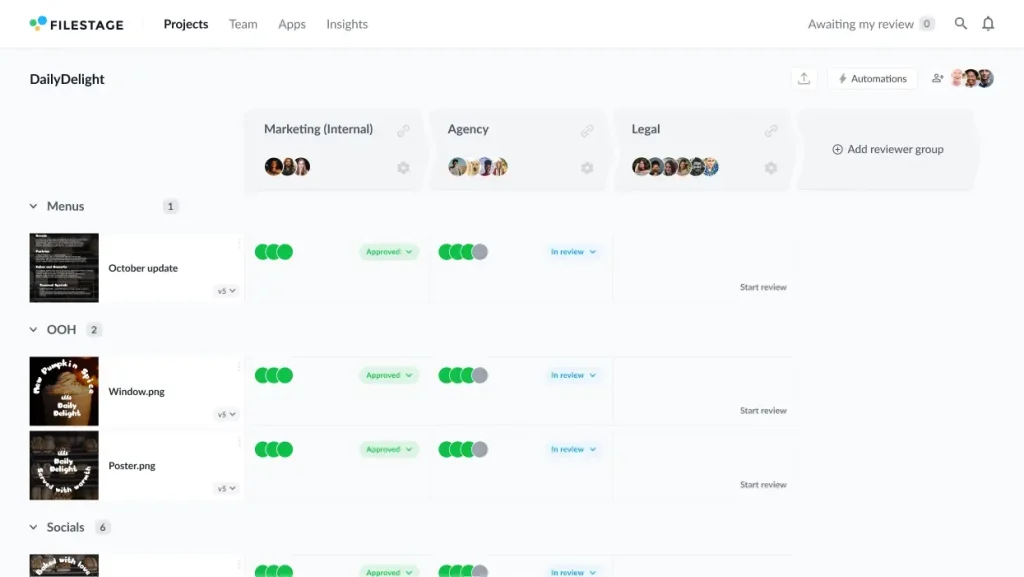
Four top restaurant advertising trends for 2024
Trends move fast in the restaurant industry, meaning businesses need to react with their marketing strategies.
I wanted to know the biggest industry trends for 2024, so I asked Alfred Goldberg, Chief Brand Strategist at Absolute Marketing Solutions. His agency has been offering marketing services to the hospitality industry industry for over 25 years.
Here are the biggest trends he’s seeing.
1. Immersive and experiential advertising
Immersive experiences are becoming increasingly popular in the restaurant industry, especially those that rely on the senses.
Interestingly, 91% of consumers think participating in experiential marketing makes them more likely to buy from a brand.
According to Alfred, these immersive experiences give potential customers a feel for your restaurant before they step through the door.

“Virtual tours, behind-the-scenes videos, interactive content, and partnerships with augmented reality (AR) platforms help potential customers experience the restaurant in a digital space before they ever walk through the door.”
Alfred Goldberg, Chief Brand Strategist at Absolute Marketing Solutions
2. Hyper-targeted AI advertising
AI has taken over every industry, hospitality included. One of the biggest advantages it offers is the ability for precision targeting. Now, you can tailor your ads to specific customer segments for a more personalized experience.
“We’re seeing an increase in AI-driven content personalization, where the ad someone sees is automatically adjusted based on their past behavior, preferences, and even their real-time context.”
Personalization is now a “must-have”. According to a McKinsey study, 71% of consumers expect it, and 76% feel frustrated when they don’t find it.
3. Ethics in AI and advertising
As AI becomes an integral tool in advertising, our attention is turning to ethical considerations. How will AI impact fairness? There are already reports of biases.
Alfred highlights the need for restaurant brands to be transparent when using AI in advertising campaigns.
“Consumers are increasingly aware of how their data is being used, and brands that prioritize ethical practices in AI are seeing stronger brand loyalty.”
Interestingly, our 2023 report revealed that 76% of creatives use AI to create marketing content, but two-thirds haven’t told their managers or clients.
4. Purpose-driven campaigns
Consumer behavior is changing, with more people than ever seeking brands that align with their values. As a result, restaurants need to make their values clear and highlight their purpose.
Alfred reminds businesses in the restaurant industry of the importance of authentic, purpose-driven campaigns.
“For restaurants, this means highlighting efforts around sustainability, community involvement, or social responsibility. Purpose-driven ads that reflect genuine commitment to a cause resonate deeply, especially with younger audiences.”
Chipotle is one of the best examples of purpose-driven restaurant marketing strategies. Let’s break down its strategy.
The five Ps – restaurant advertising lessons from Chipotle
Chipotle opened its doors in 1993. It was a humble burrito restaurant with some initial funding issues. Located near the University of Denver, it catered primarily to college students.
Despite its humble beginnings, Chipotle is now one of the biggest restaurant chains in the world. It serves a million customers every day and has over 2000 stores dotted across the US.
What’s really interesting is that Chipotle doesn’t have customers. It has die-hard brand loyalists (who affectionately refer to the chain as “Chipotbae”).
Excellent branding and a top-tier restaurant advertising strategy are the pillars behind Chipotle’s impressive rise to success.
And here are five strategies you can steal. I like to call them “the five Ps”.
1. Purpose
I’m starting with a spicy take. It doesn’t matter how incredible your restaurant marketing strategy is. Without a clear sense of purpose, you’re toast.
Chipotle is a prime example.
As a brand, it’s always had a strong philosophy: real food. Chipotle believes that food has the power to change the world. And it stays true to this philosophy, using fresh local produce, responsible-raised meat, and sustainable practices.

Source: Chipotle
2. Product
Want to know an underrated way of promoting your restaurant? Offer an impeccable product. Chipotle gives its customers the full package: five-star service, a great experience, and consistently high-quality food.
Now let’s break those down:
- Service – Chipotle restaurants always have enough staff. Plus, if you hate to wait, you can order ahead on the mobile app and pick up your order at the drive-thru.
- Experience – Chipotle launched a new responsible restaurant design in 2023 that runs on 100% renewable energy. So you can eat and save the planet.
- Food – Chipotle only uses 53 ingredients in its products. That means no growth hormones or preservatives. In fact, it prides itself on having no freezers (it’s all fresh).
The lesson? Get your product branding on point (and deliver the full package).
3. Processes
Now for the boring part. Chipotle’s success is down, in large part, to some airtight operations. That includes:
- Company-owned stores for better control and consistency.
- Focus on throughput to increase the speed of service
- Excellent staff benefits to enhance employer branding efforts and support employees’ mental health
- Chipotle has reduced staff turnover from 200% to the low 100% range
The lesson? Better processes = better customer experiences.
4. Promise
Chipotle made us a promise to “Be Real”. Making a promise to your target audience (and delivering on it) is how you build trust. It’s how you build long-term relationships and convert customers into brand loyalists.
The stats back this up.
A recent study revealed that brands that make a promise in their ads are more likely to drive a sales increase, improve brand health, and change consumer behaviors.

Source: Chipotle
Supercharge your marketing reviews
Share, review, and approve all your content in one place with Filestage.
5. Performance
Chipotle is playing the long game with its performance marketing and branding strategy. And so should you.
Chipotle understands the importance of brand building. It never skimps when it comes to priming future customers and staying top of mind.
This YouTube ad is a great example of that.
Restaurant advertising FAQs
What is restaurant advertising?
Restaurant advertising is a series of strategies to promote your business and attract customers. It usually combines digital marketing, traditional advertising, and in-store promotions.
Here are some of the most common restaurant promotion ideas:
- Digital marketing tactics – SEO, paid advertising, social media marketing, email campaigns, digital billboards
- Print advertising campaigns – flyers, brochures, newspapers, direct mail, and magazine ads
- Radio and TV ads
- POS marketing – signage, menus, table tents
- Loyalty programs – points, cards, exclusive promotions for return customers
- Supporting local community events
What are the biggest restaurant advertising challenges businesses face in 2024?
The restaurant industry faces some unique challenges. Here are four of the most prominent:
- Prices are rising and budgets are sinking – advertising on high-impact platforms like Google is getting more expensive. Restaurants need efficient campaigns and affordable alternatives like user-generated content or influencer campaigns.
- New technologies and platforms are emerging – restaurants have to stay ahead of these new tools and the associated shifts in behaviors.
- Compliance regulations are getting stricter – as privacy laws like GDPR and CCPA tighten, it’s more difficult to use consumer data for targeted advertising.
- Attention spans are shrinking – restaurant advertising needs to be concise and creative to cut through the noise and hook viewers.
What are the essential restaurant advertising tools?
The right technology can help you optimize your restaurant marketing campaign. Here are five must-have tools restaurant owners should invest in:
- Search engine marketing (SEM) tools like Google Ads or Bing Ads – to rank on search engines and track ad performance
- Email marketing tools like Mailchimp – if you want to build an email list to stay in touch with your customers and send targeted promotions
- Local SEO tools like Yelp – to optimize your restaurant’s digital presence, monitor online reviews, and gain visibility in your local market
- Customer relationship management (CRM) software like Salesforce – for tracking customer data and managing reservations
- Online proofing software – to manage advertising assets and maintain cohesive branding across multiple channels
That’s a wrap
I hope these restaurant marketing strategies give you some food for thought. Investing in paid ads, creating a strong social media presence, and participating in local community events are excellent ways to get your name out there.
But, as we’ve seen from giants like Chipotle, it all starts with a great brand story. Every piece of content your business shares across multiple channels should be consistent with your brand identity.
If you’re looking for a platform to centralize your creative assets and enhance brand governance, try Filestage. Get a free trial today.