1. Executive summary
Generative AI has fundamentally rewritten the rules of content creation, allowing marketing, creative, and communications teams to scale production at dizzying speed. But while the tools to create content have advanced quickly, the infrastructure to govern and trace that content is failing to keep up. Human review capacity does not scale at the speed of algorithms, and enterprise organizations cannot simply hire their way out of the gap. This widening validation gap now stands as one of the most significant operational and brand risks for any enterprise publishing content at volume.
That validation gap now comes with a regulatory deadline attached. The European Union’s AI Act is the first global regulatory framework to treat AI-generated content as a governance issue in its own right, and Article 50’s transparency obligations take effect in August 2026. This law puts a firm date and a paper trail requirement on a question enterprise leadership must be able to answer: who reviewed this public-facing asset, and can you prove it?
To play by these new rules, enterprises need an independent layer between content creation and publication. It should sit separate from the tools generating the content which are less capable of catching their own mistakes. This is the Trust Layer: the governance checkpoint between the content itself and what goes live. It functions as a System of Evidence, recording every review decision and who approved each asset.
When an asset moves through this Governance Pipeline, from first draft to final sign-off, it builds toward the same outcome: Certified Content, verified organizational output with a documented record behind it. The enterprises that build this Verification Infrastructure now will ultimately be the ones able to scale AI-assisted content with confidence.
2. The content explosion
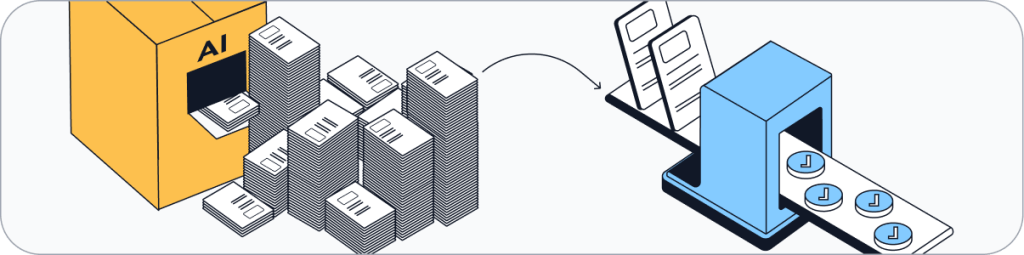
Generative AI has made producing content fast and inexpensive. A single marketer can now brief, draft, localize, and format more assets in an afternoon than an entire team once produced in a quarter. Volume scales exponentially. Human review capacity does not. The number of qualified reviewers, the hours in a working day, and the attention a compliance officer can give to any one asset are unchanged, no matter how much output is generated around them. This is a structural shift in the ratio between what can be produced and what can be checked, and that ratio keeps moving in the same direction. The new enterprise problem becomes verification, accountability, traceability, governance, compliance, and approval integrity, all at a volume no team was built to handle manually.
Enterprises are no longer managing content workflows. They are managing trust at scale.
The shape of this problem shifts by industry, but the pattern remains the same. The following hypothetical, illustrative scenarios show how this plays out across industries today.

A global FMCG brand generates 40 or more packaging variants per SKU, per market, per quarter, each requiring compliance, legal, and brand sign-off before it reaches a shelf. AI multiplies the variants. The review process does not.

A mid-sized creative agency managing a dozen enterprise clients runs 800 or more review cycles a month. Each approval lives in an email thread instead of a record, which makes it a liability rather than proof of anything.
A pharmaceutical marketing team produces AI-generated patient education materials across six markets, where every piece needs regulatory pre-approval before it reaches a patient. The volume is new. The exposure is not.
In each case, the constraint is how fast an enterprise can create content, but how fast, and how defensibly, it can verify what has been created before it reaches the public. That is a different kind of problem than the one most review processes were built to deal with, and it does not get solved by hiring more reviewers or moving faster. It requires a system to verify content at the same scale it gets created.
3. Why traditional approval workflows break in the AI era
Most review systems used today were built for a different content pipeline. They assumed slower publishing cycles, human-generated drafts, modest output volume, a small circle of stakeholders, and regulatory conditions that would hold steady long enough for a process to be designed once and trusted for years.
AI changes the shape of the pipeline. Asset volume moves from a manageable stream to something 10 or a hundred times larger. Turnaround compresses from weeks to hours. Authorship becomes harder to pin down, since a single asset can pass through a generative tool, a human editor, and a localization pass before anyone reviews it. Compliance exposure grows in step with volume, because every new asset is another chance for an unapproved claim to reach the public. The risk surface expands with no certification workflow to manage it.
A manual review process cannot function as a verification pipeline, especially at this new pace.
Under pressure, the same failure modes keep surfacing.

The illustrative scenarios below show how a workflow followed as originally intended can fail when faced with the new scale of AI.

A machinery manufacturer uses AI to localize technical documentation into 14 languages. One safety specification is mistranslated and reaches print. When the error surfaces, no one can trace which version was approved, or by whom.

A consumer goods brand uses a generative tool to draft 200 promotional claims for a campaign. Three contain language that sits close to regulated territory. Legal never sees them, because the file carries an “approved” stamp from an email thread sent 18 months earlier, long before the current claims existed.
Neither failure came from AI writing something wrong, but because there was no mechanism to catch AI’s mistakes. The only reliable solution for enterprises is to have a Governance Pipeline for AI content governance that stands between production and publication, catching errors and providing evidence-backed approvals.
4. A regulatory accelerator: The EU AI Act
The EU AI Act signals a significant shift in how enterprises are expected to govern their use of AI. This section covers what the Act means for brands, and how an exemption makes one of the strongest arguments yet for documented human review.
4.a. What the EU AI Act signals
The EU AI Act is the first global regulatory framework to treat AI-generated content as a real governance issue. But more than a set of regulations. It marks a structural shift for enterprises: transparency becomes the default, accountability becomes infrastructure, auditability becomes a requirement rather than a nice-to-have, and risk management becomes an operational standard.
4.b. The August 2026 deadline and one important exemption
The transparency obligations under Article 50 of the EU AI Act apply from 2 August 2026. A separate grace period, to 2 December 2026, covers only the machine-readable marking requirement under Article 50(2), and only for systems already on the market before August.
Under the Act, the obligation to mark AI outputs in a machine-readable format sits on the providers of generative AI systems, not automatically on the company using the tool. The organization deploying that tool carries a different set of responsibilities: labeling deepfakes, labeling AI-generated text published on matters of public interest, and taking broader accountability for what it puts into the world.
One exemption changes the calculus for every deploying organization. The labeling requirement does not apply where the AI-generated content has gone through a genuine process of human review and editorial control, and where an identifiable natural or legal person holds editorial responsibility for the publication.
Documented human review is the most effective way to stay compliant under Article 50.
Regulatory guidance is explicit that a spell-check or a cursory glance does not qualify. It has to be a deliberate examination of the substance of the content, carried out by someone with the competence and judgment to assess it. The person responsible cannot be implied or assumed after the fact, they have to be identifiable at the time of publication. An email thread does not meet that bar.
4.c. C2PA: the technical standard emerging alongside the regulation
C2PA (Coalition for Content Provenance and Authenticity) attaches a machine-readable record to a content file: where it came from, what tools touched it, whether it was edited. The European Commission’s Code of Practice on transparency, finalized in June 2026, names C2PA Content Credentials as the reference mechanism for that machine-readable marking layer.
Companies are already building C2PA into their products.
Hardware and software makers are moving in the same direction. Google’s Pixel 10 signs every photo taken with its native camera by default, using hardware-backed credentials that are harder to fake than ordinary file metadata, while Samsung’s Galaxy S25 takes a narrower approach and signs only the images it has AI-edited. On the professional side, Leica was first to ship a production camera with content credentials built in, and Sony has since extended the technology to nine models across its professional Alpha and video lines.
Gartner named digital content provenance one of its top strategic technology trends for 2026, pointing to the same pressure driving all of this. As synthetic content grows, organizations need a way to verify what they are looking at rather than simply trusting it.
“No credentials, not trusted” is becoming the working assumption for how content gets evaluated.
C2PA answers one half of the provenance question: where a piece of content came from, and what tools touched it along the way. Filestage’s Governance Pipeline addresses the other half. Every asset approved through Filestage is logged, versioned, and recorded as reviewed by a specific, identifiable person, at a specific time, with a specific decision attached. That record is the human-review evidence that complements C2PA’s provenance data. It is the System of Evidence made concrete, proving that someone with the standing to judge the content actually looked at it before it went live.
4.d. Why marketing and creative teams are now governance stakeholders
The consequence of all this lands squarely on teams that have never had to think about compliance until now.
- Marketing content creates compliance exposure the moment it goes live, regardless of who or what drafted it.
- Creative operations are functionally risk operations now, whether the team has updated its job descriptions to say so or not.
- Brand governance and legal governance are converging into the same conversation, often for the first time.
- The team that clicks approve owns the liability for what it approved.
The following illustrative examples show how these responsibilities play out.
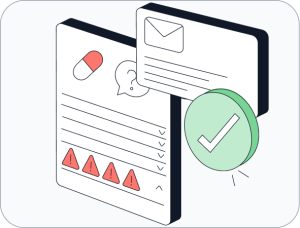
A pharmaceutical marketing team publishes an AI-generated patient FAQ. It contains a dosage implication that medical affairs never signed off on. When it is flagged after the fact, the approval trail shows a single email from a junior copywriter. No legal review is documented anywhere.
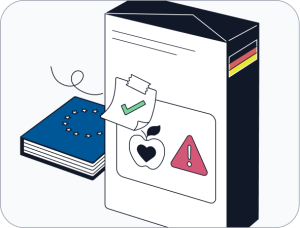
A CPG localization team adapts packaging claims for the German market. The adapted copy contains a nutrition claim that does not comply with EC 1924/2006, the EU’s regulation on nutrition and health claims. Nobody catches it, because the review process for that market was treated as an informal check.
5. The rise of the Trust Layer
Content volume has outpaced human review capacity, and the law is starting to require documented proof that a qualified person looked at what got published. To manage this, organizations need a structural shift in their review process: a layer built specifically to sit between the moment content is created and the moment it reaches the public.
That is the Trust Layer. It is a neutral, independent verification system between content creation and distribution. Independence here is a structural necessity. A generation tool is built to optimize for output, for speed, for volume, because that is what it is for. Those incentives are entirely reasonable for a creation tool but entirely wrong for a governance function. Verification has to sit somewhere else, run by something with no production quota to hit and no output to defend.
The creator cannot also be the auditor.
Filestage also runs Review Agents that use AI, so is this not AI auditing AI as well? The answer is structural. Filestage does not generate the content it checks. It verifies content created elsewhere, and a named person remains responsible for every consequential decision. The agents remove noise from the process; people still own the call. Independence comes from separating creation from verification, and from human editorial responsibility, not from the absence of automation.
Filestage serves as the Trust Layer that verifies content made somewhere else, making space for a named person to make the final decision. This is the same standard the Article 50 exemption sets.
Most organizations already have some version of a review process. What differs is how much of it could be proven if someone asked. We’ve broken this down into five different levels.
The Trust Maturity Model
| Level | Process |
|---|---|
| 1. Manual reviews | Email-based approvals, no version control, no audit trail |
| 2. Workflow coordination | Centralized platform, structured steps, basic tracking |
| 3. AI-assisted governance | Automated pre-checks, less manual noise, smarter routing |
| 4. Certified content operations | Every published asset is a verified organizational output |
| 5. Enterprise trust infrastructure | Governance embedded across departments, audit-ready by default, with a human-review evidence record that complements C2PA provenance |
Many enterprises currently sit at Level 2. There is a platform, a process, some tracking, but nothing that would hold up as a documented, attributable record if a regulator or a client asked for one. The distance between that and Level 4, where every asset carries proof of who reviewed it and what they decided, is smaller than it looks. It has a verification layer added on top of what most teams already have, not a rebuild of how they create content. That is the gap Filestage is built to close, the bridge from workflow coordination to Certified Content operations.
6. From AI features to AI governance agents
For a verification pipeline to work with the scale and speed of AI-generated content, it needs certain levels of automation to catch the routine problems before a human reviewer spends time on them. That is what Filestage Review Agents do. They operate exclusively inside the review process, using a combination of AI and rule-based logic to flag common errors.
| Agent | What it checks | Sample use case |
|---|---|---|
| Grammar Agent | Tone consistency, spelling, and grammar | An agency delivering copy to a CPG client: catches a brand-voice inconsistency before the client review round begins |
| Sensitive Language Agent | Potentially discriminatory, offensive, or culturally inconsistent language | A global pharma company localizing patient materials; flags a term that is standard in the US but negatively connoted in DACH |
| Forbidden Terms Agent | Language that cannot be used by a brand, based on its own guidelines | A financial services company updating its website: catches restricted claims that a freelance copywriter would not know to avoid |
| QR/Barcode Agent | QR codes, barcodes, and other machine-readable elements for technical validity | FMCG brand printing packaging for 12 markets: a QR code pointing to an expired URL is caught before printing |
| Custom Prompt Agent | An organization’s own brand or legal rules, configured per account | Enterprise CPG brand with proprietary claims guidelines: checks every asset automatically. |
| CLP Compliance Agent (early access) | Chemical labeling against CLP regulation standards | A manufacturing or chemicals company; mandatory hazard statements are verified before packaging goes to print |
None of these agents can approve content. Their sole function is to remove the noise a reviewer would otherwise sort through by hand. Review Agents filter, people make the final call. This division of labor is what lets governance scale with content volume instead of breaking under it.
This is a human-on-the-loop model: not fully autonomous, and not fully manual either. Review Agents filter out the routine noise; people review the strategic exceptions that remain. That balance is what makes the governance model scalable as content volume continues to grow.
7. What a certified content workflow looks like
The diagram below shows the journey an asset takes from creation through to publication using the Trust Layer.
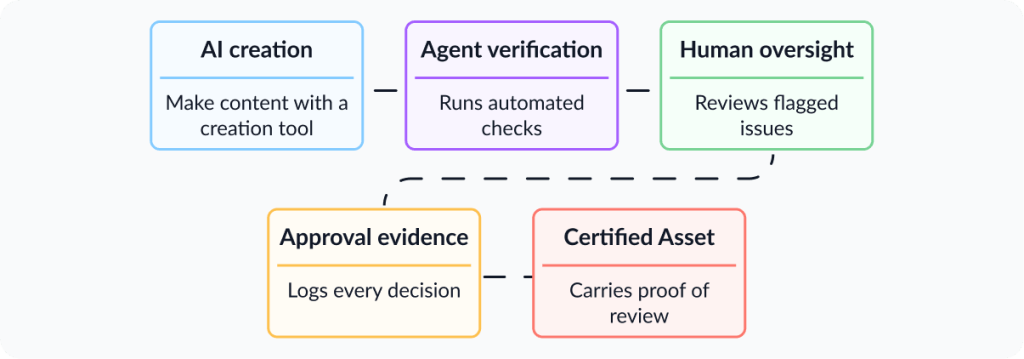
An approved file could be something someone signed off on, informally, with no guarantee that the sign-off means anything to anyone who was not in the room. A Certified Asset, on the other hand, is a verited organizational output that carries its own governance history wherever it goes.
Every Certified Asset carries that history forward, whether it is pulled up for a regulatory audit, a legal claim, or simply the next campaign built on top of it.
Below are two illustrative examples of how a Certified Asset comes together.

CPG: Before a packaging file goes to the printer, it has passed Grammar, QR/Barcode, and CLP Agent checks, received sign-off from Brand, Legal, and Regulatory, and carries a full version history.

Healthcare: A patient brochure has passed Sensitive Language and Custom Prompt Agent checks, been approved by Medical Affairs and Compliance, and the audit trail can be reconstructed for any regulatory review.
8. Building a System of Evidence
Questions like these are becoming more common for enterprises producing content at scale.
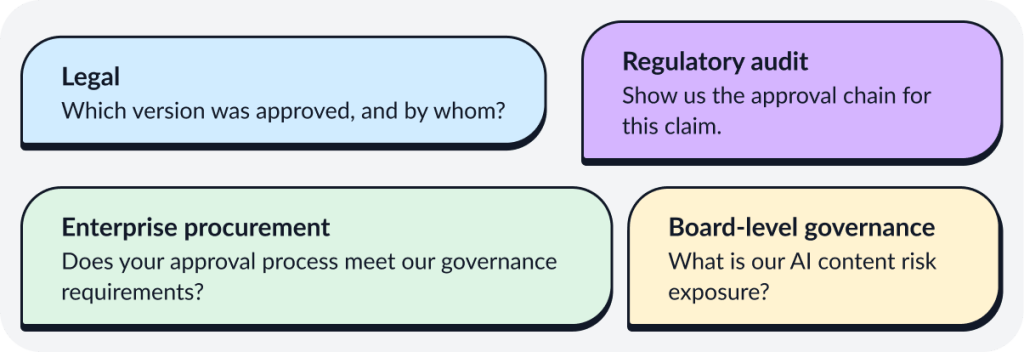
To answer them with absolute certainty, teams need a system built to produce proof on demand rather than piece it together after the fact.
Filestage approval trails paired with C2PA content credentials are an effective way to make sure enterprises have the answers they need, when they need them. C2PA carries the provenance side: where an asset came from, and what tools touched it along the way. Filestage carries the human-review side: who looked at it, when, and what they decided. Together, they form a defensible, machine-readable governance record, proof of origin on one side, proof of judgment on the other.
Below are two illustrative scenarios to show what that record is worth when it is actually needed.
Manufacturing: an industrial equipment maker faces a product liability claim over an asset approved eighteen months earlier. Filestage reconstructs the full approval chain in minutes, rather than the weeks a manual search through old files and inboxes would otherwise take.

Agencies: a large agency is audited by a financial-services client that needs proof every marketing material for a regulated product was approved in the correct sequence. Filestage exports the full approval history for every asset in the campaign.
9. The strategic opportunity for enterprises
Everything up to this point has been about risk: what breaks under volume, what the law now requires, what a lawyer or auditor eventually asks for. The opportunity for enterprises sits on the other side of that same coin.
Enterprises that put this governance layer in place now are building a capability most competitors still lack. They will scale AI adoption faster, carry less compliance friction, protect brand trust at volume, and move to market faster without cutting corners on safety. This is the kind of adoption legal and the board can actually defend.
With governance, AI becomes something an organization can scale with confidence.
The real difference shows up after publication, in whether anyone can stand behind what went out.
10. The future belongs to trusted content
Content volume has already outpaced what manual review can catch. The law now requires documented proof that a qualified person looked at what went out before it reached the public.
In the AI era, creation becomes abundant but trust becomes harder to hold onto.
When anyone can produce content at volume, the organizations that can prove theirs is accurate and accountable are the ones that will earn trust by default. That proof has to be built into how content moves from creation to publication. Piecing it together after the fact will no longer suffice.
The organizations that come out ahead will be the ones that built the systems to certify which content deserves to reach the public, before an audit, a regulator, or the next compliance deadline forces the question instead.
Filestage is the Trust Layer that turns AI-assisted content into Certified Content.
To see the Trust Layer in action, book a demo here.