You’ve probably been using Artificial Intelligence (AI) in your content workflow for a while now, along with 86% of enterprises working with AI to generate and optimize content (found in the full report).
But as your output ramps up, how can you trust everything that goes out? And how do you make sure your audience can too? The answer to both of those questions is AI content governance.
Keep reading to find out how to build a simple, effective framework that protects your brand at scale. First though, let’s see what AI content governance actually is, and why it’s become a big deal for enterprises in 2026.
What is AI content governance?
AI content governance is a set of policies, processes, and tools that manage AI-generated content. It applies across the AI technologies your team already relies on for everything from creation to publishing.
If you want a deep dive on the topic, check out our latest white paper about governing content at the speed of AI.
Why traditional governance breaks down at AI speed
While traditional governance models already exist, they were built for small teams, predictable schedules, and a human overseeing every stage. Remember those days?
AI marketing tools have fundamentally changed content production and content strategy, driven by three key factors:
- Volume: One creator can brief, draft, and iterate on dozens of pieces before lunch.
- Velocity: Content moves from an initial prompt to a published asset in minutes instead of days.
- Variability: Generative models are unpredictable. Prompt the same request twice, and you’ll get two different results.
This creates an operational gap. A team of five producing 20 pieces a month can rely on shared folders and good instincts. That approach crumbles when a team uses AI to generate hundreds of assets across multiple regional variants, each one expected to match the same brand identity.
Rather than relying on manual checks after the fact, a comprehensive AI governance framework builds control into every stage of the content lifecycle. These are the key AI governance practices:
- Creation standards: Prompting guidelines, tone specs, and brand guardrails set before anyone drafts a line.
- Review workflows: Standardized approval paths that determine who checks what, and in what order.
- Permissions: Clear role access defining who can publish directly versus who requires a second pair of eyes.
- Audit trails: Documented histories recording who edited, approved, or flagged an asset and when.
- Lifecycle rules: Expiry dates and refresh schedules to retire stale AI output automatically.
The risks of ungoverned enterprise AI-generated content
Nobody sets out to publish a fake statistic or leak sensitive information. But without the right content governance model, mistakes slip through, and the consequences can be pretty dire.
Here are the biggest pitfalls enterprise teams face when scaling their AI output:
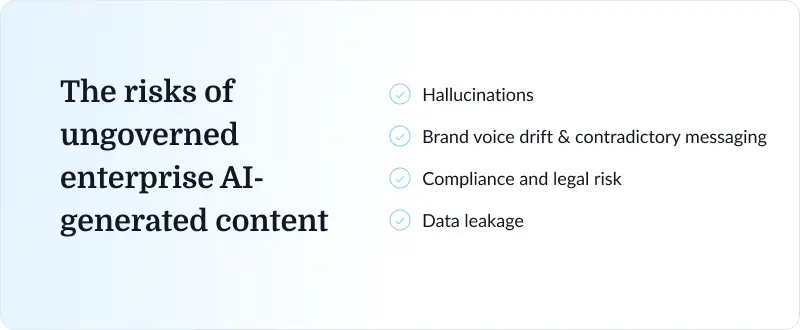
Hallucinations
Hallucinations happen when an AI model invents facts, quotes, or sources while sounding entirely confident. In July 2025, Deloitte Australia delivered an AUD 440,000 report to Australia’s Department of Employment and Workplace Relations. Academics subsequently identified fabricated academic references and a misquoted Federal Court judgment. Deloitte published a corrected version, which disclosed that Azure OpenAI had been used in drafting, and in October 2025 agreed to repay the final instalment of its fee, later confirmed at roughly AUD 97,000.
Brand voice drift and contradictory messaging
When regional teams prompt AI models independently, brand tone can quickly fall to pieces. One campaign might sound warm and approachable while another reads like a legal disclaimer. Across product pages, sales decks, and social posts, these uncoordinated prompts result in inconsistent messaging that degrades customer trust and chips away at brand credibility.
Compliance and legal risk
The EY Responsible AI Pulse Survey, which polled 975 C-suite leaders across 21 countries, found that 99% of organizations had already taken a financial hit from an AI-related risk, and 64% had lost more than $1 million. Non-compliance with AI regulation was the single most common cause, cited by 57% of respondents. This is exactly what responsible AI governance is meant to prevent.
For the regulatory side of this, our EU AI Act compliance checklist walks through what you need to label, review, and document.
Data leakage
Employees pasting confidential drafts, customer data, or unreleased product details into a public AI tool is one of the fastest ways sensitive information leaves a building, undermining data privacy along the way. In May 2023, Samsung confirmed it was temporarily restricting employee use of ChatGPT and other generative AI tools on company devices, after staff entered sensitive company code into the chatbot. A spokesperson told TechCrunch: “The company is reviewing measures to create a secure environment for safely using generative AI… until these measures are ready, we are temporarily restricting the use of generative AI through company devices.”
Building an AI content governance framework in four steps
If you think AI content governance is a temporary trend that will fade once the hype settles down, AI development shows no signs of slowing, so one look at the market data might change your mind: Gartner predicts that by 2027, 75% of AI platforms will incorporate Trust, Risk, and Security Management (TRiSM) as a primary differentiator.
Building an AI content governance framework for your own team doesn’t have to be complicated. You can break it down into four practical pillars.
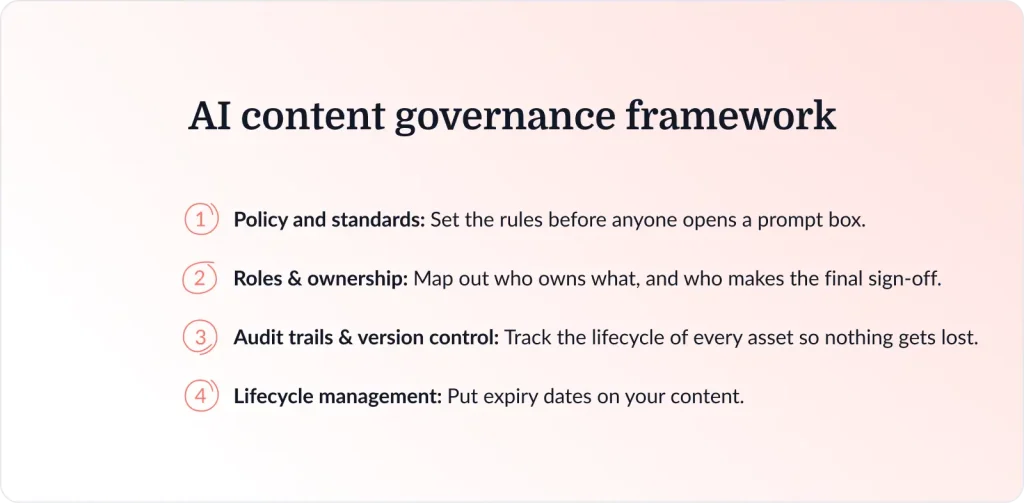
1. Policy and standards
Job to be done: Set the rules before anyone opens a prompt box.
Define your tone of voice, content pillars, brand guardrails, ethical considerations, and master prompting templates. It can help to give your team concrete examples of what “good” looks like too, along with explicit rules on what never to input into public AI tools. This is also where your AI ethics commitments turn into concrete rules, not just values on a slide.
This is the step a lot of companies rush (or skip entirely), but without clear standards, every writer and regional team ends up inventing their own version of your brand voice, one prompt at a time.
2. Roles and ownership
Job to be done: Map out exactly who owns what, and who makes the final sign-off.
Establish a clear decision matrix for every content type. Who drafts? Who reviews? Who has the ultimate authority to hit publish?
Ambiguity creates a breeding ground for bottlenecks and costly mistakes. Defining an explicit path for high-risk assets (like regulated product claims) versus low-risk assets (like routine social posts) means nobody is guessing who has the final say when time is tight.
Who approves what: an AI content governance decision matrix
When AI drafts content at volume, reviewer chains get messy fast. Use this matrix to see who signs off on what, adjust it for your team, and share it with legal, brand, and compliance.
Just tap any cell to switch between required, optional, and not needed.
Manage and track every approval with Filestage
Turn this matrix into a real workflow with Filestage. Route each piece to the right reviewers, keep all your versions in one place, and track every decision as it happens.
3. Audit trails and version control
Job to be done: Track the lifecycle of every asset so nothing gets lost.
Make sure every AI-assisted piece has a traceable record: who generated the initial draft, who edited it, what changed, when, and who gave final sign-off.
This way, if a claim is ever questioned by a customer, your legal team, or a regulator, you can pull up the exact history in seconds to prove due diligence.
4. Lifecycle management
Job to be done: Put expiry dates on your content so old AI output doesn’t stick around.
Good content governance stays working long after you hit publish. Establishing clear schedules for reviewing, updating, or archiving older AI content keeps your library clean and gets rid of outdated information that could be misleading.
Choosing an AI content governance platform
Once you’ve got a framework in place, you need a platform that can actually run it across your entire content creation process. It can be hard to know where to start, so here are five things you want to look out for when choosing an AI content governance platform:
- A centralized content repository: One place where approved assets live, so nobody needs to hunt through old email threads for the “final final” version.
- Smart permissions and access controls: Role-based access by team, region, or content type.
- AI-native workflow integration: Governance built into the content approval process, not added as an extra step after the fact. If reviewers have to leave the tool to check a draft against brand rules, they will skip it under deadline pressure.
- Search and retrieval: If people can’t find the right approved asset in seconds, they will reuse whatever they can find, approved or not.
- Analytics and content health monitoring: Visibility into what’s being used, what’s stale, and what’s actually performing, so decisions about what to refresh or retire are based on data instead of guesswork. That keeps every asset relevant to your target audience.
The strongest AI content governance platforms bring together creation, approval, distribution, and analytics under one governance layer. So the record of what was approved and who approved it lives in a single place instead of scattered across tools. More on that in the next section.
The missing link: structured review workflows for AI-generated content
Publishing anything (AI-generated or not) without proper approval is asking for trouble. You need to know who checks your content, in what order, and against what criteria. And you need to be able to prove it with a clear paper trail if anything goes wrong.
How AI governance policies are changing in 2026
Regulators are cracking down on how businesses can use AI. An AI content governance model becomes a must under the EU AI Act, coming into full force on August 2, 2026. Article 50 requires public-facing AI content to carry an explicit disclosure tag. With the caveat that running a verifiable human review by a qualified expert grants an exemption from the labeling mandate. Getting ahead of this risk-based approach means your framework won’t need a rebuild every time a new AI regulation lands.
But even though it carries the highest risk, the review phase is still the most underinvested stage of the AI content lifecycle. Many teams attempt to manage high-volume AI approvals through scattered email threads, messaging apps, and shared drives. This lack of structure creates blind spots that brands can’t afford to have.
To learn more about how the EU AI Act impacts your team, check out our article on the EU AI Act for brands.
Scale your AI content safely with Filestage
A content governance platform like Filestage centralizes the review process across brand leads, legal teams, compliance officers, and subject matter experts. Feedback is tied directly to specific document versions, while sign-offs, edits, and timestamps log automatically to create a complete audit trail.
To make sure teams review content as quickly as it’s being created, they can use Filestage’s automated Review Agents to scan content for common issues instantly.
Review Agents flag things like grammar and spelling mistakes, broken QR or barcodes, forbidden terms, and sensitive language across markets. Then human reviewers make the final decision. This workflow meets regulatory mandates, while giving teams more time to focus on creative and strategic decisions.

Scaling AI content governance in 2026 and beyond
The volume of AI-generated content is only going to grow as tools advance and teams get more comfortable using them in day-to-day production. As AI initiatives move from pilot projects to core workflows, that pace will only pick up. If you want to come out on top, you need a content governance strategy that can keep up with your AI content creation.
That doesn’t mean you need to rebuild your entire operation from scratch. Just take a few intentional steps to set your business up for sustainable scale.
It boils down to three things: build a simple framework, choose a platform that centralizes your work, and never underestimate the review layer. Having that safety net in place lets your team move fast without worrying about what’s getting published.
To start making progress today, take a close look at your current AI content approval process:
- Pull 10 pieces of AI-assisted content your team published over the last month.
- Try to answer three simple questions for each: Who reviewed it? What criteria did they check it against? Where is the record of that sign-off stored?
If those answers take more than a few minutes to find, you know what you need to fix.
And if you’d like to see how Filestage can help you build trackable review workflows for every piece of content, start your free trial today.