Remember when making content took most of your team’s time? Drafting, designing, resizing for every channel, translating for every market.
Now look at where that time goes today. AI can draft the copy in minutes and pumps out ten variants before lunch. In Ahrefs’ 2026 survey of 301 marketers, 93% said they use AI to create or help create content. The making is getting cheaper and faster every quarter.
What’s yet to catch up is the moment someone on your team looks at a piece of content and decides whether it’s right. Is the claim accurate? Does this sound like us? Can we legally say this in Germany? Should this go out at all? Those questions still need a person, and you now have far more content relying on them.
What is human-in-the-loop in AI marketing?
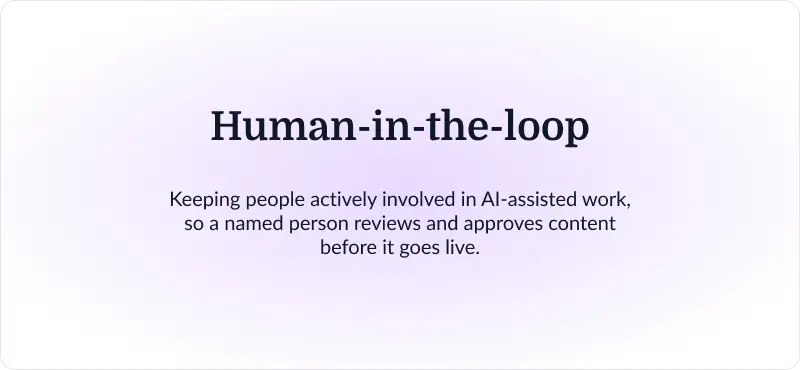
Human-in-the-loop (HITL) in AI marketing means people stay actively involved in your AI-assisted content work. You brief and guide the AI, check what it produces, and approve it before it reaches your audience. The AI handles drafting, resizing, translating, and localizing. A person decides whether the result is accurate, on-brand, and safe to publish.
The term itself comes from machine learning, where people label data and correct model outputs. In marketing it’s more practical: in a human-in-the-loop AI content process, nothing goes live until a named person has reviewed it and signed it off.
A human-in-the-loop AI review process is the part of that workflow where human oversight and judgment are built in on purpose, so it deserves more love than it usually gets.
AI scales your decisions along with your content
When teams plan for AI content, most of the focus is on cranking up output: how many more assets can be produced, how many more markets can be covered. It’s easy to miss that every one of those assets also comes with a decision attached.
Say your team used to publish 40 pieces of content a month and now publishes 200. Your reviewers are making five times as many judgment calls with the same amount of hours in a day.
Production capacity gets planned carefully. You might budget for tools, freelancers, and headcount to make more. Meanwhile, review stays something people squeeze in between meetings, approved from a phone, owned by “the team” and measured only by how fast it happens.
That made sense when review was a small step at the end. But the logic starts to crumble when judgment is most of what your people contribute. If AI is doing more of the making, the quality of your content now depends on your team’s decisions. You get good decisions the same way you get good production: by designing for them, giving people the time and context to do them well, and valuing them as real work.
Human-in-the-loop AI content is supposed to capture this, but in a lot of organizations, it’s become a glorified reassurance phrase. It appears in the AI policy and in vendor decks. Whether the human in that loop actually has the authority, scope, and time to decide is a different kettle of cod.
What happens when you undervalue judgment
When you don’t properly plan for decisions, they tend to bite back in two ways.
The first one is when a file sits for days, waiting for “someone” to sign off.
I chatted to Christina Tadros, our Senior Client Success Manager, about this and she often sees a pattern when looking at customer workflows.
A team appears to be waiting on one person, but it may also be unclear what that person needs to check or whether their approval is required.
Christina Tadros, Senior Client Success Manager in Filestage
If you don’t know where your responsibility ends, approving anything feels risky, so you wait or loop in someone else.
The second sits at the other side of the spectrum. A reviewer is short on time, nothing looks obviously wrong, and they click approve. AI makes this easier to fall into, because a file that one tool generated and another tool checked feels like it’s already been handled.
AI doesn’t automatically clarify who decides. Without clear responsibilities, people may assume AI or another reviewer has already checked something.
Christina Tadros, Senior Client Success Manager in Filestage
The two failures come from the same place. In the first, nobody has been given the authority to decide. In the second, nobody has been given the time or attention to decide well. Either way, there’s a person in the loop, but the decision isn’t really getting made and nobody’s happy about it.
What taking judgment seriously looks like

If judgment is now your team’s most important work, it deserves the same care you put into production. In practice, that comes down to a few principles.
Be clear about who inputs and who decides. Most workflows treat everyone who sees a file the same way. Instead, try grouping your reviewers into three roles: contributors who give feedback, approvers who must sign off on the area they own, and one person who can release the content. When you make that distinction explicit, suggestions stop holding work up, and the people who really are deciding know it.
Give every approver a defined scope. Your brand lead decides on tone and visuals. Your subject matter expert decides on accuracy. Legal decides on claims and disclaimers. A reviewer asked to “check everything” either stalls or skims. If you want a step-by-step setup, our guide to building an AI content review process walks through who checks what.
Bring judgment in when it can still shape the work. If legal only sees an asset once it’s finished, their decision arrives as a rewrite. Let their requirements inform the brief, even if formal sign-off happens at the end. The earlier a decision-maker’s criteria are known, the less rework their decision causes.
Protect your reviewers’ attention for the calls only they can make. Spelling, forbidden terms, missing logos, and broken QR codes don’t need senior judgment. Filestage Review Agents check files before human reviewers are notified, so your people can spend their attention on things like accuracy, tone, and risk. Automated checks like these give your reviewers a cleaner starting point, while the decision stays with a named human.
Measure the quality of decisions alongside their speed. Turnaround time is the metric most teams track. Instead, look at how often approved content has to be corrected after publishing, how often approvals get reopened, and how often files bounce back because nobody knew who had the final say. Those numbers tell you whether your team’s judgment is working.
Make every decision visible. Record who approved which version, in which role, and when. That record protects you when a client, a regulator or your own legal team asks how something went live. It also changes how approval feels to the person giving it. A named, recorded decision is something people take seriously. If you’re building this from scratch, our guide to setting up a content approval workflow is a good place to start.
The teams that get this right will scale faster
More drafts and variants let you test, localize, and personalize in ways that weren’t realistic just a few years ago.
But the more AI makes, the more your results depend on what your people decide. The teams that scale AI content well will be the ones that treat their reviewers’ judgment as the valuable resource it has become, and design their process around it.
If you want to see how Filestage gives your reviewers clear roles, automated pre-checks and a full record of every decision, book a demo with our team.