
Teams are pumping out campaigns, social posts, and ad copy at high speed, often across multiple brands and regions – largely thanks to a little thing called AI.
But it’s not all rainbows and record-breaking launch dates. For every hour saved on first drafts, teams often lose more time untangling factual errors, off-brand tone, and compliance red flags before anything can go live. It can easily happen, considering McKinsey’s 2025 State of AI survey saw nearly a third of respondents report consequences stemming from AI inaccuracy specifically.
This guide is designed for marketing teams and content managers who want to build a more efficient review process for their AI-generated content, so quality stays high without the chaos.
But before we get into the practical stuff, let’s quickly clarify what an AI content review is and how it differs from traditional editing.
What is AI content review?
At its core, AI content review is the process of checking AI-generated drafts for factual accuracy, brand voice, originality, and compliance before anything hits publish. Done right, it gives marketing teams zero doubt that their content is safe to share, along with a clear audit trail showing who checked what.
It’s important not to confuse AI review with AI generation. Generation is simply the automated drafting stage where a model produces text. AI review determines if that draft is actually fit for public consumption, with a human making the final call.
AI content review also goes beyond traditional proofreading. While a standard copyedit focuses on flow, grammar, and typos, an AI content review digs into the foundational integrity of the piece: verifying claims, validating sources, and flagging potential regulatory risks before it ever goes out into the world.
Why AI content review matters for marketing teams
I’m not going to sugarcoat it: if your review process was a little shaky before AI, it’s going to crumble when you add generative tools into the mix.
Instead of reviewing a few assets a week, you’re all of a sudden drowning in drafts across multiple campaigns, regions, and channels. And volume isn’t the only issue you’re contending with.
Reviewing AI-generated content is a relentless test of your teams’ brand and industry knowledge. Because AI sounds like a seasoned pro, it easily hides hallucinated stats, off-brand phrasing, and subtle compliance risks under a cloak of unearned confidence.
Without a structured content review workflow, these mistakes can slip through your teams’ review rounds and onto your live channels. Which is one of the quickest ways to erode your brand’s authority.
On the flip side, if you spend hours eyeballing your AI-generated content for mistakes, you’re wasting all that time you were supposed to save by using AI in the first place.
There’s a better way, so let’s take a look.
How to review AI-generated content before publishing
Balancing speed and accuracy is the key to building a proper review workflow for AI content. A one-and-done checklist isn’t going to hold up, so I’ve put together a simple, repeatable four-step process you can follow for every review.

1. Set explicit standards before you draft
Let’s start at the beginning. Before anyone touches a prompt, turn your brand style guide, compliance requirements, sourcing rules, brand guidelines, and approved terminology into a written checklist. That way, you have a set standard every AI draft gets measured against, not something a reviewer reconstructs from memory every time.
Include specifics like:
- Which claims need a named source before they can publish
- Which terms or phrases are banned outright, including generic phrasing
- What tone reads as on-brand versus off-brand, and how the content sounds against brand standards
- Which topics automatically require legal or subject-matter sign-off
2. Automate the first pass
When your team’s creating large amounts of content, your reviews need to keep pace. A good first step is bringing in an AI review assistant to automate routine checks before manual review, so human editors can focus on higher-value decisions instead of getting stuck in the weeds of routine errors.
That first pass can cover things like :
- Broken links and other mechanical issues before reviewers even open the file
- Running a plagiarism checker on ai generated text for originality and plagiarism
- Banned or unsupported claims, forbidden terms, and missing disclaimers for compliance
- Brand terminology and tone of voice
- Readability and structure
- Image or layout requirements
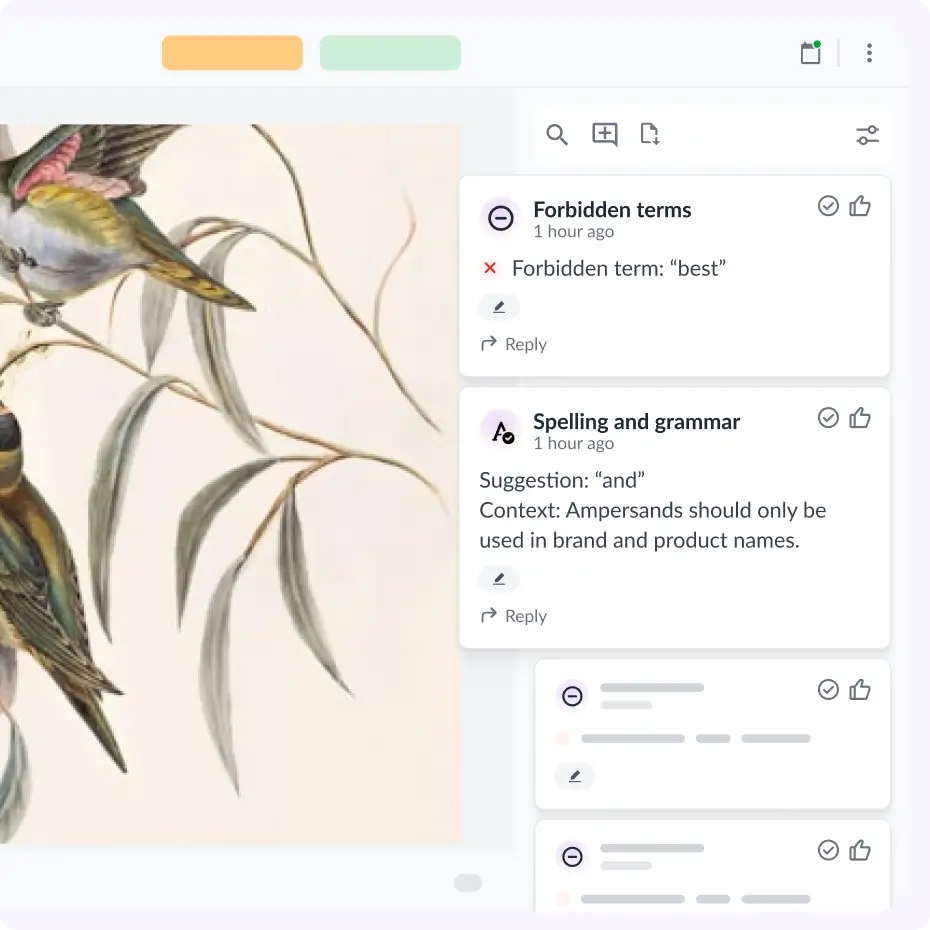
At this point, I want to make it clear that these automated checks aren’t there to replace the reviewer. AI detection and Natural Language Processing (NLP) can analyze AI patterns and writing patterns, but false positives mean the results still need human oversight.
3. Route by risk, not by availability
A social post introducing a new hire doesn’t carry the same weight as a regulated product claim. And your review process should reflect that.
For example, your employer branding social post might need one human review before it goes live, while the regulated product claim needs to move through layers of reviewers built for higher stakes, especially with regulations like the EU AI Act raising the bar for what counts as a properly reviewed claim (here’s what the EU AI Act means for brands if you want the full picture).
Review workflows should classify content by risk before drafting, instead of either slowing everything down or leaving the things that really matter under-checked.
4. Set up a clear review workflow
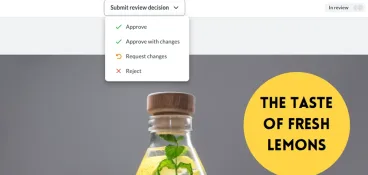
Once standards exist and risk is routed correctly, you’ll want to create a clear review and approval workflow for the review itself, not a chain of forwarded emails.
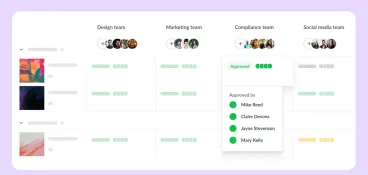
- Every reviewer group, legal, brand, subject-matter expert works within the same process
- Approved content moves automatically to the next group in a pre-aligned sequence
- One place where comments, approvals, and version history live, instead of scattered across Slack, email, and tracked changes
We built Filestage for this kind of workflow. Final sign-off from the last group acts as a final check confirming the content meets the required standards before publication, and leaves a record showing exactly that. Our Business and Enterprise plans also have a set of Review Agents that run automated checks on your content to speed up reviews (see step 2).


“Our content approvals are now much more precise as you can be more specific about the content’s details and make your comment on-the-spot.”
Supercharge your marketing reviews
Share, review, and approve all your content in one place with Filestage.
Common mistakes in the AI content review workflow to avoid
AI review mistakes happen, especially when content scales and our time gets squeezed. I’m sharing a few common culprits we see time and time again, so you can share them with your team and avoid them in future reviews.
Treating fluency as accuracy
Confident, well-structured AI-generated writing often gets waved through review because it reads well. But AI models can produce incorrect assessments referred to as hallucinations. For example, a paragraph with clean grammar and no typos can still contain a made-up statistic or a product claim nobody approved.
Reviewing tone only
Sounding on-brand and actually being accurate are two different things (and the stakes are higher for the second one). A TOV check on its own was never built to catch a factual error or a compliance risk.
Skipping review because it “sounds right”
Deadline pressure can make “this seems fine” feel like enough, especially on content that looks low-stakes. But skipping review on that assumption is exactly how small errors reach customers, and these can quickly damage brand credibility.
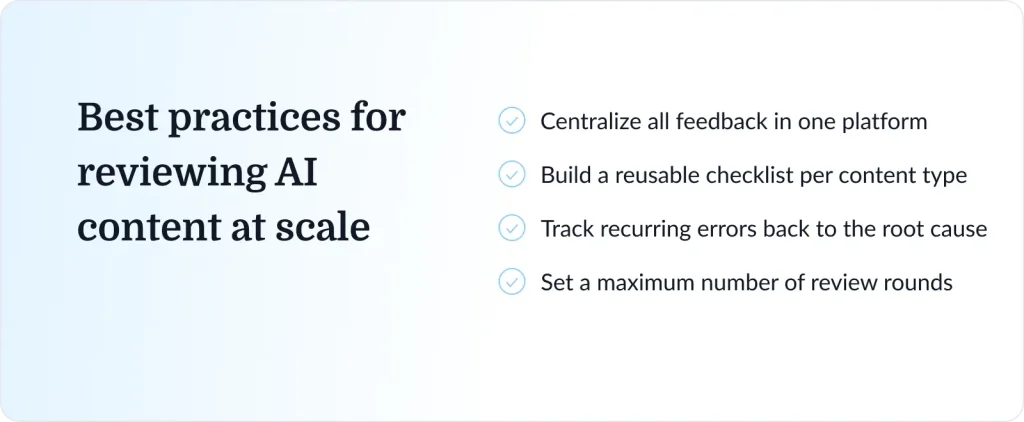
Best practices for reviewing AI content at scale
By now, you have almost everything you need to build a solid AI review workflow. But before you go, let’s put the cherry on top with a few best practices to keep your reviews running smooth no matter the scale.
Centralize all feedback in one platform
If your review is scattered across comments in Slack, edits tracked in a Word doc, and an approval buried in an email thread, things will move slow and mistakes can easily slip through the cracks.
To avoid this kind of chaos, run your reviews in one place from start to sign-off using content governance software. That way, every scrap of feedback gets picked up and stays tied to the exact file and version it belongs to.
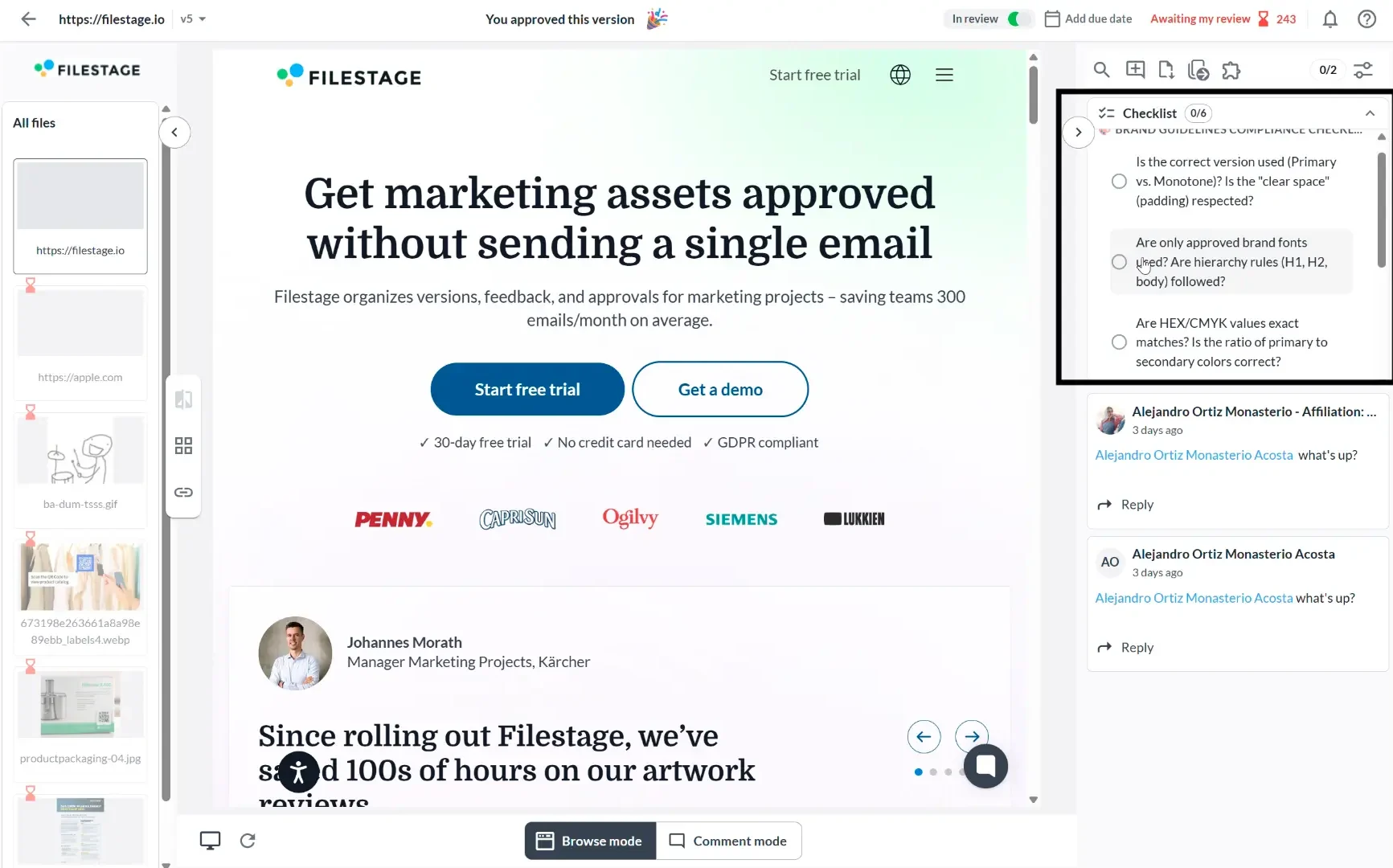
Build a reusable review checklist per content type
Each type of AI writing needs to be judged against a different list of criteria. For example, a blog post lives or dies on sourcing, while a product page relies on accurate pricing and compliance language.
Build a distinct checklist for each content type matched to where that format usually breaks. This works as a tool for factual correctness and content quality instead of running one generic pass over everything and hoping it catches issues it was never built to catch.
Track recurring errors back to the root cause
If your reviewers keep catching the same mistake, you’re throwing resources down the drain every time.
A simple fix is to log what keeps coming up (a banned phrase that keeps coming up, a stat your team keeps flagging as unsourced, that kind of thing). It’s worth building a shared prompt library while you’re at it. Save the prompts that reliably produce on-brand drafts, so your next round of review isn’t catching the same problem all over again.
Set a maximum number of review rounds
It can be tempting to review a piece of AI-generated content to death. But not only is this a massive waste of time, it rarely results in a great outcome.
Cap how many rounds a draft can go through (three’s a solid default) before someone with the authority makes the final call. I’m not telling you to cut corners here. It’s about keeping your reviews lean and focused, so quality work gets across the finish line without too much back-and-forth.
Final thoughts
AI can produce reams of content in a matter of minutes. But it can’t tell you if what it wrote is actually safe to publish. That responsibility sits with the brands using those AI tools.
Properly reviewing your AI content means setting clear standards up front, using automated checks doing the first pass, routing risks to the right reviewers, and keeping everything logged in one place instead of scattered across five tools.
If you’re working out where the EU AI Act fits into all this, our EU AI Act checklist for marketing teams covers the practical steps, including an AI label checker for your own content.
Thanks for reading! I hope this article helps you make the most of your AI-generated content. And if you’d like to see how Filestage can keep all your content reviews on track and on record, start a free trial today.
FAQ
Still got questions? Below you’ll find some of the most common queries we get when it comes to AI content reviews.
What is an AI content reviewer?
An AI content reviewer is the person or process that checks AI-generated content for accuracy, brand voice, and compliance before it publishes. That might be a team member doing a manual check, or a workflow combining automated checks with human judgment.
Does AI-generated content need the same review process as human-written content?
Not exactly, it needs more scrutiny in some areas. AI models can fabricate statistics or sources and make unsupported claims with total confidence, so AI content review should include a dedicated fact-check step alongside the usual brand and compliance checks.
Who should be responsible for reviewing AI content in a marketing team?
It usually spans a few roles rather than one person. A content or brand lead checks tone, a subject-matter expert or legal reviewer checks facts and compliance risk, and someone with the authority to approve makes the final call.
How do you review AI content for factual accuracy at scale?
Document a named source for every claim or statistic before it goes into a draft. Automated checks catch banned terms and obvious pattern issues, but a human still needs to verify facts against an approved source, and proprietary source access helps keep claims correct before anything is published.
Should AI-generated content always be reviewed by people?
For high-risk, customer-facing, or regulated content, yes, especially with the EU AI Act tightening its rules around content governance. In practice, many teams use automation for low-risk steps while reserving manual review for the pieces where errors would matter most.
What tools help marketing teams manage AI content review across departments?
Look for content review tools that centralize comments, approvals, and version history in one place, so feedback from different reviewers doesn’t get lost across email and Slack. Some also automate checks before reviewers step in. That’s the kind of workflow Filestage supports out of the box.
Are AI detection tools reliable?
They can be useful as a signal, but they shouldn’t replace review. Detection tools can still produce false positives, so they’re best used as one input rather than a final decision.