Apple has sold over two billion iPhones. But there’s a stat that impresses me even more. 28.8% of buyers keep their Apple boxes forever and 59.5% keep them until they replace their phone.
Is it because resale value is higher with the box? Probably. But it’s also because of the psychology and marketing genius behind Apple’s packaging strategy.
That’s what I’m unpacking today. Keep reading to learn:
- How Apple uses the human brain to create boxes we can’t bring ourselves to part with
- Six packaging design strategies you can steal and the science behind them
- Apple packaging examples I love
First up, let’s get inside the brain of Steve Jobs.
Apple’s packaging: Where it all began …
If you’re an Apple fan, you’ve probably already heard the fence story. But just in case, I’ll remind you since it sets the stage for Apple’s packaging strategy.
Paul Jobs was Steve’s adopted father. One day, when they were building a fence, Paul gave Steve the following advice:
“You got to make the back of the fence that nobody will see just as good looking as the front of the fence. Even though nobody will see it, you will know and that will show that you’re dedicated to making something perfect.”
It’s a lesson that stuck with Steve, and later became the driver behind one of Apple’s main marketing principles: perfect packaging.

What’s the Apple Marketing Philosophy?
Mike Markkula was Apple’s original investor and the second CEO. He also wrote the now-famous “Apple Marketing Philosophy”.
Here’s a summary:
Empathy
Develop a deep understanding of customer needs, desires, and pain points:
“We will truly understand their needs better than any other company.”
Focus
Focus on a limited number of products and marketing strategies to achieve excellence.
“In order to do a good job of those things that we decide to do, we must eliminate all of the unimportant opportunities.”
Impute
Create a strong brand image through exceptional design, customer experience, and storytelling.
“People DO judge a book by its cover. We may have the best product, the highest quality, the most useful software etc.; if we present them in a slipshod manner, they will be perceived as slipshod; if we present them in a creative, professional manner, we will impute the desired qualities.”
Six Apple packaging strategies to steal (with examples)
Now you’ve got the backstory, it’s time to dissect Apple’s packaging strategy and what your brand can learn from it.
1. Never cut corners
Obviously, no brand wants to make mistakes or take shortcuts with its packaging design process. That said, many underestimate the power of product packaging.
Not Apple.
Back in 1984 when Apple launched the Macintosh, Steve Jobs’ team suggested using a plain box to ship the product. It was cost-effective and simple. A no-brainer, right?
We all know that’s not what Jobs decided to do. Instead, he followed the “impute” principle and decided to create a box that reflected the quality of the computer inside (full color, of course).
And as you can see in the image below, Apple has continued to impute ever since.

The lesson
Sure, you may not have Apple’s budget. But that doesn’t mean you should scrimp on packaging quality.
Think like Apple and consider every detail of the boxes you use, including:
- Placement of the product image
- How the product is arranged inside the box
- The size and shape of the packaging
- If there are any distracting or unnecessary elements
- How easy (and satisfying) it is to open
And remember, great design is as functional as it is visually appealing.
Get organized with our 11-step packaging design process
7-in-10 customers say packaging influences their buying decision, but you need a solid process to make your project a success.
2. Stimulate all the senses
Jony Ive was Apple’s former head designer and is often touted as being the genius behind Apple’s packaging.
His appreciation of packaging is clear in this statement from Ive:
“Steve and I spend a lot of time on the packaging. I love the process of unpacking something. You design a ritual of unpacking to make the product feel special. Packaging can be theater.”
Stories say that Apple dedicates thousands of hours to perfecting the iPhone box. Other stories reveal there’s a “packaging room” in Apple HQ where employees spend months opening prototypes to find the perfect experience.
Apparently, the brand even considers how long it takes for the suction to release the top of the iPhone box.
In his popular article, Read Trung points out how Apple packaging uses the psychological phenomenon of “synesthesia”. This principle shows how human beings react positively to experiences that stimulate multiple senses.
Like the Apple unboxing experience.
A quick YouTube search will uncover a host of videos of people unboxing the latest iPhone. And these videos have billions of views. Why? Because there’s something strangely satisfying about the unboxing experience.
The lesson
I’m not suggesting that you lock your lead designer in a room for months and make them test hundreds of prototypes. Buutttt … I am suggesting that you look at your packaging with a new lens.
A robust packaging review workflow can help you nail this. Start by using packaging design software to review your materials and spot any potential issues.
Once you’ve approved the final design, factor in time to test the prototype.
How does it feel? What emotions come up as you open the box? Where is there friction? How can you make unboxing your product a more tactile and memorable experience?
Your packaging approval process isn’t just about spotting typos or errors, it’s also an opportunity to consider these questions.
3. Treat packaging as part of the customer journey
For Apple, the customer journey starts the second you walk into one of its stores or land on a product page.
The process of buying and unboxing an Apple product is also an integral part of the customer experience.
As we’ve seen from the unboxing videos, opening your Apple packaging is part of the story. It’s exciting. It’s experiential. It reflects the brand values.
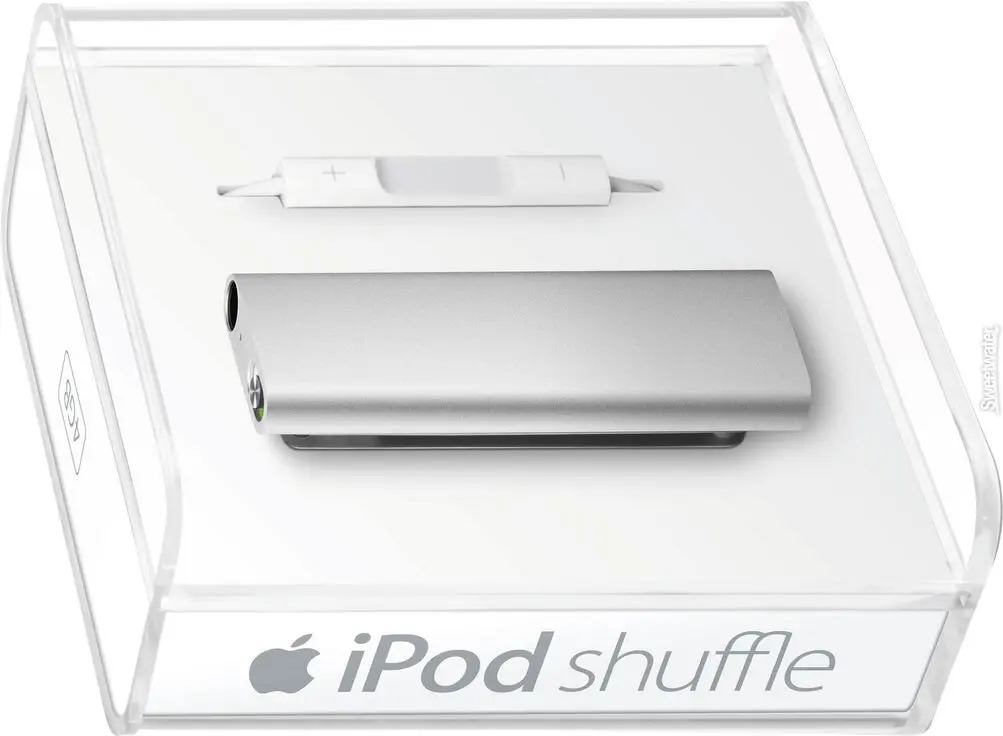
Let’s look at the iPod boxing.
In a patent application, Apple states:
“It may diminish from the aura of a well-designed product to present it to consumers in a standard cardboard box. A package that is more fitting of the high-tech design of the product is what consumers expect.”
So instead, the iPod Shuffle ended up in this sleek box design that gives consumers the experience they’ve come to expect from the brand.
The lesson
Start viewing your packaging as a key step in the customer journey. Just as you optimize your website’s UX and the customer experience in your stores, take that same level of care with your product boxing.
Make unboxing smooth, intuitive, and aligned with your brand identity.
4. Consider human psychology
I promised you science, and here it is.
Apple’s packaging plays on a number of psychological principles. So, let’s take a look at some of them.
Desire and anticipation
A famous psychological experiment told people to imagine they had won something (a prize, tickets to a show, a smooch from their favorite celebrity, etc.). The psychologists then asked people when they wanted to receive their prize: right away, in a week, or in a year.
Interestingly, most people chose to get their prize in a week.
This experiment says a lot about the concepts of desire and anticipation. While we live in a society of “instant gratification”, Apple knows that people enjoy the anticipation and buildup of desire almost as much as the payoff.
A fascinating study backs this up. It found that consumers get more excited (and have more anticipation) before experiential purchases compared to material ones. They also report higher levels of post-purchase happiness.
Color psychology
We all know how important color theory is. Your brand colors play a huge role in telling your story and evoking certain emotions from your audience. But don’t stop there. Think about what emotions and connotations the color of your packaging evokes.
For example, Apple uses clean white boxes. Is this a coincidence? Nope.
According to color psychology, white symbolizes purity, simplicity, and safety. It also signifies space. White could be too sterile for some brands, making it hard for consumers to connect. But it’s the perfect choice for Apple.

Social comparison
Social comparison theory is the idea that people evaluate their own self-worth or value by comparing themselves to others.
So, when you see your colleague has the latest iPhone, you want it too. Apple products are a sign of status. They separate you. They allow you to align with other people you believe share your status.
That’s why every element of the brand, including the box, needs to convey a sense of quality and prestige.
The lesson
You don’t have to be a psychologist or behavioral scientist to make design choices that rewire the human brain. Work with your designers and brand specialists to visualize the experience you want consumers to have when they open your product.
Then, test your prototypes to make sure you deliver. Playing into common theories like desire and anticipation or social comparison can help you find a design that elicits an emotional reaction from your customers.
Are you an Apple aficionado? Dig into its winning brand strategy.
5. Create a collectable item
While browsing on the r/Appleboxes subreddit (yes, there are literally channels dedicated to Apple’s packaging), I found one fan’s stellar collection of boxes.
It struck me just how genius Apple’s packaging strategy is. Its boxes are collectible items that people are proud to show off and spend big money on.
By playing into our collective love of collecting items, it secures brand loyalty and next to no customer churn.
The lesson
Make your packaging so appealing that it becomes a keepsake your customers want to hold onto. I’m talking custom boxes with meticulously designed finishings.
Easier said than done, I know. But that should be the goal.
If you’re hungry for more, check out these juicy Apple ads.
6. Consider packaging materials
Apple boxes are known for a few things:
- Sleek, minimalist electronics packaging design
- Premium materials – Apple’s pulp inlays and magnetic closures are top quality
- Precisely designed, full-cover rigid boxes
In recent years, the brand has also moved towards more sustainable packaging materials.
The Apple Watch packaging is a great example.
To reduce the use of plastics and lower its environmental impact, Apple has introduced 100% fiber-based packaging materials.
Check out this Apple Watch unboxing video.
The lesson
Your brand probably doesn’t have Apple’s resources. Fortunately, small and medium-sized businesses can still recreate Apple-like packaging.
Start by finding a signature hallmark. What makes your brand unique? How can the packaging mirror this?
Next, consider your packaging materials. What works best for your product? Your brand? Your sustainability values?
What matters is that your packaging matches your product branding.
If you’re a luxury brand, custom boxes in premium materials make sense. For instance, Apple boxes have a pulp inlay, foam insets, and magnetic closures for a premium feel.
Get organized with our 11-step packaging design process
7-in-10 customers say packaging influences their buying decision, but you need a solid process to make your project a success.
Wrapping up
Have you ever noticed that when you buy Apple products in the store, the staff hand you the box to open? Even if they’re going to set it up for you? There’s a reason behind that.
Apple uses human psychology and UX design principles to turn packaging into a marketing tool. A simple white box is now a collectible item. A symbol of status. And an integral part of the customer experience.
If you want to invest in custom packaging design that turns buyers into brand loyalists, it all starts with a proper creative review and approval process.
This allows you to spot errors and inconsistencies, guaranteeing your customers the best unboxing experience possible. Maybe even video-worthy.
Grab a free seven-day Filestage trial today to build a winning packaging design process.