TL;DR
Client feedback helps you align work with expectations and secure project approvals. Customer feedback reflects how real users experience your product or service, including their needs and pain points. The strongest teams treat both as extremely valuable and build a customer feedback strategy that uses qualitative and quantitative data. They use the feedback loop to turn feedback data into actionable insights, improve customer satisfaction, and push the business forward. Over time, that drives continuous improvement, customer success, and customer loyalty.
Why client and customer feedback is the fastest way to improve what you ship
The first step in creating a new product or service is generating a great idea and executing it.
But once you’re up and running, you need a way to make sure you’re giving people what they really want. Qualtrics XM Institute found that only 31% of consumers sent feedback directly to a company after a very good experience, and 32% did after a very poor experience. In other words, if you don’t ask and make it easy, most people stay silent.
That’s where client and customer feedback come in. By taking this feedback to heart, you can create products, services, and content that people love!
So let’s dive into the specifics of client and customer feedback and see how a client feedback tool makes both processes more effective.
What is client feedback?
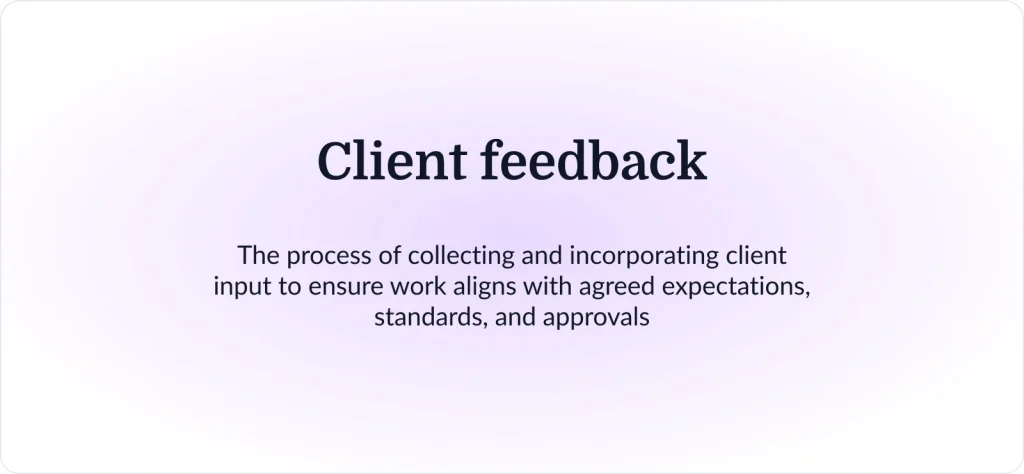
Client feedback focuses on aligning your vision, ideas, and concepts with your client and ensuring the project meets specific standards. This may involve adhering to brand guidelines or obtaining approval from legal and compliance departments.
Anyone working with clients has two seemingly simple goals: keeping the client happy while amazing them with their ideas and projects. But this process is far from smooth, and securing client approval can be a long, bumpy road.
No matter the project, always collaborate with your clients and seek their feedback to deliver your best work.
Five reasons client feedback is important
The first time you show your work or a concept to your client can be a scary moment.
Despite following the brief, you’re always a little bit in the dark about how they’ll react to your work. But by viewing your clients as a source of knowledge or a doorway to their brand, you can make your work even better.
Here are five ways client feedback can help you and your team:
- Make sure creative concepts meet the brief
- Check that product descriptions are accurate
- Get approval from legal or compliance
- Resolve problems faster
- Absorb knowledge from brand and product experts
Is poor communication losing you time (and accounts)?
See how top agencies cut feedback costs and roll out campaigns 30% faster with our client feedback tool.
What is customer feedback?
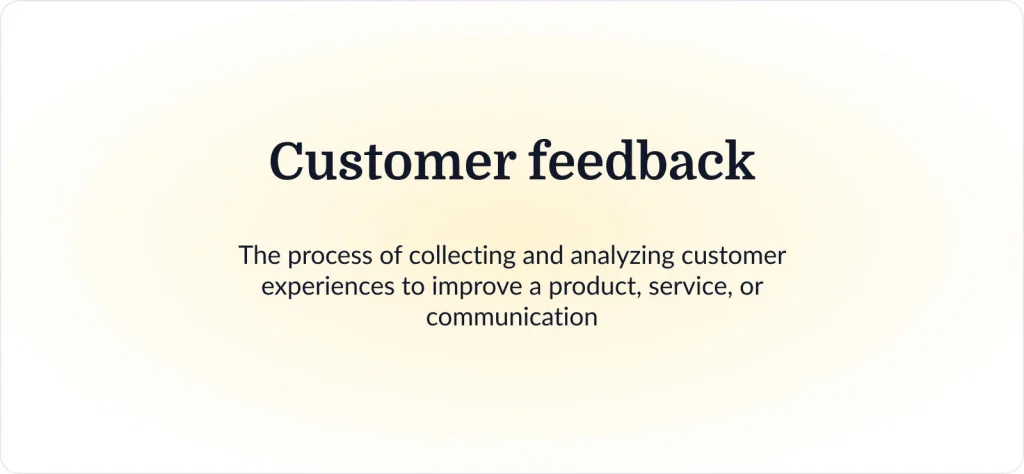
Customer feedback is about learning from your customers’ experiences to improve your product, service, or communications. While equally important as client feedback, customer feedback has entirely different goals.
Both you and your client can easily get stuck on the production side and forget how your users will actually interact with your product, design, or service. Customer feedback has the power to make you stop for a second, reach the “aha moment,” and make some vital improvements.
Five reasons customer feedback is important
How many times have you worked hard on something only to find that it doesn’t resonate with your customers?
By making customer feedback an integral part of your review process, you can reduce that stress.
Here are five ways customer feedback can help you:
- Make sure your content resonates with your target audience
- Fix usability problems with your product
- Enhance the customer experience
- Expand your customer base
- Make better business decisions
Finding the sweet spot between client and customer feedback
I know what you’re thinking. How do you strike a balance between creativity, client expertise, and customer insights?
That, my friend, is the million-dollar question.
That’s why great products, services, and communications are the champions in balancing these three forces.
Here are some things to look out for when finding the sweet spot between client and customer feedback.
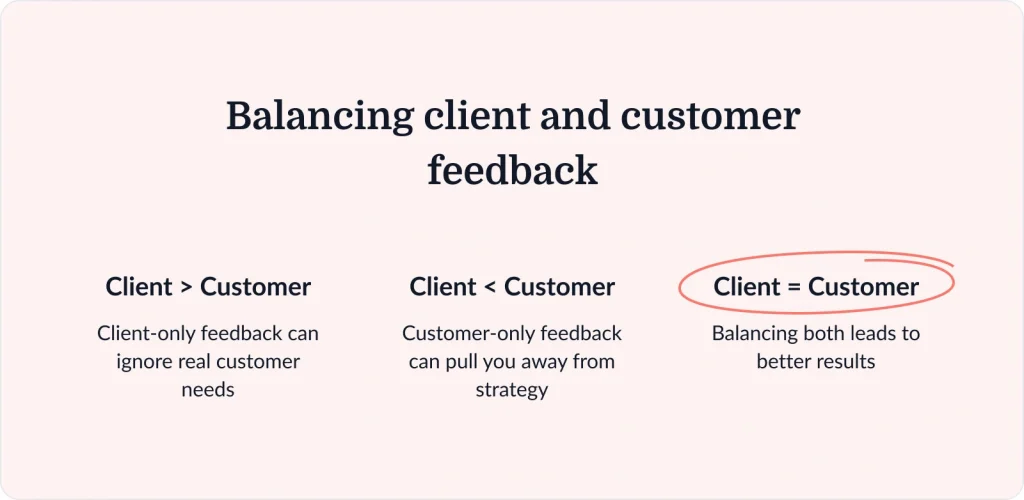
If you only listen to client feedback, you may forget about your customers
One of the most important things when working on a project is keeping customers in mind. Whatever you’re working on, only listening to your clients puts you at risk of forgetting about the people that matter most – your customers.
Balancing client wishes with customer satisfaction is always tricky. But you should never compromise customer experience solely to feed your client’s ego by implementing their ideas.
If you only listen to customer feedback, you may miss your company’s goals
As much as only listening to your clients can lead to poor results, the same goes for focusing too much on customer feedback.
No matter how useful it can be, customer feedback can also be a distraction, pushing you to focus on new features or key messages that don’t align with your company’s strategy. If you follow every customer’s wishes, you risk spreading your team too thin and missing the targets that have already been set.
Use both client and customer feedback to create the best products, services, and communications
Like everything in life, the key is finding the right balance. Trust your strategy and your client’s experience, and reach out to your customers for help. Then put it all together to create something you can truly be proud of!
With a client feedback system like Filestage, you can share your work with clients and customers simultaneously and use both to improve your product.
Three ways a client feedback system can help
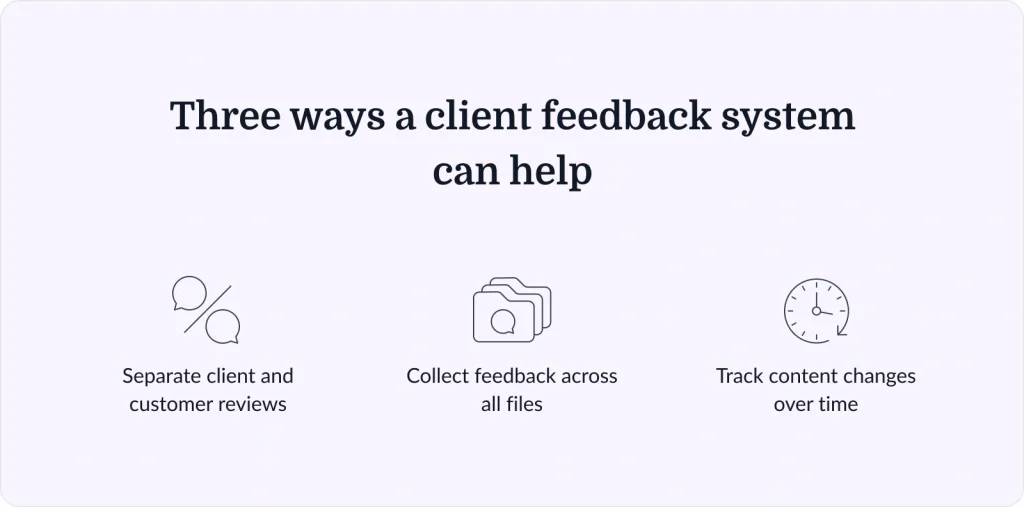
Think collecting feedback is more trouble than it’s worth? Think again!
Here are three ways Filestage helps you manage feedback from clients and customers – all in one place.
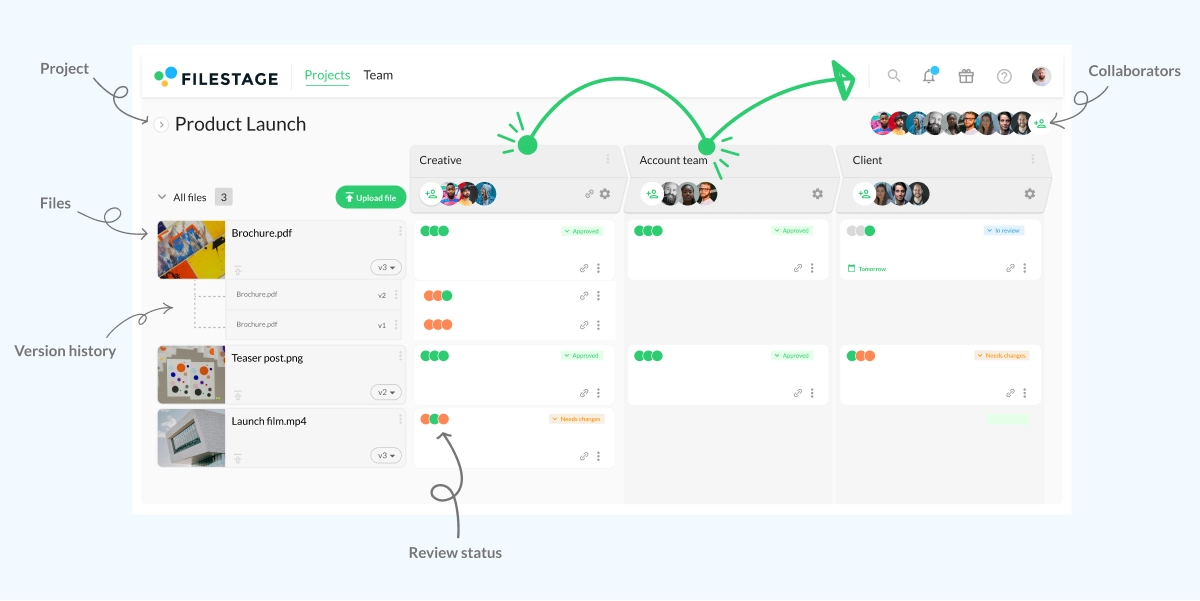
1. Create separate review steps for client and customer feedback
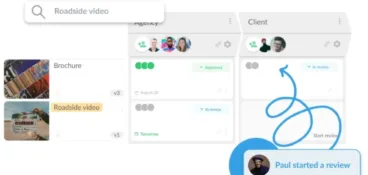
With Filestage, you can create separate review steps for your clients and customers. Then you can invite them to provide feedback directly on your content. That way, you can ask your clients for feedback and gather customer reviews all at once.
By adjusting the settings in your review steps, you can request client approval while collecting feedback only from your customers.
2. Get collaborative feedback on any file format
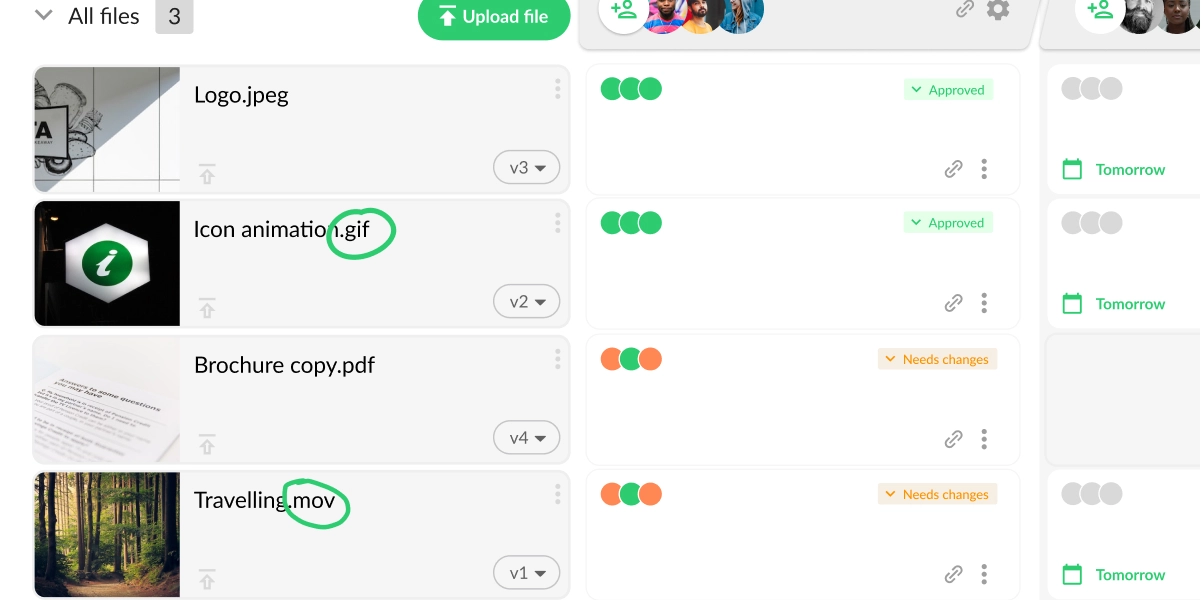
In Filestage, you can collect feedback on top of almost any file format. Because all compression is handled in Filestage, you can simply drag and drop your files into your project dashboard.
This includes:
- Videos
- Images
- Designs
- Documents
- PDFs
- Live websites
- Interactive HTML
- Audio
Once you upload your file, the reviewer can simply point and click to add a comment. You and your reviewers can then reply, post emojis, and attach files to keep all your discussions in context.
Is poor communication losing you time (and accounts)?
See how top agencies cut feedback costs and roll out campaigns 30% faster with our client feedback tool.
3. See how your content has developed over time
There’s nothing more satisfying than watching your content develop over time. With each version and review round, your content quickly transforms from concept to masterpiece.
Filestage has built-in version management for all your file formats, so you can quickly jump back to previous review rounds to see how far you’ve come. With our side-by-side comparison feature, it’s easy to confirm that new versions address your feedback as well.

Final thoughts
Creating great content, products, and services is no walk in the park. But when you include client and customer feedback in the process, you increase your chances of success.
To see how easy it is to manage client and customer feedback in Filestage, start a free trial →
FAQ
1. Why do client feedback and customer feedback create different types of value?
Client feedback protects delivery quality and the client experience. It helps teams avoid rework and stay aligned throughout the creation and approval process. That’s the importance of client feedback in project work.
Customer feedback protects the overall customer experience. It helps you understand how many customers respond in real life, spot pain points early, and make product improvement decisions that increase customer satisfaction.
2. What does a “good” feedback loop look like when you use both?
A strong feedback loop is simple. You collect feedback, translate it into decisions, and follow up with tangible improvements. It includes positive feedback and constructive criticism, not just complaints. It also separates actionable feedback from opinions. That structure helps the team make informed calls and creates a competitive advantage over time.
3. What should a customer feedback strategy include beyond surveys?
A clear strategy uses multiple channels. Surveys matter, but so do customer support interactions, tickets, and patterns in a support channel like chat or email. Add in-app surveys for real-time feedback when the context is freshest. Combine survey responses with qualitative feedback to better understand customer needs. Pair that with quantitative data, such as usage trends and Net Promoter Score, to spot trends and gain a clear picture.
4. Which client feedback questions lead to valuable insights, not vague answers?
Use questions that force specifics, such as:
– What almost stopped you from moving forward?
– What did you expect to find but didn’t?
– What would make this easier to understand or approve?
– What’s one thing we should change first?
– What should we keep exactly as it is?
– Is there anything that feels off-brand, unclear, or risky?
– Can you share a quick example of what you mean?
This is how you gather feedback that yields actionable insights rather than noise. These also serve as client feedback questions when you’re seeking feedback on deliverables.
5. How do you handle unhappy customers in a way that builds loyal customers?
Start with speed and clarity. Acknowledge the support experience, take on board negative feedback, confirm what will happen next, and set a short timeline. Then route feedback data to the product team so it can become product improvement or new features when it makes sense. Close the loop with a follow-up so customers see progress. That is how you turn feedback into trust, stronger relationships, and customer loyalty.
6. How can you collect client feedback and customer feedback without mixing goals or slowing the project down?
There are a few ways to do this, but the core rule is the same: separate the two feedback streams and define what each one is for. When collecting client feedback, focus on whether the work meets the brief, brand guidelines, and approval requirements. For customer feedback, focus on how people respond and where the experience breaks down.
To keep it clean, set up separate review workflows with different questions and outcomes. For example, when you’re getting client feedback, ask for approval or specific changes. That’s often the easiest way to ask for client feedback in a way that stays focused. At the same time, you can collect customer reactions to key features, clarity issues, and pain points through research or product feedback tools. Pair that with quantitative feedback where it helps, like quick ratings or a simple “would you use this?” score, so you can compare themes without guessing.
With Filestage, you can run structured review workflows with clients, keep comments tied to the exact file, and avoid scattered feedback across email threads or chat messages. It also makes it easy to involve the right stakeholders at the right time, so clients can respond without friction. When client feedback stays organized and transparent, you move faster, build trust, and strengthen relationships.