
We seem to have reached this status quo where everyone is using Slack, Teams, and the odd email and video call to communicate and collaborate. But true digital collaboration goes beyond using these standard collaboration tools. It’s about leveraging advanced tools and strategies to take things to a whole different level.
From project management to review and approval, there are specialist digital collaboration solutions to suit just about every use case. These top-tier tools are designed to help team members collaborate seamlessly, regardless of time zones and geographical boundaries.
In this guide I’ve narrowed it down to the seven best digital collaboration tools to help you achieve god-tier digital collaboration in 2025. I’ve covered a range of use cases so that you can pick the tool (or tools) that would benefit your team the most.
But first …
What is digital collaboration?
Digital collaboration is all about harnessing the power of technology to work together effectively, no matter where you and your team are all based. It encompasses a wide range of tools and platforms – such as video conferencing software, project management apps, shared digital workspaces, and communication tools – that help teams to communicate, share ideas, manage projects, and create together in real time.
Digital collaboration can help with just about every aspect of team collaboration, including:
- Project management
- Real-time communication
- Brainstorming
- Designing
- Decision making
- File sharing
- Content reviews
- Knowledge sharing
- Document editing
As you can see, its potential is vast. Which is why you want to look beyond Slack and Teams, to elevate the way you collaborate across the board. In the era of remote work, digital collaboration is essential for teams wanting to work flexibly, efficiently, and inclusively.
The benefits of digital collaboration
Digital collaboration isn’t just a workaround for when your team can’t be in the same room. Done right, it can improve on traditional collaboration in almost every meaningful way.
Here are the key benefits that make it worth getting right.
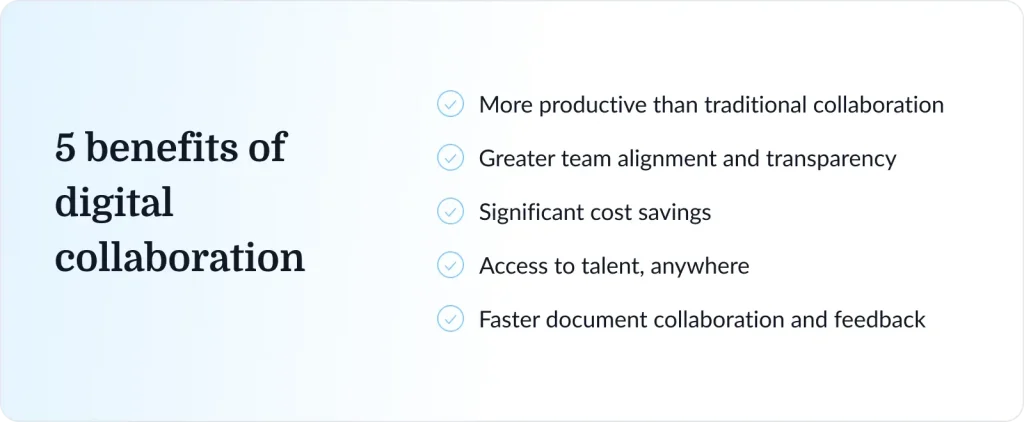
More productive than traditional collaboration
When team members have access to shared workspaces, real-time documents, and collaboration platforms that centralize communication and decision making, work moves faster. There’s less time spent chasing updates or waiting for someone to forward an email, and more time spent on the actual work. Gallup research finds that teams with a formal collaboration plan are 66% more likely to be engaged at work and 29% less likely to experience burnout. The right collaboration platforms make that kind of structure the default.
Greater team alignment and transparency
Progress tracking becomes natural when your work happens in digital platforms. Everyone can see what’s moving, what’s blocked, and who’s waiting on what (without booking a meeting to find out). For cross-functional collaboration across multiple departments, this visibility is a genuine game-changer.
Significant cost savings
Digital collaboration tools reduce the need for in-person meetings, business travel, and the overhead that comes with coordinating globally in person. For global teams and distributed teams, those savings add up fast. Less time in video calls trying to replicate in-person interactions, more time doing actual work.
Access to talent, anywhere
When collaboration isn’t limited by location, neither is hiring. Digital platforms enable hybrid and remote teams to work just as effectively as co-located ones – sometimes more so, because the right tools create the structure that in-person collaboration can lack.
Faster document collaboration and feedback
With the right tools, document collaboration, design reviews, and content approvals can happen asynchronously and at speed. No more waiting for someone to be in the office, or dealing with version control confusion. Just clean, structured feedback from the right people at the right time.
Why digital collaboration often fails
Most digital collaboration doesn’t fail because of bad tools. It fails because of the habits (or lack of them) that teams build around those tools.
It’s worth watching out for these common pitfalls.
Tool overload
Too many platforms, not enough clarity. When teams are spread across one app for messaging, another for project management, a third for file sharing, and a fourth for online meetings, things fall through the cracks. Decisions made in one collaboration app never make it to the others, and team alignment suffers as a result.
Poor adoption and a steep learning curve
New digital tools only deliver value if your team actually uses them. Rolling out new digital tools without proper onboarding or a clear rationale creates a split: some team members use the platform, others default to email, and nothing improves. The learning curve for any new tool needs to be actively managed, not left to chance.
Time zone challenges
For global teams, time zone differences create real obstacles to effective digital collaboration. If your collaboration processes rely on real-time communication for every decision, team members in different regions end up either waiting on answers or being left out. This is one of the biggest reasons digital collaboration across multiple departments breaks down, even when the collaboration platforms themselves are solid.
Lack of clear ownership
Without clear responsibilities and task tracking, even the best tools fail to prevent project delays. Knowing who owns what, by when, is as important as the digital platform you use to record it.
Security and privacy concerns
As teams move more of their work into cloud-based collaboration apps, security and privacy concerns become more pressing. Using the wrong communication platforms for sensitive work, or failing to configure access controls properly, creates real risk. Let alone when multiple users are collaborating on regulated or confidential material.
Version control issues
Without a clear system, multiple users end up working on different copies of the same document. Version control issues create rework and erode trust in the process, undoing the speed gains that digital collaboration is supposed to deliver.
Seven digital collaboration tools for god-tier collaboration
The right digital collaboration platforms make the difference between a team that struggles and one that thrives. These tools cover every key aspect of modern teamwork, from brainstorming and document collaboration to project management and content reviews. This makes them ideal for hybrid and remote teams and co-located ones looking to level up how they work.
1. Collaborate on content reviews with Filestage
Collaborating on content reviews can be challenging. Discussions happen here, there, and everywhere – on email, Teams, and Slack channels. And you’re left trying to piece it all together and make sure nothing’s been missed.
Enter Filestage.
Filestage is a remote collaboration tool that helps you collect feedback on designs, videos, documents, and more. All in one place. You can invite as many people as you like to review your content, and reviewers can see what others have already suggested before leaving their own feedback in a way that suits them.
Any conflicts can be ironed out there and then, and you can keep communicating and collaborating until everyone’s happy.
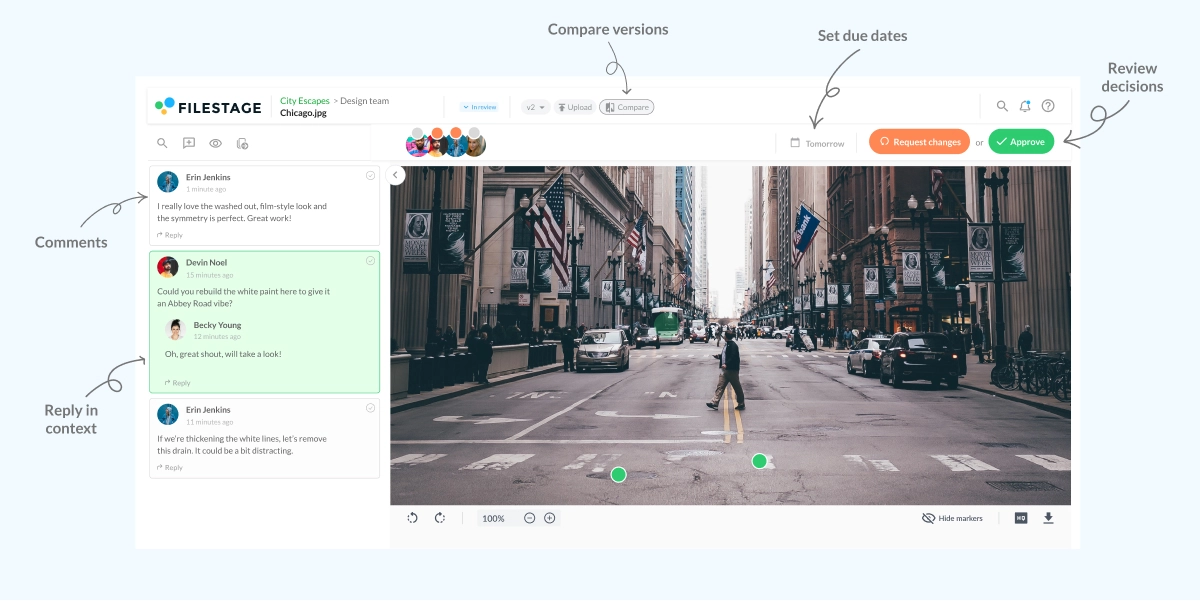
Key features for digital collaboration
- In-context comments – for clear feedback that shows up in real time
- Visual annotations – to bring comments to life and make it clear what needs changing
- To-do lists – to give your team a clear picture of what needs amending
- Compare versions – to keep track of what’s changed
- Version control – to make sure you’re always working on the latest version
- Reviewer groups – to make sure your files get approved by the right people at the right stage of the process
- Due dates – to keep your project on track and moving forward
- Project dashboards – to keep track of who you’re still waiting to hear from
- Automations – to reduce manual tasks and speed up content reviews
- Integrations – with other digital workplace collaboration tools including Dropbox, Slack, Figma, and more
Pricing
Filestage offers different pricing plans, including:
- Free plan with unlimited files, versions, and reviewers
- Basic plan – Starts at $49/month for unlimited users and includes more projects and storage
- Professional plan – Starts at $249/month for unlimited users and includes more storage and complex features like compare versions and automations
- Enterprise plan – Custom pricing (contact sales)
Supercharge your project collaboration
Share, review, and approve all your content in one place with Filestage.
2. Record Looms to save time on meetings
Fatigue from virtual meetings is a real thing. In fact, almost 50% of professionals experience it. And not only can they be draining, too many meetings can also wreak havoc on your productivity, popping up at the most annoying time and breaking your flow.
God-tier collaboration has no room for meeting fatigue and inconvenience. Which is where Loom comes in.
With Loom, you can cut back on meetings and record messages and demos to send to your team instead. Record your screen, face, and voice as you walk your team through a process, explain a roadmap, or clarify why you’ve made a decision.
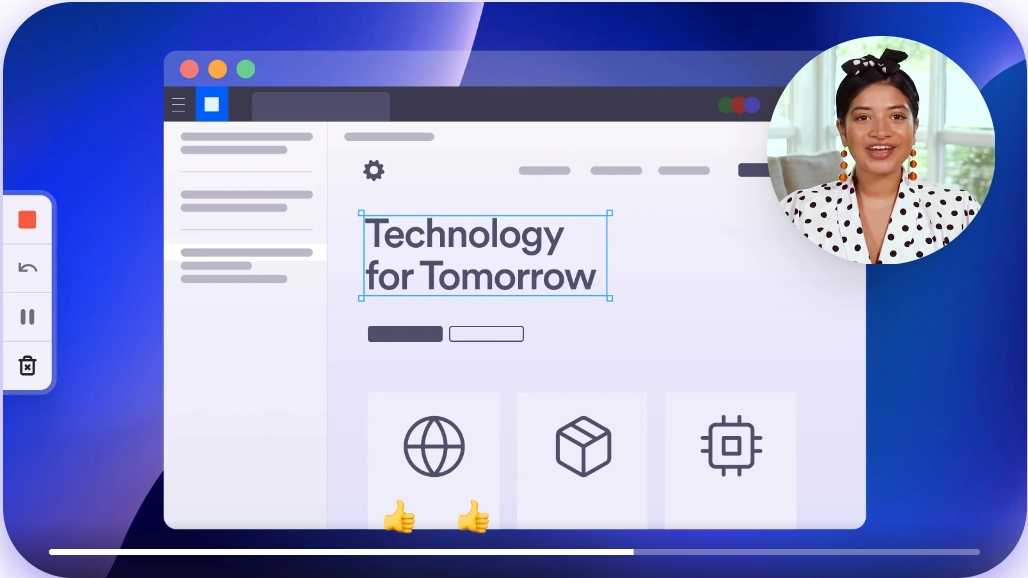
Your team can watch the recording in their own time and at their own pace – without breaking their flow when they’re on a roll.
Key features for digital collaboration
- Record your screen, face, and voice at the same time
- Add links to relevant files and resources for your viewers to reference
- Viewers can add comments and react to your video with emojis
- Automatically save videos to the cloud and share them instantly with a link
- Watch content in double speed to get information faster
- Get notified when someone views, reacts, or comments on your video
Pricing
There’s a free version, or paid plans with advanced features start at $12.50/user per month.
3. Host digital brainstorms with FigJam
One of the biggest challenges for remote teams is brainstorming and workshopping. It’s hard to bounce ideas off each other when you’re not all in the same room, with a physical whiteboard to scribble, plan, and organize your ideas on.
Until you introduce a god-tier digital collaboration tool like FigJam, that is.
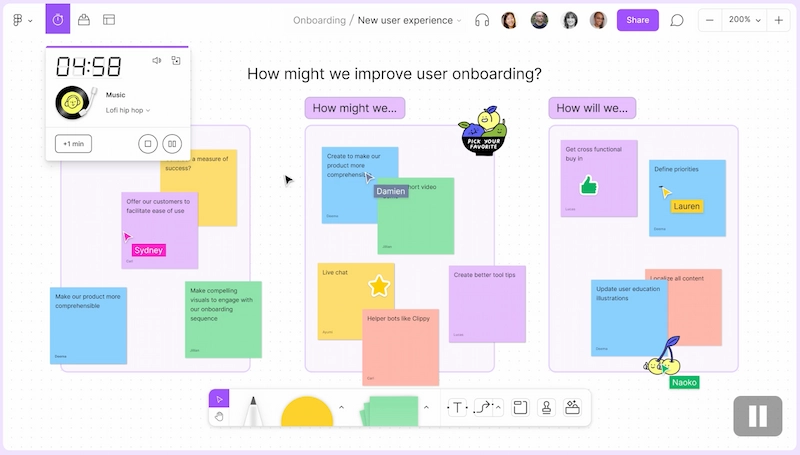
FigJam, created by Figma, is an online whiteboard tool designed to help remote teams collaborate in real time. It’s the ideal tool for brainstorming, mapping out ideas, and project planning, particularly if you’re part of a creative team.
You and your team can use its virtual whiteboards to bounce ideas off each other visually, with loads of features to make digital collaboration as effective and as seamless as possible.
Key features for digital collaboration
- Collaborate with your remote team in real time
- Jot down ideas and feedback on moveable sticky notes
- Sketch out ideas to show exactly what you mean
- Add flowcharts and design diagrams for structured planning
- Communicate with comments and emoji reactions
- Add audio files to quickly explain designs and talk through ideas
- Make the most of templates to jumpstart the digital collaboration process
- Integrate with Figma and other popular digital collaboration tools for seamless UX
Pricing
There’s a free plan, or paid plans with unlimited FigJam files and advanced features start at just $3/user per month.
4. Centralize your team’s knowledge base with Notion
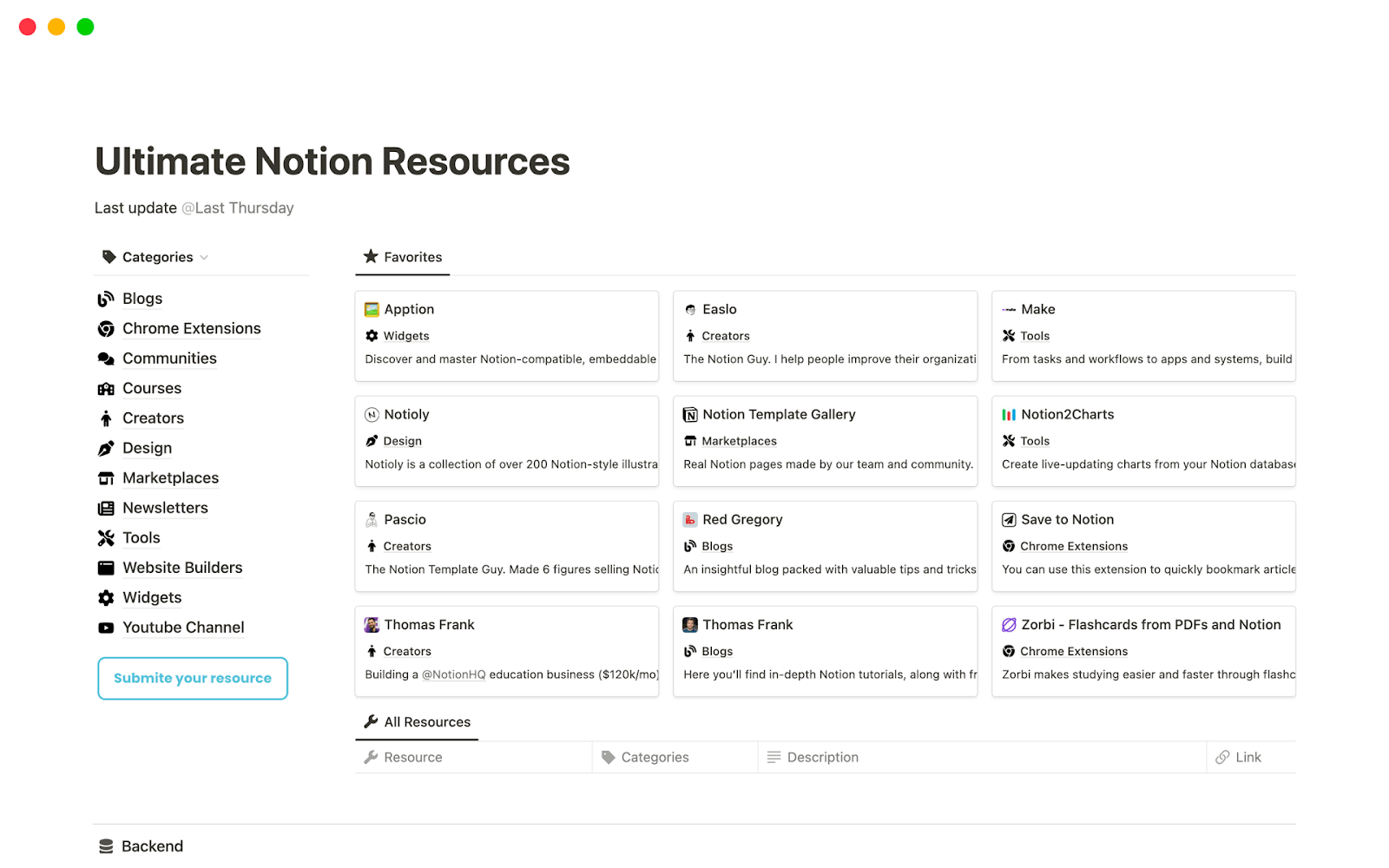
Every team has important documents and info it needs to share with its members – from process documents and brand guidelines to databases and onboarding materials. But without a centralized depot, you’ll find yourself regularly bombarded with requests for these documents.
Notion is a next-level digital collaboration software which helps you store and share this information in one easy-access place. Better still, you and your team can work together seamlessly – in real time or asynchronously – to build up your team’s knowledge base. And everyone can find everything they need without having to ask you to forward emails, send documents, and share links.
Which is better all round, for everyone involved.
Key features for digital collaboration
- Invite collaborators so that your entire team can help keep knowledge up to date
- Customize your wiki to make it work in the way that suits you best
- Choose from thousands of customizable templates for quick and easy setup
- Collaborate and communicate in real time with comments and tracked changes
- View version history to monitor changes and roll back to previous versions if necessary
- Embed content from other services, such as Google Workspace and Figma
Pricing
There’s a free plan for individuals and a free trial for teams. Paid plans start at $8/user per month.
5. Use Figma for digital collaboration on design work
Collaboration is a fundamental part of any creative project. And when you and your team are working on a design at different times and from different locations, you need a digital collaboration tool that helps you to work together, bounce ideas off of one another, and problem-solve with ease.
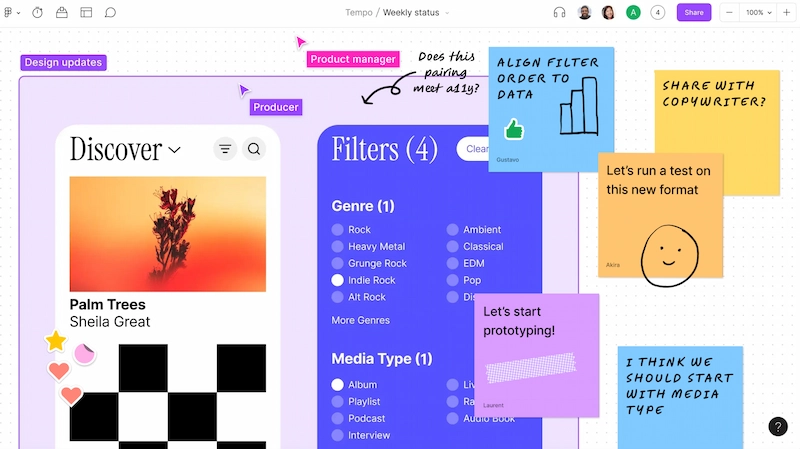
Figma is a next-level design collaboration tool that allows creative teams to co-design at the same time, with features like real-time editing, commenting, and version history tracking. Changes and comments appear immediately, for god-tier digital collaboration.
It’s highly customizable, easy to use, and a must-have for design teams working on graphic designs, wireframes, UI projects, and prototypes.
Key features for digital collaboration
- Collaborate on designs with your teammates in real time
- Access your designs from anywhere and on any device
- Add in-context comments and tag your teammates for clear communication
- View version history to keep track of changes and revert to previous versions if needed
- Create and share customizable and reusable design systems for consistency in your designs
- Integrate with other digital collaboration tools like Filestage, FigJam, and Google Workspace
Pricing
There’s a free version, or paid plans with advanced features start at $12/user per month.
6. Keep your team in sync with Asana
A fundamental part of digital collaboration is staying organized and keeping everyone aligned on projects. Without good project management, it can be hard for team members to see the bigger picture. Which can result in crossed wires, endless update requests, and all-round chaos.
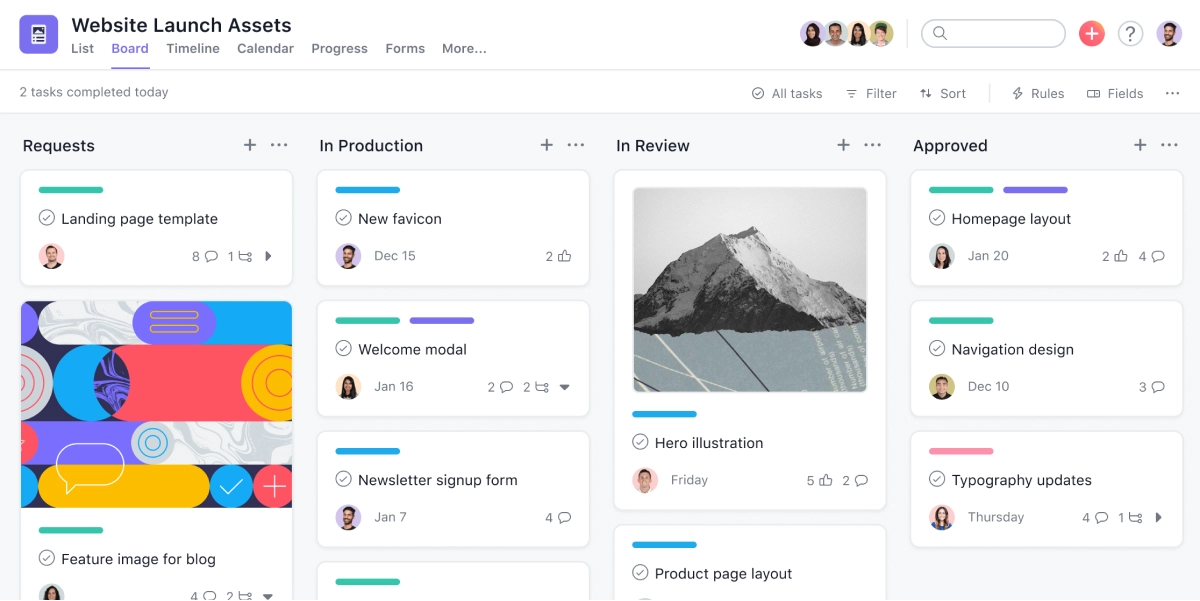
Digital project management tools like Asana make it easy for you and your team to manage and organize projects, processes, and tasks. Asana helps you and your team to build workflows, communicate deliverables, and track progress. And it gives everyone visibility over what’s what.
Everyone knows what each person is tasked with, when those tasks are due, what the big goals are, and a well-defined path for achieving those goals. Without needing to message you or call a meeting. This transparency fosters collaboration and helps your team to stay productive, prioritize their workloads, and deliver work in a better, faster way.
Key features for digital collaboration
- Create projects, organize tasks within projects, and set dependencies between tasks
- Set task assignees so everyone knows who’s responsible for each task
- Set deadlines so everyone is aware of when things are due
- Use status updates to keep other team members aligned on project progress
- Set clear priorities for your team, so everyone knows which tasks are most important
- Integrate with a variety of other digital collaboration tools, such as Google Drive, Salesforce, and Slack
Pricing
There’s a free trial for individuals and small teams of up to 10 people, or paid plans start at $10.99/user per month.
7. Create a virtual office environment with Tandem
In the remote work era, it’s easy to feel disconnected from your team. No popping over to someone’s desk to ask a quick question. No coffee machine chats that help you build rapport and friendships. Team spirit can take a hit and team members can feel pretty isolated.
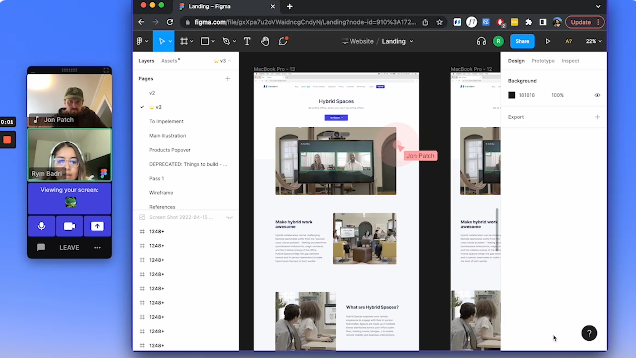
Tandem provides the solution to these woes. It’s an online collaboration tool which transcends geographical boundaries by creating a digital workplace that feels just like an office. Tandem replicates the feeling of working together in the same room, allowing for real-time communication and recreating those all-important nuances of office interactions like hallway high-fives, water cooler chats, and impromptu brainstorm sessions.
It’s about keeping that team culture vibrant and everyone feeling connected – like you’re all just desks apart, not continents.
Key features for digital collaboration
- See who’s available to chat and quickly hop on voice or video calls without the need for scheduled meetings
- Send direct messages via private chats or group chats, with easy file sharing
- Share your screen and enable remote screen control for interactive collaboration
- Get notifications when your teammates are free for a chat
- Create virtual rooms for team members to gather for specific projects or topics
- Integrate with a range of online collaboration tools, including Figma, Slack, and Google Docs
Pricing
There’s a two-week free trial for teams of all sizes, or paid plans start at $49/month for up to 10 team members.
Digital collaboration best practices
The right tools will only take you so far. To get to god-tier digital collaboration, you also need the right habits. Check out these five digital collaboration best practices to build into how your team works.
1. Set collaboration protocols before you add more tools
Before onboarding new digital tools, agree on how your team will use the ones you have. Which platform is for which type of communication? How are decisions recorded? Where does team feedback live? Clear collaboration protocols prevent the tool overload that trips up so many teams and ensure everyone is using your collaboration platforms effectively.
2. Assign responsibilities, not just tasks
It’s not enough to manage tasks. Someone needs to own them. When you assign tasks, be specific: who owns it, what done looks like, and when it’s due. Use task tracking in your project management tool to make responsibilities visible to everyone, and manage deadlines proactively before they become project delays.
3. Default to async first
Not every update needs a real-time call. Building an async-first culture, using shared documents and recorded walkthroughs to communicate, enables teams to collaborate efficiently across time zones without meeting fatigue. Save your video meetings for decisions that genuinely need real-time collaboration.
4. Track progress in the open
Progress tracking should be visible to everyone who needs it, not buried in someone’s to-do list. Use shared workspaces and project dashboards to track progress so your team can spot blockers early and keep projects moving. When the whole team can see the plan, teams plan better.
5. Review your tools regularly
Seamless digital collaboration comes from using the right tools well, not from having the most tools. Review your collaboration platforms at least once a quarter. If a tool isn’t being used to enable seamless teamwork, retire it. Support teams perform best when they’re not drowning in apps they’ve stopped using.
Final thoughts
So there you have it – seven of the most effective digital collaboration tools for god-tier collaboration. With the right tools, or the right combination to fit your team’s needs, you can streamline communication, boost productivity, and create a dynamic, vibrant, and connected workplace.
If you’d like to see how Filestage can improve digital collaboration in your content review process, you can start a free trial here →