Miscommunication between teams. Missed deadlines. Mounting workloads. Sound familiar? Then there’s a good chance you’re dealing with a broken marketing agency process. In fact, studies show that a mere 21% of content and creative professionals believe their organization’s workflows are actually working.
Your marketing agency process (also known as a marketing workflow) covers everything from developing a campaign strategy to brainstorming ideas and content production. So even seemingly small inefficiencies can have a domino effect, derailing entire projects in the blink of an eye.
The good news? You’ve just taken the first step toward streamlining your marketing agency process. The better news? This article will give you all the tools you need to make it happen.
Here are the three key topics we’re going to cover today:
- Six key stages of a successful marketing workflow
- Seven steps to streamline your marketing agency process
- How to boost productivity with Filestage
Let’s get to it.
Six key stages of a successful marketing workflow

Image source: ipleaders
Whether you work in a traditional or digital marketing agency, your main priority is to help clients hit their business objectives. But to achieve client satisfaction, you also need to create and maintain a healthy, productive work environment for your team.
That’s why it’s super important to have an effective workflow in place that empowers your entire team to do their best work.
Here’s a simple breakdown of what a successful marketing workflow looks like (this also applies to digital marketing agency workflows).
Supercharge your marketing reviews
Share, review, and approve all your content in one place with Filestage.
1. Understand the client’s objectives
Every stellar marketing campaign starts with a well-structured client briefing.
At this stage, it’s essential to ask the right questions and collect all the information you need to succeed.
This includes:
- Campaign goals
- Target audience
- Key messages
- Deliverables
- Timelines
The more comprehensive the brief, the smoother the entire creative process will be.
2. Develop a solution-focused strategy
Once you’ve understood the client’s goals, it’s time to build a compelling campaign strategy.
Marketing agencies often conduct their own research to further support and guide the direction of the campaign. But these days, it’s becoming more common for agencies to double down on the key information provided in the client brief, turning it into a single-minded strategic proposition.
Either way, it’s a must to make sure your strategy is aligned with the client’s business goals.
Want to know what a day in the life of a 2040 agency will look like? We asked 31 agency creatives to give their predictions. Read the results.
3. Collaborative concept creation
Marketing strategy in hand, it’s time for the creative team to get to work brainstorming, designing, writing copy, and developing initial concepts.
It should go without saying that collaboration between designers, writers, and strategists is crucial for your creative process. Otherwise things can get messy real quick, leading to disjointed concepts and stunted project progress.
If you want to dive deeper into this stage of your agency process, check out our guide on how to manage your creative workflow.
4. Set up a clear, cohesive review process
Before showing your work to the client, you’ll need an internal review process so that your team can make sure everything’s up to scratch. Once the internal review is done and your teammates are all aligned, you can confidently share your work for client feedback.
If you’ve set foot in a marketing agency before, you’ll likely know this stage can drag out the amount of time spent on the creative review process. But if you work smart, you can centralize both internal and client feedback in one place. I’ll show you how in just a minute.
5. Deliver your campaign assets
Once it’s time to get your campaign out there, you’ll want to have a checklist of deliverables ready to go. This will make sure your client gets what they need on time, without any hiccups.
Clear communication between agency and client is key here, as a simple mix-up can come back to bite when the final deadline arrives.
6. Optimize your marketing workflow
Even when you’ve covered these key stages of your marketing workflow, there’s always room to optimize the way you work going forward.
Regularly document insights, successes, and areas for improvement. Then, store this information in an accessible place for future reference. This will help your team build on what worked, avoid repeating mistakes, and refine your processes for client management going forward.
Seven steps to streamline your marketing agency process
So, you’ve got a good idea of what a successful marketing agency workflow looks like. It’s now time to dive into some more specific, actionable steps to refine and optimize your day-to-day processes.
Here are seven steps to streamline your marketing agency process:
- Onboard clients and new team members
- Set clear roles and responsibilities
- Establish a clear handoff process
- Prioritise project management
- Templates, templates, templates
- Limit unnecessary meetings
- Use AI to speed up content creation
Let’s take a closer look and learn how to implement each step.
1. Onboard clients and new team members
Finding new clients is no easy feat. So when you do bring in new business, it’s essential to make a great first impression with a clear, informative client onboarding.
This is your time to welcome new clients and bring them up to speed on your marketing agency workflow and client feedback software. That way, you can collaborate seamlessly and drive client satisfaction from the start.
Similarly, new team members need a structured onboarding process to help them integrate smoothly into your agency’s workflows. Take the time to outline essential tools, key contacts, agency goals, and expectations for each role.
One tip to support your employee onboarding is to create a knowledge hub where they can access all the important info about how your marketing agency runs on a daily basis.
2. Set clear roles and responsibilities
Without clear roles and responsibilities, tasks will inevitably fall through the cracks. And that quickly leads to delays, duplicated work, and stressed-out team members. So rather than diving headfirst into a new project, schedule a kick-off meeting to discuss who will work on what and how each team member will contribute to the bigger picture.
Documenting these roles and responsibilities will also help maintain clarity throughout the project. Everyone should know exactly who to report to and who they’ll be collaborating with. And don’t forget to outline your project deadlines!
3. Prioritise project management
Even the most talented teams will struggle without a solid system in place to keep projects organized. So, project management really is your best friend when it comes to streamlining your marketing agency processes.
Marketing agencies are spoilt for choice when it comes to quality project management tools. I’d highly recommend incorporating one into your process optimization.
Once you’ve picked a project management tool to help manage your projects, you can implement this checklist of best practices that’ll keep your agency running smoothly across the board:
- Break large projects into smaller tasks with defined timelines
- Assign owners to each task to ensure accountability
- Use status updates to keep everyone aligned on progress
- Set up recurring check-ins to review priorities and roadblocks
4. Templates, templates, templates
Reinventing the wheel for recurring tasks is a massive waste of time. So while you might already have a few templates knocking about for things like briefs and presentation decks, this is your sign to revisit your processes to identify more potential shortcuts.
As well as saving precious time, templates help keep things consistent and reduce the chance of errors. Having a go-to format means your team can focus on execution instead of fiddling around with admin.
Here are just a few processes that you can tighten up with templates:
- Client onboarding checklists
- Content and design request forms
- Social media content calendars
- Email marketing calendars
- Performance reporting dashboards
- Project timelines
- Blog post outlines
- Video script outlines
- A/B testing results
- Review and approval workflows
And the list goes on.
Needless to say, make sure to save all your templates in a shared space so people can easily download and edit them.
5. Limit unnecessary meetings
By now, I’m sure we’ve all seen the memes about meetings that could have been emails. Yet marketing teams still spend way too much time stuck in Zoom calls and stuffy meeting rooms. Make it make sense!
Of course, we need to check in and communicate with our teammates from time to time. But meetings should be scheduled wisely, with a clear agenda and outcome. And if certain meetings become redundant, for the love of productivity, remove them from your teams’ calendars.
You might also want to pick one or two meeting-free days per week, where teams are given the space to focus on tasks without distraction. The key is to keep an open dialogue and create a meeting schedule that supports work culture while respecting people’s time.
6. Speed up tedious tasks with AI
AI will never replace marketers, but it can make our jobs easier by cutting the amount of time spent on routine processes.
From bringing order to your brainstorming sessions to social media post scheduling, there are so many ways that AI can help your marketing agency work smarter and faster.
You don’t want to lose sight of authenticity along the way, so the golden rule is to collaborate with the software rather than letting it do everything. And use it for more functional, manual tasks so your team can focus on strategy and creativity.
7. Set up performance tracking and reporting
A strong client-agency relationship is built on trust. And the best way to earn that trust is through data-driven decision-making. By tracking key performance indicators (KPIs) like website traffic, conversions, and ROI, you can show the impact of your work in a tangible way. This is particularly important for a digital marketing agency.
One tip here is to communicate your stats in a simple, action-focused way. This will help you build long-term partnerships. Plus, your day-to-day job is much easier when you have trust from the businesses you work with.
Boost productivity with Filestage
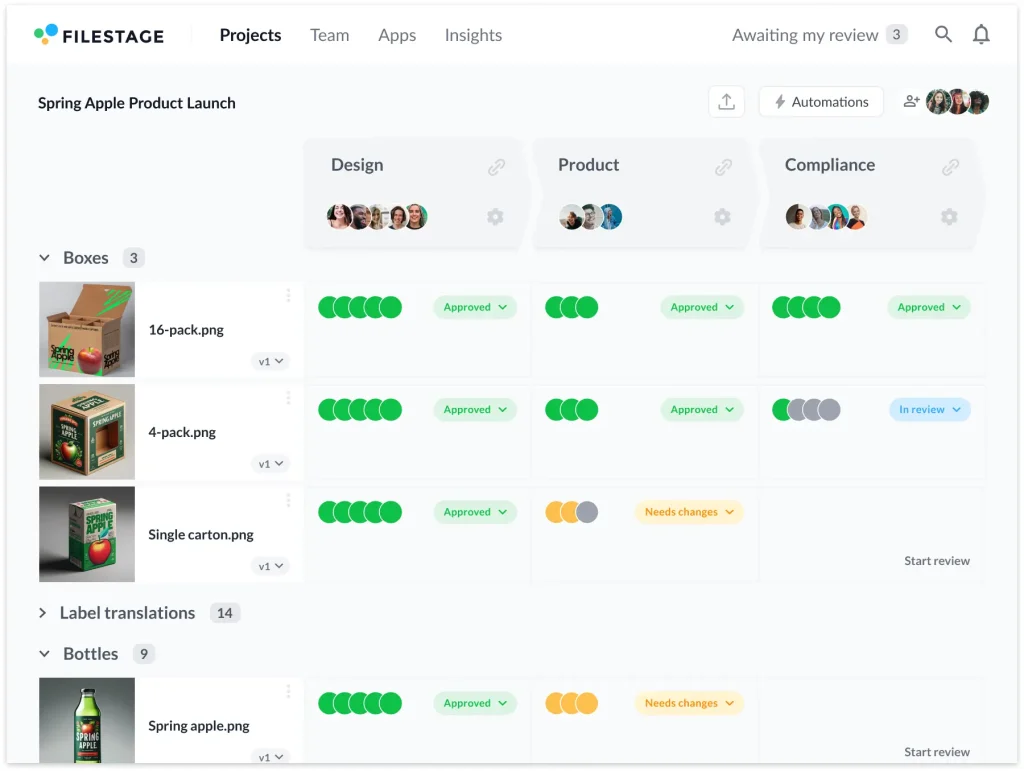
Whipping your agency process into shape involves taking a close look at every aspect of the way you work and collaborate as a team. Thankfully, there are lots of cutting-edge tools to help you do just that.
I think less is more when it comes to picking your marketing software. Ideally, you want a few hardworking tools that will help achieve your goals. And this is where Filestage comes in.
Filestage is a collaboration platform designed to simplify the way you share and review files. So even if you’ve got a bunch of different projects to manage (we’re talking website wireframes, social media assets, poster designs), all you need is a single, intuitive tool.
Let’s look at some of the ways Filestage can streamline your agency process.
Supercharge your marketing reviews
Share, review, and approve all your content in one place with Filestage.
Centralize feedback
Disorganized feedback can wreak havoc on your agency workflow, so this Filestage feature is a big deal.
With Filestage, you and your team can leave precise comments on every kind of file, from PDFs to videos. And those comments stay there unless you decide otherwise.
That’s not all. You can share your files with clients using Filestage, too. All you need to do is copy and paste the file link or pop in their email address to invite them to review it that way. This means no more hopping between email threads. No more missed feedback. And faster client approval.
Manage file versions
It’s all groovy when you share that first file for review. But cut to a few feedback rounds later, it becomes very tricky to keep track of the most up-to-date file version. And overwriting past files is even riskier business, which is why every marketing agency needs a solid file versioning tool.
With Filestage, you can access previous versions of any file and compare versions side-by-side to track progress and see what’s changed. All reviewers will also get an automatic notification whenever a new file version has been uploaded to the platform.
It’s also essential for brand asset management.

Automate workflows
Like all of the best marketing tools, Filestage is constantly looking for new ways to speed up your workflow. And one of the most effective ways to do this is by automating repetitive tasks.
With Filestage, you can create a bunch of custom automations to reduce the amount of time your team spends on menial manual tasks.
For example, you can get Filestage to add a due date to your project when starting a review and send automated emails to reviewers as that due date comes closer. Trust me, all these little shortcuts add up to some serious time saved in the long run.

Final thoughts
Agency processes can get pretty hectic, and that’s okay. All you need is clear communication, consideration, and a few quality marketing tools to help your team thrive.
I hope this article gets you pumped up and ready to streamline your marketing agency processes. And if you’d like to work smarter with Filestage, go ahead and start your free trial today.