

Running a marketing campaign in one market is hard enough. Running one simultaneously across multiple markets, each with different languages, regulations, and cultural expectations, is a different challenge entirely. Brands that build a meaningful global presence do so by treating their marketing strategies as adaptable frameworks, not fixed blueprints.
Deloitte’s 2023 Global Marketing Trends report, which surveyed more than 1,000 CMOs worldwide, found that expanding into new markets and geographies ranked among their top three priorities.
This guide walks you through how to reach a global audience in an increasingly competitive global marketplace. From setting your marketing campaign strategy to aligning the teams that bring it to life, we’ll show you what’s involved without losing your brand (or your mind).
TL;DR
- A global marketing campaign promotes a brand across multiple countries using a shared strategy, while adapting to local markets, languages, and cultural expectations.
- The core challenge is maintaining a consistent brand image while giving local teams the flexibility to adapt execution for each market.
- Effective campaigns are built on four foundations: central brand guidelines all regional teams can reference, thorough market research, localized content for each region, and KPIs that translate across markets.
- Channel selection, local laws, performance measurement, and creative approvals all need to be configured market by market, not applied as a global default.
- Structured approval workflows keep distributed global teams aligned and reduce the version control failures that derail international campaigns.
What is a global marketing campaign?
A global marketing campaign is a coordinated effort to promote a brand, product, or service across different countries using a shared strategy and core message. The aim is to keep brand identity consistent while allowing the creative execution to flex for diverse audiences and local preferences.
If you’re still mapping out your broader approach, it helps to understand the full range of marketing campaigns before committing to a global rollout.
Global marketing campaign vs. international marketing campaign
The terms are often used interchangeably, but they describe very different approaches. A global marketing campaign delivers a standardized message across markets, with minor local adaptations such as translated copy over a shared visual system. The core marketing elements, from tone and visual identity to product positioning, remain consistent across every region.
A good example of a global marketing campaign is Nike’s “So Win” brand anthem, which launched in 2025 with one core message and a consistent creative system across markets.
By contrast, an international marketing campaign is built around a distinct international marketing strategy for each market. Each region gets a different creative direction and sometimes different product positioning, all coordinated under a single brand umbrella.
A recent example is McDonald’s France’s “Welcome as you are” campaign, which was adapted in more than 10 languages and tailored to local audiences and cultural context.

How do you choose? The right choice depends on how significant the cultural differences are between your key markets, and how much local differentiation actually moves the needle with your target audience and target market.
Key elements of a successful global marketing campaign
The most effective global marketing campaigns share a consistent set of foundations, regardless of how many markets they span:
- Central brand guidelines that all regional teams can reference
- Localized content that adapts language, visuals, and tone for local audiences without compromising global brand identity
- A centralized approval workflow that keeps global and local stakeholders aligned across every market
- Measurable KPIs that translate meaningfully across different regional contexts
Speed up your marketing reviews
Share, review, and approve all your campaign content in one place with Filestage.
What are the challenges of creating and managing a global marketing campaign?
Even well-resourced brands run into serious difficulties when they take their marketing global. The challenges cut across culture, operations, legal compliance, and technology, and they often compound each other.
Balancing global brand consistency with local relevance
Maintain the same brand identity everywhere and you risk producing campaigns that feel generic in every market. Localize too aggressively and you fragment the brand into something that no longer holds together. Neither outcome is what you’re after.
The most effective global marketers treat brand consistency and local relevance as parallel goals. A framework defines what’s fixed: core values, tone of voice, and the consistent brand image your audiences recognize globally. Local teams adapt the execution within those constraints, respecting local cultures and local traditions without compromising the global brand.
When Coca-Cola ran its “Share a Coke” campaign, it kept the visual identity consistent globally while replacing its logo with locally popular names in more than 80 countries, maintaining a unified campaign concept while creating space for genuine local customization.

Managing localization, translation, and transcreation
Where translation handles words, transcreation handles meaning. For campaigns built around wordplay, humor, or emotional resonance, transcreation is essential, and it requires skilled local copywriters, not just fluent translators. Effective localized marketing adapts the cultural nuances, imagery, and promotional tactics that make a campaign land in each market.
HSBC’s “Assume Nothing” tagline seemed clear enough. Yet, in multiple overseas markets, it arrived as “Do Nothing.” The bank reportedly spent $10 million rebranding to fix it. One mistranslation. Ten million dollars.
Navigating legal, cultural, and compliance differences
Advertising standards vary substantially across borders. What’s permitted in one market, whether comparative advertising claims or particular types of imagery, may be prohibited in other countries due to local laws.
Cultural differences and local traditions add a further layer of risk that’s easy to underestimate from the center. The marketing compliance guide covers the key frameworks worth reviewing before taking campaigns into new territories.
When Dolce & Gabbana released a video ad in China in 2018 depicting a Chinese model struggling to eat Italian food with chopsticks, the cultural backlash led to the brand’s products being pulled from major Chinese e-commerce platforms, causing significant and sustained damage to its position in one of the world’s largest luxury markets.
Managing the logistical challenges of cross-market coordination
Running a campaign across multiple countries means coordinating marketing materials, approvals, and deadlines across teams spanning a dozen time zones. Without clear processes, the result is version control failures, missed deadlines, and unauthorized changes to finalized assets.
The solution is structure: defined roles, centralized feedback loops, and workflows that establish who holds approval authority at each stage. Global teams need a single source of truth for all marketing activities.
Measuring performance across channels and regions
Comparing campaign performance globally is harder than it looks. Different regions rely on different online platforms and customer behaviors, which means the same campaign can perform very differently from one market to another. WeChat and Weibo are central in China, LINE is widely used in Japan and parts of Southeast Asia, and platforms such as Instagram and Facebook remain important across many European and Latin American markets.
Click-through rates and conversion metrics don’t transfer neatly when the platforms, payment behaviors, and customer journeys differ this much. As such, it’s best to build your measurement framework before the campaign launches, define which KPIs apply globally and which will be tracked locally, and document your methodology so regional results can be read in context.
Global marketing strategy: How to plan and execute campaigns at scale
Effective global marketing is what separates teams that stay in control from those that spend most of their time firefighting. A clear campaign planning process gives you the structure to build an international marketing strategy that moves from global objectives down to market-level execution without losing coherence.
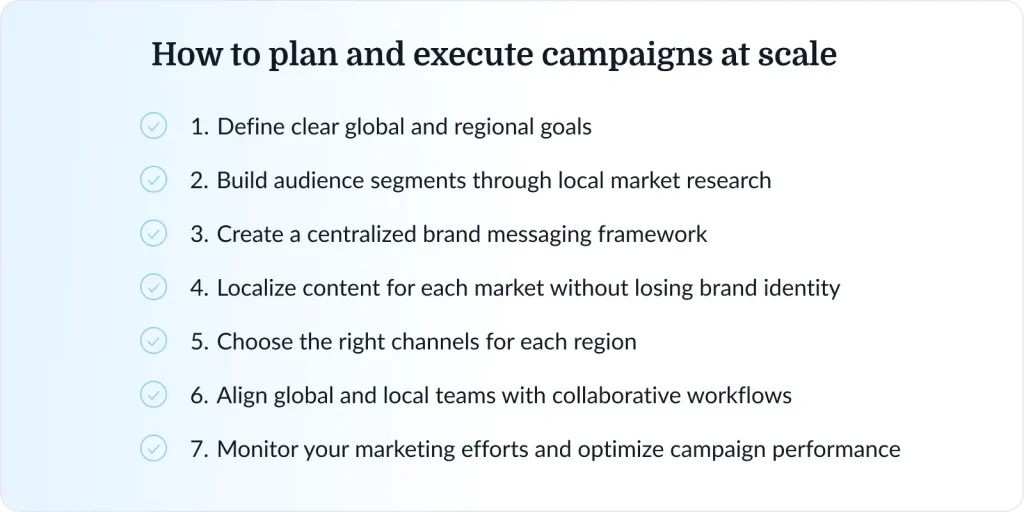
Step 1: Define clear global and regional goals
Separate what global marketing success looks like at the campaign level from what it looks like in each individual market. A global objective might target a 20% increase in brand awareness across Europe over 12 months. A regional goal for Germany might track trial rates for a specific product, while Spain focuses on cost per acquisition.
Build regional marketing strategies from global objectives, not alongside them. This creates a direct line between the overall campaign direction and the decisions being made in each market, making it far easier to adapt strategies when regional results diverge.
Step 2: Build audience segments through local market research
Consumer behavior, purchase motivations, and decision-making processes vary significantly between regions, and assuming otherwise is one of the more expensive mistakes in international marketing.
Effective market research goes beyond demographic overlaps. You need to understand local tastes, regional preferences, local competition, and what local audiences expect from brands in your category.
Working with in-market research partners rather than a centralized insights function gives you the international audience knowledge that thorough market research requires.
Step 3: Create a centralized brand messaging framework
A brand messaging framework keeps global and local teams aligned on the elements that can’t change: brand values, tone of voice, visual identity, and core positioning. It gives you a consistent brand image in every market you enter and a genuine competitive advantage over rivals who lack that internal coherence.
Without one, regional teams make independent creative decisions that gradually fragment the brand. With one in place, they can adapt marketing strategies while working within a structure that protects the global brand.
Step 4: Localize content for each market without losing brand identity
Localization goes further than translation. It means adapting visuals, cultural references, and promotional tactics to reflect local values and local preferences while still reflecting the global brand identity. The result should be localized campaigns that feel native to each market.
That usually takes two passes: an AI translation tool for the campaign copy and supporting materials, then a review round where local reviewers check terminology, tone, and cultural references before anything goes live.
Define what’s fixed and what’s flexible at the brief stage. Give local teams clear parameters for adapting the rest, and you prevent the central team from becoming a bottleneck while keeping the brand recognizable across diverse markets.
Step 5: Choose the right channels for each region
Email and paid search drive strong results in many Western markets but are secondary in regions where social messaging platforms dominate consumer attention. The right mix for each market should be driven by the online platforms your local audiences actually use, not by where your central team is most comfortable.
In some markets, short-form video is the primary engagement format. In others, in-app messaging performs better. Build channel selection into your global marketing strategy before creative production begins, treating regional preferences as a starting point rather than an afterthought.
Step 6: Align global and local teams with collaborative workflows
Global campaigns involve more stakeholders than any single project manager can coordinate manually. Brand teams, regional marketers, legal reviewers, and local market contacts all need to review the right marketing materials at the right stage, without creating conflicting version histories or leaving feedback in disconnected email threads.
Structured approval workflows keep distributed teams manageable. Filestage centralizes feedback collection and version control across campaign assets, giving global and local teams a shared workspace for review and sign-off.

Setting up a clear marketing approval process from the start is one of the most practical steps you can take to reduce delays in international campaign launches.
Speed up your marketing reviews
Share, review, and approve all your campaign content in one place with Filestage.
Step 7: Monitor your marketing efforts and optimize campaign performance continuously
Finally, keep in mind that global campaigns don’t run in set-and-forget mode. Market dynamics, consumer behavior, and competitive activity shift throughout a campaign’s lifetime, and your measurement setup needs to surface those shifts fast enough to act on them.
Set up regional dashboards that track performance against the KPIs you defined before launch. Build in regular review intervals, weekly or biweekly, where global and local teams assess which marketing strategies are working and where adjustment is needed.
This guide to campaign management covers the key frameworks for managing this at scale.
The future of global marketing campaigns: AI, automation, and real-time localization
The tools available for global marketing are changing faster than the underlying strategies. AI-driven capabilities are removing several of the bottlenecks that have historically made international marketing slow and expensive.
The global companies best positioned to benefit are those that have already built scalable workflows and treat their marketing strategies as living documents rather than fixed plans.
How AI is changing campaign localization and personalization
AI translation tools are now capable of producing a workable first draft of localized copy that local experts can then refine, cutting turnaround times significantly.
Beyond translation, AI can analyze regional engagement data in real time and surface which creative variations are performing best with diverse audiences across each market, giving global marketers faster insight into what’s resonating with local audiences.
For teams scaling their international marketing efforts, the range of campaign management tools now includes AI-assisted options worth evaluating as part of your broader global marketing strategy.
Why operational agility matters more than ever
Market conditions, regulatory changes, and consumer sentiment can shift mid-campaign. The brands that handle this well maintain flexible execution cycles, with smaller, more frequent creative updates rather than large single drops that can’t be quickly revised. Successful global marketing requires the ability to adapt strategies fast when a specific market isn’t responding as expected.
Approval bottlenecks that slow a domestic campaign by a few days can halt a global marketing campaign for weeks when you add time zones, regional stakeholders, and compliance review into the mix. Building agility into your process from the start is what makes real-time optimization possible across diverse markets.
Final thoughts
The creative part of a global marketing campaign is what everyone talks about. The coordination part is what actually determines whether it works or not. What makes global marketing success possible is the combination of clear marketing strategies, scalable approval workflows, and genuine local insights.
The brands that consistently get it right build campaigns that feel global in ambition and local in execution. They maintain a consistent brand image while respecting the cultural norms, local values, and consumer behavior of each market they enter. That’s how you build real brand loyalty across different countries, not just recognition.
If your team is managing campaign reviews across multiple markets and feeling the friction of scattered feedback and email-based approvals, Filestage can help.
Start your free trial and see how centralized review and approval can simplify global campaign management.
Frequently asked questions
What is an example of a global marketing campaign?
Coca-Cola’s “Share a Coke” campaign is one of the most studied examples of global marketing that balanced brand identity with local relevance. It expanded to more than 80 countries, replacing the brand logo with locally popular names while keeping the same visual identity throughout, building brand loyalty at a local level without fragmenting the global brand. The best marketing campaigns of all time covers more landmark examples.
What is the difference between global and local marketing?
Global marketing delivers a consistent brand message across different countries using a shared campaign framework, with regions adapting through their own international marketing strategy. Local marketing focuses entirely on a single market, optimizing for local audiences and consumer behavior. Most international brands use global marketing strategies as a foundation with meaningful local customization at the execution level.
Why is localization important in global marketing campaigns?
Localization makes your campaign relevant to local audiences in each market. People engage more readily with messaging that reflects their cultural context, local values, and local traditions. Without it, even a strong global campaign feels disconnected from local audiences, reducing engagement and limiting the brand loyalty that international marketing campaigns are designed to build.
How do global brands maintain consistency across markets?
Consistency is maintained through clear brand guidelines, centralized asset libraries, and structured approval workflows. A messaging framework defines what can and can’t change across markets, and review tools ensure local adaptations, whether to promotional tactics, marketing materials, or creative formats, are checked against global standards before going live.