

TL;DR
Marketing compliance is the practice of making sure marketing, advertising, and sales content follows the laws and standards that protect consumers and their data, covering everything from ad claims to data privacy. It matters more in 2026 because AI has multiplied content volume while regulators tighten disclosure and data rules at the same time.
Marketers work hard to produce and share high-quality marketing, advertising, and sales content that gets results. The process is often painstakingly executed and marketers must meet high internal standards.
There’s also another critical challenge: marketing compliance.
Large multinational companies have huge compliance departments that monitor and approve outgoing content, whereas smaller teams need to rely on marketers with lots of knowledge and understanding. In both cases, non-compliant marketing practices can be disastrous for a business.
This article is for creative and marketing leaders looking for a practical way to get marketing compliance right without the chaos.
What is marketing compliance (and why should you care)?
Marketing compliance basically means making sure your marketing, advertising, and sales content follows the laws and standards that protect consumers and their data.
Governments and regulators write marketing compliance regulations to stop false claims and prevent companies misusing customer data. The EU’s General Data Protection Regulation (GDPR) is the clearest example. When it landed, it reshaped ad tech and forced marketers everywhere to overhaul their websites and data systems.
GDPR fines alone can be severe, and it’s only one regulation among many. Break any of them and your business is at risk of:
- Steep fines
- Reputational damage that outlasts the campaign
- Costly reworks – pulling live content, revising assets, and repeating the approval process
Why it matters more in 2026
Marketing teams are producing more content than ever with the help of AI, and regulators have tightened the restrictions around it, with the EU AI Act rolling new rules out over the past couple of years.
More content moving faster through the pipeline means more places for a compliance issue to slip through, and more pressure on the review step meant to catch it.
That’s why the best marketing teams build a compliance strategy, often supported by marketing compliance software, rather than relying on quick ad hoc checks.
Here’s a closer look at how AI is changing digital marketing compliance.
How AI is changing marketing compliance
Content volume has multiplied faster than review teams have grown, so manual checks no longer scale, and regulators are scrutinizing AI-generated claims more closely than before.
But AI is also part of the fix.
Run at scale, it can do a first pass before a human ever sees the content – flagging forbidden terms, missing disclosures or disclaimers, and off-brand language.
That first pass has a ceiling though. AI can support review, but only a person can give legal sign-off or judge tone, risk, and context the way a trained reviewer does. A named reviewer should approve the content, and an audit trail needs to record who decided what and when. That’s the accountability frameworks like the EU AI Act expect, and it’s what keeps AI-assisted review defensible rather than just fast.
If you want to get up to speed on these new regulations, check out what the EU AI Act means for brands.
5 marketing compliance pitfalls to avoid
I’ve spoken about the hypothetical risk for brands that neglect marketing compliance. But here are five real-world cases of marketing compliance failures and the consequences that followed, so you can avoid making the same costly mistakes.
1. Handling user data – Facebook
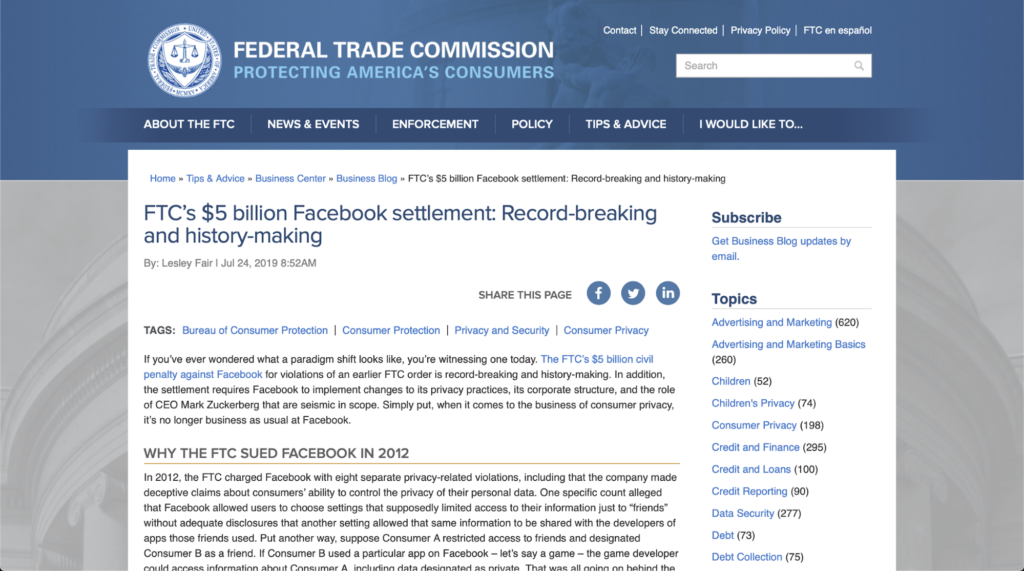
InIn July 2019, the FTC (Federal Trade Commission) hit Facebook with a $5 billion penalty (the largest privacy fine the agency had ever issued at the time).
The case followed the Cambridge Analytica scandal, where Facebook let third parties access user data without proper consent and failed to enforce its own privacy commitments. Beyond the fine, the settlement forced Facebook to build a new, independent privacy oversight structure and gave the FTC ongoing tools to monitor its compliance.
Your business is unlikely to face fines on that scale, but you still don’t want to mess around with the law. So you should always know where user data goes once you collect it, and never let third parties access it without real consent.
2. Creating unfair terms – Amazon

Amazon was hit with a huge four million Euro fine because of the content of some of the clauses within its contracts. French courts discovered that Amazon’s contracts contained unreasonable demands, which would place their providers’ businesses in jeopardy.
In addition to the fine, Amazon was told that it would receive additional fines if the six offending clauses were not changed within six months. This story underscores just how important it is for the terms of service and contracts to be produced in collaboration between all your business’s departments.
3. Failure to comply with GDPR – Google
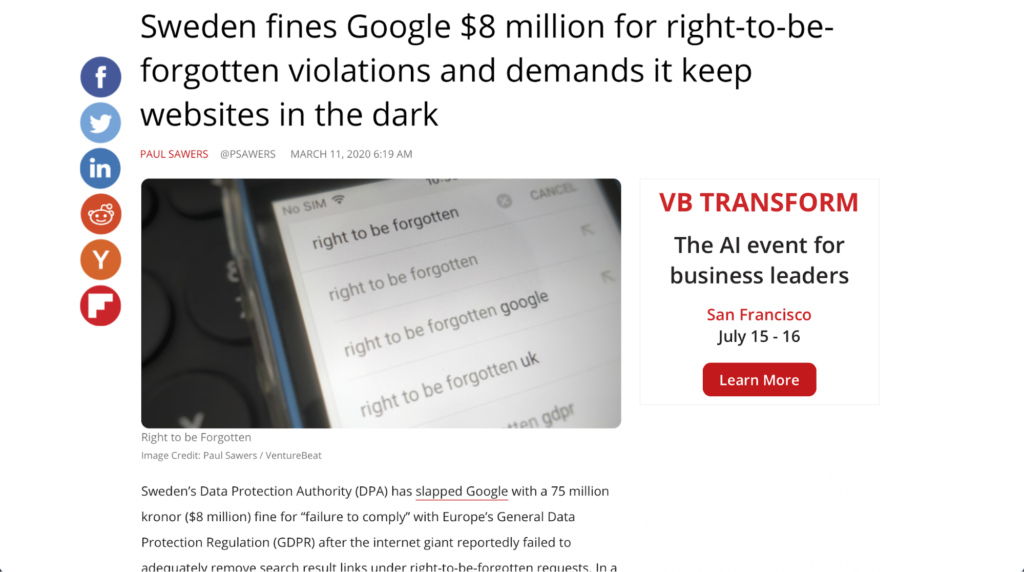
In March 2020, Google was slapped with an USD 8 million fine for failure to comply with Europe’s General Data Protection Regulation. The fine was imposed, after Google failed to remove the search result links of right-to-be-forgotten requests.
This was a significant fine and was just the latest, in a series of large GDPR infraction penalties, that the company received in recent years. Google’s woes are a cautionary tale for marketers and businesses around the world, who struggle to comply correctly with their GDPR commitments.
4. Inconsistent branding – Jaguar

In November 2024, Jaguar unveiled a full rebrand ahead of its shift to an all-electric lineup. This included a new logo, a new colour palette, and a launch campaign, “Copy Nothing,” that showed no cars at all. The reaction was immediate (and not in a good way).
Critics called it a break from everything the brand had stood for, and the campaign became one of the most mocked ad rollouts of the year. This example shows what happens when a heritage brand changes its identity faster than its existing customers are ready to follow. If you’re going to evolve your branding, bring your audience along with the story instead of springing it on them out of nowhere.
5. Poor use of AI – Coca-Cola

In 2024, Coca-Cola seemingly crossed the line of acceptable AI use with their Christmas campaign. The ad featured snowy streets, warm lighting, and festive themes but fell oddly flat as people started to notice that something was off. It turned out the ad was almost entirely AI-generated.
The consequence was largely reputational, but it became one of the most widely covered AI-marketing missteps of the year, reported on by NBC News, Forbes, and Newsweek. It also got its fair share of backlash online.
The takeaway here is that while AI can help us create content, it needs to be used and reviewed mindfully. Otherwise you run the risk of losing the brand trust you worked so hard to build.
Who owns marketing compliance?
Marketing compliance is a team sport. It sits across four roles, which of course means confusion about who owns which part is often where things slip through.
Marketing and brand teams own execution: writing the copy, designing the assets, and keeping messaging consistent with what’s already been approved.
Legal owns sign-off: reviewing claims, contracts, and consumer protection risk before anything goes live.
Compliance or regulatory teams own the industry-specific rules, things like data protection, financial promotions, or advertising standards, that marketing and legal alone might miss.
Brand holds the line on tone and identity, catching content that’s technically compliant but off-brand.
None of these roles works well in isolation. A claim that’s legally sound but off-brand still needs a rewrite. A campaign that’s on-brand but missing a required disclosure still can’t ship. That overlap is why marketing compliance needs a structured review process, so every draft passes through the right hands before it goes out.
When campaigns span several markets, agencies, or teams, write these responsibilities down as part of a marketing campaign governance framework, so everyone knows who signs off on what before work starts.
What needs to be compliant in marketing?
Marketing compliance covers more ground than most teams expect, and it rarely lives in one channel or one document. Here’s a map of the areas that need review before anything goes out the door.
Brand compliance
Every asset that reaches a customer, be it an ad, a landing page, or a sales deck, needs to match your approved brand guidelines. When that slips, the risk usually isn’t a fine so much as a diluted brand that customers stop recognising, especially across the growing range of channels most marketing teams now publish to.
See our full guide to brand compliance to learn more.
Content compliance
Blog posts, video scripts, and product pages all need to be accurate and properly sourced. They also need to avoid making claims your legal team hasn’t cleared. This matters even more as AI tools speed up content production, since a faster draft doesn’t mean a more accurate one, no matter how confident the content sounds.
We have a dedicated article on all things content governance if you want a practical guide in this area.
Social media compliance
Social posts move fast and get published outside the usual review cycle more often than any other channel. While it might seem lower stakes than other channels, platform ad policies, influencer disclosure rules, and industry-specific regulations all apply, on top of whatever your brand guidelines already require.
Get a practical guide to social media compliance here.
Advertising claims and disclosures
Any claim about what your product does, how it performs, or how it compares to a competitor needs evidence behind it before it airs. Regulated industries like pharma and finance face the strictest version of this, where every claim needs backup and every asset needs sign-off before it can run.
We cover pharma marketing compliance in more detail here, if you want to learn more.
Data and privacy, including email
Any part of your brand that deals with customer data, from a newsletter signup to a retargeting pixel, has to meet the consent and data-handling rules of GDPR, CCPA, plus whichever other regulations apply in your markets.
A dedicated compliance management software is worth considering if you regularly deal with customer data.
Label and packaging compliance
Physical products carry their own compliance burden. Required warnings, ingredient lists, and country-specific labelling rules that vary by market and product category all need to be managed properly. Getting this wrong after a print run is one of the most expensive mistakes on this list, since it means pulling stock rather than editing a file.
Get the full lowdown on label compliance here.
Key marketing compliance regulations (by channel & industry)
Marketing compliance touches a different set of rules depending on the channel and the industry. Here’s a quick reference to the regulations marketers run into most, organized by what each one covers, who it applies to, and what happens if you get it wrong.
| Regulation | Region | What it governs | Applies to | Key requirement for marketers | Penalty |
| FTC Act – Advertising and Disclosures | United States | Truthful, substantiated advertising claims and disclosure of paid partnerships | Any business marketing to US consumers, including influencers and affiliates | Have real evidence behind every claim, and disclose material connections clearly | Up to $50,120 per violation on rules the FTC has put businesses on notice about, plus consumer redress |
| GDPR | EU / EEA | Collection, storage, and use of personal data | Any business processing EU or EEA residents’ data, including email and retargeting | Establish a lawful basis and get clear consent before using personal data | Up to €20 million or 4% of global annual turnover, whichever is higher |
| CCPA / CPRA | California, US | Consumer rights over personal information | Businesses meeting CCPA’s revenue or data-volume thresholds and serving California residents | Honor opt-out, access, and deletion requests within required timeframes | $2,500 per violation, $7,500 per intentional violation, adjusted periodically for inflation |
| FDA (drug and health claims) | United States | Marketing claims for prescription drugs, medical devices, and health products | Pharma and healthcare marketers | Keep “fair balance,” giving risks the same prominence as benefits in every claim | Warning or untitled letters, forced ad withdrawal, potential misbranding enforcement |
Social platforms add their own ad and disclosure policies to whatever general advertising law already applies. For example, a sponsored post has to clear both the platform’s rules and the underlying law (the FTC Act, for a US audience) at once, with consequences ranging from a pulled post up to the FTC or GDPR penalties above – depending on what’s actually violated.
Physical products carry required warnings, ingredient lists, and claims that vary by country. So CPG, food and drink, pharma, and other labeled goods need their label content matched to each destination market’s rules before the print run.
Note: This is general guidance, not legal advice. Requirements and penalty amounts change and depend on where you operate, so check with your legal or compliance team before treating any of this as final.
How to manage marketing compliance (step by step)

Knowing the rules is great, but building a process that catches problems before anything ships is a whole other beast. Here’s how to run marketing compliance as a repeatable workflow instead of a last-minute check squeezed in before launch (if you know, you know!).
1. Set clear brand and compliance guidelines
Start with a single source of truth. Get straight on things like brand voice, approved claims, regulatory red lines, and who needs to sign off on what. Without this, every reviewer applies their own judgment, which is how inconsistent decisions creep in across a team.
A brand governance framework with clear approval roles turns these decisions into a shared reference, so every reviewer applies the same standard.
2. Standardize the brief with an intake form
Capture requirements and constraints before work starts. A structured intake form covering target audience, any regulated claims involved, industry-specific rules, and the deadline means the creative team knows the guardrails from day one.
3. Use templates for recurring assets
For anything you produce repeatedly, like ads, packaging, or email footers, build the compliant version once and turn it into a template. This will help your team create assets fast without watering down the brand.
4. Run an automated pre-check before human review
We built Review Agents for this job. They flag routine errors before a human opens the file. An assigned person on your team still makes the final call on anything the check flags. Find out more about what AI review assistants can do in 2026 here.

5. Route through a structured review and approval workflow
Use a review and approval software to send the asset through a defined sequence of reviewers, brand, legal. A formal MLR stage is also needed for regulated industries.With visibility into where every asset actually stands, you can monitor adherence and see when a stage gets skipped or rushed instead of finding out after something’s already live.
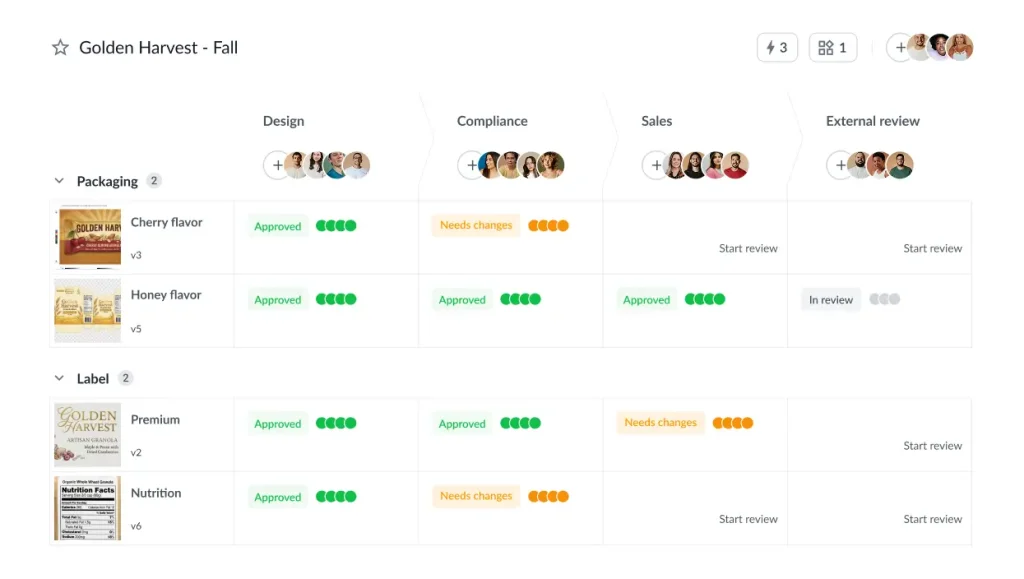
Deliver compliant content with confidence
Set up a consistent and compliant marketing review process with Filestage.
6. Capture sign-off and a time-stamped audit trail
Every approval needs a record: who approved it, when, and which version they saw. This protects you if a regulator or a customer ever asks how a claim made it to publication. For regulated industries especially, this needs to be part of your content review as what an inspection or investigation will actually ask for.
7. Store and distribute approved assets from a single source
Once something’s approved, it needs a forever home. A shared drive with folders named “final,” “final v2,” and “final FINAL” is how outdated or unapproved versions end up live. Instead, keep your approved assets in a DAM so everyone knows that’s “the one.”
8. Monitor, document, and keep pace with regulation
Check how well your compliance process is actually being followed, keep your documentation updated as guidelines and templates change, and monitor legal updates in the markets you operate in. Regulations change, so a process that isn’t revisited often can quietly go out of date. Staying on top of it is also what helps boost visibility into where your compliance program actually stands.
Using marketing compliance software effectively
The right compliance software for you depends on what’s actually breaking down in your process. But as a rule of thumb, look for tools that combine your guidelines, your review workflow, and your record-keeping in one place, rather than three separate systems nobody keeps in sync.
If the bottleneck is the review step itself, a compliance content review platform is the category to look at, since it pairs automated checks with named human sign-off and a full approval record.
Filestage handles this directly. Review Agents run automated pre-checks for things like forbidden terms and missing disclaimers before a human ever opens the file, and every decision gets logged in a time-stamped audit trail automatically, no separate system needed to prove who approved what.
Beyond review and approval, teams typically round this out with a DAM like Canto or Bynder for managing recurring assets, plus a platform like Mailchimp or HubSpot that builds consent and unsubscribe handling into your email marketing.
Final thoughts
If you’re going to run a resilient business that thrives in the marketplace, you’ll need to focus carefully on marketing compliance. Get the guidelines, the workflow, and the audit trail right, and the whole process becomes much easier to manage.
I hope that this guide has helped you to pick up some new strategies and techniques to keep your mind on compliance, throughout the creative process. And if you’d like to speed up your review process while staying audit-ready with Filestage, start a free trial.
Frequently asked questions
What is marketing compliance?
Marketing compliance is the practice of making sure marketing, advertising, and sales content follows the laws and standards that protect consumers and their data, covering everything from ad claims to data privacy.
How do you create a marketing compliance process?
You create a marketing compliance process by assigning clear ownership across marketing, brand, and legal, building the rules into style guides and templates, and routing every asset through a structured review and approval workflow before it goes live.
What are the main types of marketing compliance?
The main types of marketing compliance are brand compliance, content compliance, social media compliance, advertising claims and disclosures, data and privacy, and label and packaging compliance.
Can AI check marketing compliance?
AI can check marketing compliance by flagging routine issues like forbidden terms, missing disclosures, and off-brand language before a human reviewer sees the content, though a named person still needs to make the final call. Check out our guide on AI marketing compliance to learn more.
What are the penalties for non-compliance?
Penalties for non-compliance range from regulatory fines, such as up to €20 million or 4% of global annual turnover under GDPR, to reputational damage and costly rework, like pulling mislabeled stock from shelves or facing forced ad withdrawal.