

TL;DR
- Since 2 August 2026 the EU AI Act’s transparency rules apply to any company whose AI-generated content reaches EU users, wherever that company is based
- AI marketing compliance has become a question of proof rather than process, meaning you can show who checked each asset and when
- Volume broke the old review process, because the same reviewers cannot check 400 assets a week the way they checked 40
- A compliant workflow produces evidence on its own through automated checks, routed human review, recorded sign-off, and a log that writes itself
- Marketing teams in regulated industries can capture audit trails for every asset in Filestage before a regulator ever asks
Last year your brand team shipped 40 assets a week. This quarter it’s 400 a week, and the same two people still check every one. That’s what AI did to regulated marketing teams, and to the legal and compliance reviewers who sign their work off.
This guide is for marketing and compliance professionals building or fixing that review process, whether you’re briefing the AI or signing off on what it produces. It covers AI-regulated marketing content, not AI governance more broadly. You’ll get what the current roles require, and a workflow that produces proof of review by default instead of scrambling for it after the fact.
Since 2 August 2026, the EU AI Act’s transparency rules have been in force. The question is no longer whether you used AI to create your marketing content. It’s whether you can prove it was reviewed by a real person.
Getting this wrong carries real regulatory risk, and it slows down a team trying to review 400 assets a week by hand. It also costs you customer trust the moment a mistake reaches the public.
What is AI marketing compliance?
AI marketing compliance is the practice of making sure your AI-generated content meets the advertising, disclosure, and consumer data rules that apply in your markets, and being able to show that each asset was checked before it went live.
A handful of terms carry specific meaning here, so it’s worth being precise about each one before going any further.
- Truth in advertising – your claims must be honest, substantiated, and non-deceptive, whether a person or a model wrote them. The FTC enforces this standard under the FTC Act.
- Privacy – how you collect, store, and use the personal data behind an asset, from training data through to any targeting built on customer information. GDPR and UK GDPR set the baseline across Europe.
- Disclosure – telling your audience when they’re looking at AI-generated content or interacting with an AI system, in the form each market’s rules require.
- Audit trail – a single record, timestamped, showing what was checked, who signed off, and what changed. It rebuilds itself, so nobody has to dig through inboxes or chat logs to find it later.
AI marketing compliance is narrower than AI governance. Governance covers how your organization builds, buys, and deploys models across the whole business. AI marketing compliance is only the slice that touches what you publish, the part your customers actually see.
It’s also broader than traditional marketing compliance. Artificial intelligence adds two obligations on top of the ones you already had. You have to disclose synthetic content, and you carry the legal liability for output that no person actually wrote.
AI didn’t create a new marketing compliance problem so much as expose an old one. The buffer that let a slow, manual review process look like it worked only held while volume stayed low. A careful reviewer could catch most issues by hand at 40 assets a week. At 400, the buffer is gone and the gaps start to show.
New compliance standards for AI-generated content
The EU AI Act’s transparency obligations took effect on 2 August 2026, and they don’t care where your company is headquartered. If your AI-generated content reaches people in the EU, the rules reach you. These disclosure requirements apply directly to marketing content, not only to systems labeled high-risk.
Three duties touch marketing work directly.
- Disclose when someone is interacting with an AI system, like a chatbot
- Mark AI-generated content if you work in a regulated industry, creating “public interest” content like allergens or recycling notices
- Label deepfake content in a way a person can clearly see from the start
Get these wrong, and regulatory violations carry a real ceiling. Non-compliance with these regulatory obligations under Article 50 can reach €15 million or 3% of worldwide annual turnover, whichever is higher. That regulatory risk applies wherever your content reaches EU users.
For a deeper read on how the Act lands for brands, see our guides to the EU AI Act for brands and content governance under the EU AI Act.
AI label checker
The checker below can help you work out if you need to label your content.
Disclaimer: Under the EU AI Act, providers handle machine-readable marking (Art. 50(2)). Deployers must add a visible disclosure in two cases: deepfakes — content resembling a real person, object, place, entity, or event in a way that would falsely appear authentic (Art. 50(4); defined in Art. 3(60)) — and AI-generated text on matters of public interest (Art. 50(4)).
Only the text case can be waived, and only with documented human review by someone holding editorial responsibility. Deepfakes have no such waiver — the sole exceptions are law-enforcement authorization or content that’s evidently artistic, creative, satirical, or fictional.
Which rules may apply to your AI marketing content
The EU AI Act is rarely the only rule set in play. Depending on where you operate and what you sell, several regimes can apply to the same asset at once, some covering artificial intelligence directly, others advertising or how you use consumer data.
A workable AI marketing compliance strategy cuts through the regulatory complexity by knowing which key regulations are yours, not by trying to master all of them.
| Rule | What it covers |
| EU AI Act | Transparency and risk duties for AI systems used by anyone reaching EU users |
| GDPR and UK GDPR | How you collect and use personal and consumer data across Europe and the UK |
| FTC truth in advertising rules | Substantiation, honesty, and consumer protection for any claim shown to US consumers |
| FINRA advertising rules and the SEC Marketing Rule | Communications standards for US financial services firms |
| FDA and EMA promotional rules | Promotional claims for pharma and medical devices in the US and EU |
| Packaging and labeling rules | Mandatory on-pack information for packaging and consumer goods |
| US state AI and privacy laws | A growing patchwork of AI, privacy, and consumer protection duties across individual US states |
Take this list to your legal and compliance teams and confirm which regulatory requirements apply to you before you rely on any of it.
Where AI breaks the marketing review process
AI concentrates marketing compliance risk in four places, each one easy to miss until an asset is already live. Here is where the review process gives way, and what closes each gap.
When 40 assets a week becomes 400, and the reviews stay the same
Your review team stays the same size while the queue grows tenfold. Nobody decides to cut corners. It just happens, because manual review processes run by a handful of people become the bottleneck, and a quiet pressure builds to wave things through.
Solution: Run an automated first pass on every asset before a person opens it, so human review stays focused on the judgment calls that actually need a person.

When the model invents a statistic and nobody checks the source
A model will hand you a clean, believable figure with nothing behind it. Left unchecked, that number rides through several creative versions before someone notices the citation was never there, and by then the whole batch carries compliance risks.
Solution: Check the source at the moment the claim is made. A claim with no source never enters the review queue, so a reviewer is checking real references instead of hunting for missing ones.
When the disclosure is on nine assets out of ten
Producing variants in bulk is where disclosures slip. If your team is adding the required label to dozens of AI-generated versions by hand, one will eventually go out without it, and you won’t know until a regulator or a customer points at the non compliant content.
Solution: Define the required elements once for each asset type and market, then check every asset against that list automatically. Consistency comes from storing the rule, not from remembering it.
When you can’t say who approved the claim
Sign-off happens in a Slack thread, a comment nobody saved, a nod in a standup meeting. Six months later a regulator asks for the approval record and there isn’t one, just fragments you would have to piece back together.
Solution: Make approval a recorded action instead of a message, tied to the asset and the person, with a timestamp that doesn’t depend on anyone’s memory.

Supercharge your marketing reviews
Share, review, and approve all your content in one place with Filestage.
What regulators actually ask for when something goes wrong
This is where AI marketing compliance gets real, because every regime in that table has a records dimension. When something goes wrong, regulators rarely ask whether your process was good in the abstract. The question after a complaint or a regulatory action is almost always the same. Prove what happened with this asset.
You can check yourself against the list they’ll work from.
- Which version of the asset went live?
- Which checks ran against it, and what each one returned?
- Who reviewed it, and in what capacity?
- Who gave final approval, and when?
- What changed between versions?
A Slack or Gmail thread won’t answer those questions. Scattered approvals can be reconstructed with enough effort and luck, but that’s not the same as an audit trail. An audit trail is a single timestamped record that rebuilds itself, without anyone digging through inboxes.
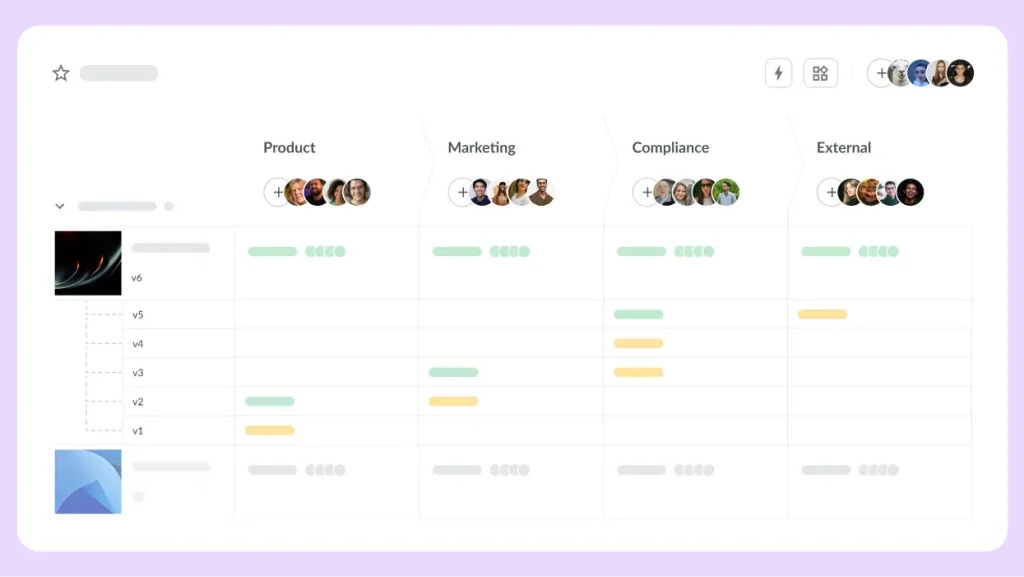
When automated checks run through something like Filestage’s Review Agents, each result is logged against the version it checked, so the record forms as the work happens rather than after the fact.
How to build an AI marketing compliance workflow
Your AI marketing compliance strategy lives or dies here, in the review and approval loop. A compliant workflow isn’t a longer version of what you already do, it’s a shorter path where the evidence falls out as a byproduct.
This section covers reviewing and approving content. What you set up beforehand, and what you do after publishing, sit on either side of it.
Before the workflow starts
First, set the rules for using AI. This compliance framework covers what AI may draft, what it must never draft, which asset classes always need a human signature, and whether legal or compliance teams own that call.
Second, capture your compliance requirements at intake with a structured creative intake form that records which markets an asset targets, which claims it makes, and which disclosures apply.
1. Run automated checks before a human opens the file
Automated checks, many now using natural language processing, catch mechanical failures so the manual review that’s left focuses on the judgment calls. Legally, though, an automated check is a control in your compliance process, not an approver. The final sign-off stays with a human. These four checks suit AI tools well.
- Mandatory disclosures and required legal text – every required element present for the target market
- Forbidden, restricted, and unsubstantiated performance claims – nothing that crosses a line you’ve already defined
- Brand elements, logos, and imagery – the correct version of each, matched to your brand guidelines
- Codes, barcodes, and links – all present and resolving where they should

2. Route the asset to the reviewers it actually needs
Not every reviewer needs to see every version, and not in the same order. The difference that matters is sequential versus parallel. Brand compliance and product review don’t depend on each other, so run them in parallel and save the days you’d lose stacking them.
Legal teams are different. They usually need to sign off on the version everyone else has already approved, so that step runs last, once the content is stable. Build your content approval workflows so a low-risk social post doesn’t sit in the same queue as a regulated product claim.

3. Capture and log every human sign-off
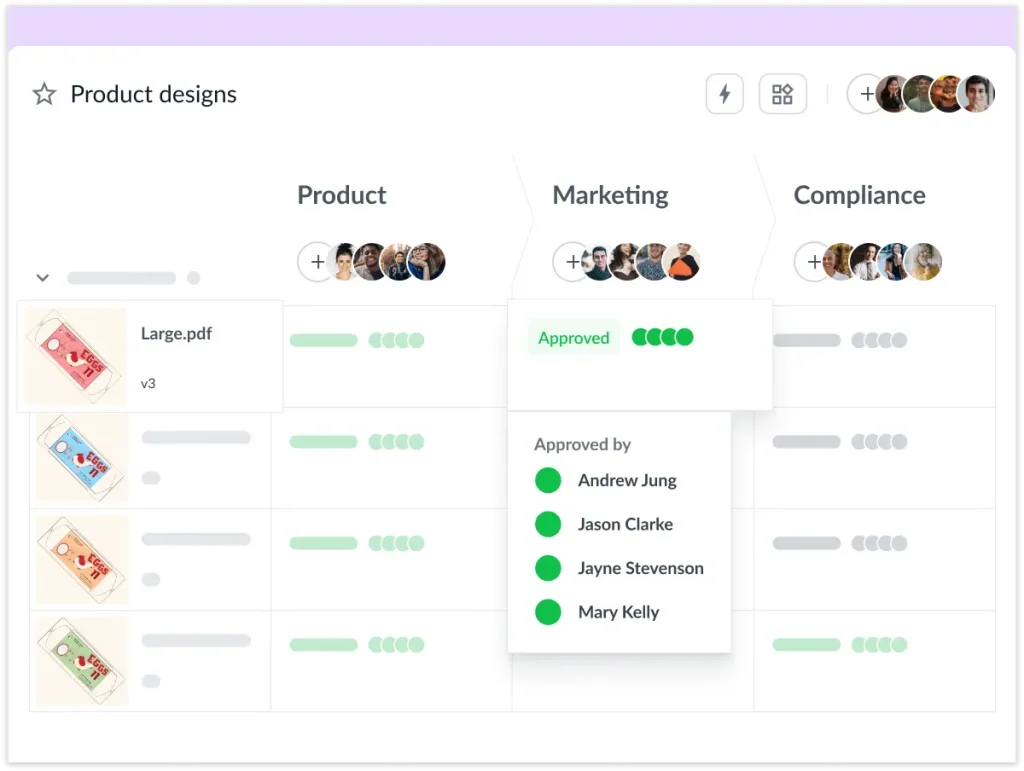
An approval is only useful later if it records who approved, what exactly they approved, and when. Tie the approved messaging to the specific version, not to the campaign in general. Where you need formal attestation, add an e-signature step so the sign-off carries legal weight instead of sitting as a comment.
And ditch the idea that saying yes in a meeting counts. A verbal yes leaves no record, and a record is the entire point. With the approver named against a locked version and a timestamp, you can answer the who-approved-this question in seconds instead of days.
4. Log everything, automatically
If the record depends on someone remembering to write it down, it will be missing exactly when you need it. The log has to build itself, capturing every check, every comment, every version change, and every approval as it happens, kept together against the asset. This is what the record is for.
Article 50 expects you to be able to show that your AI content was disclosed and marked, and scattered notes won’t prove it. A record that links each asset to the checks it passed and the named person who approved which version will.
Automated workflows that log by default turn that proof from a scramble into a given, and solid version control underneath means you can always show which version was live and what changed to get there.

What to do about content that is already live
Publishing an asset isn’t the end of its marketing compliance life. Rules and claims don’t stand still, and old marketing materials keep running long after anyone last looked at them. Set a fixed quarterly compliance review of live content, give one named person ownership of it, and build light regulatory monitoring into the cadence. Regulations evolve, so re-review whenever the rules change.
Supercharge your marketing reviews
Share, review, and approve all your content in one place with Filestage.
AI marketing compliance best practices
Strong AI marketing compliance comes down to a few habits more than to any of the AI tools you buy. These five AI marketing practices keep the evidence flowing and the humans accountable.

Treat AI as a reviewer that never signs off
You can automate the first read on all your marketing content, flagging weak claims and missing disclosures at a scale no person can match. Then stop it there. The moment a tool approves its own output, you’ve lost the human review the rules are built around. AI is your fastest reviewer and your worst approver.
Keep the approval record with the claim, not in someone’s inbox
Good marketing compliance keeps the evidence with the asset, tied to the version that went live. Scattered across inboxes and chat threads, it isn’t evidence, it’s a research project you’ll run under pressure the day someone asks. Store approvals where the work happens, and the audit trail is already written when you need it.
Train the people prompting and approving
The person writing the prompts needs to know what the model can’t claim. The person approving needs to know what they’re signing for. Neither is obvious, and neither comes from the tool. Short, specific training on your disclosure requirements and compliance rules sharpens your marketing practices and prevents more compliance failures than software bought to catch them later.
Apply one review standard across every market
It’s tempting to hold regulated markets to a high bar and let everything else slide. That’s how gaps open. Consistent AI marketing practices mean one review standard across all your marketing channels, with industry specific rules layered on top where they apply. A single set of compliance standards is easier to audit than a patchwork, and it stops a US asset shipping to a lower bar than another market’s rules demand.
Test your audit trail before someone else does
Don’t wait for a regulator to be the first person who pulls your evidence. Once a quarter, pick an asset that went live and rebuild it from the record alone. Which version shipped, who approved it, what changed, and what the checks returned. If you can’t do that in a few minutes from the complete audit trails you keep, you don’t have a workable one yet.
What to look for in AI marketing compliance software
If you’re choosing marketing compliance software to run this, the feature list matters less than whether it produces the evidence regulatory compliance now demands. Compliance professionals care about one thing here, which is whether you can prove what happened. Six things are worth checking for.
- Automated or AI checks before human review – so mechanical failures get caught before a person spends attention on them
- Structured intake – so compliance requirements are captured when work is briefed, not bolted on later
- Configurable review routing – so sequential and parallel steps match how your approval processes actually run
- Formal sign-off and e-signature – so an approval carries weight and names a person
- A complete, exportable audit trail – so you can hand a regulator a record instead of a reconstruction
- Integrations with the tools your team already uses – so the workflow fits the stack instead of fighting it
Plenty of AI tools cover parts of this. For named options, see our roundups of content governance software and compliance management software. Filestage is built for the review and approval end specifically, giving regulated marketing teams automated checks, routed sign-off, and an audit trail for every AI-generated asset in one place.
AI marketing compliance checklist
Use this marketing compliance checklist to sanity-check your own workflow against what a compliant setup actually looks like. It’s grouped into four areas, and gaps tend to hide in just one of them.
Policy and ownership
- Decide what AI may and may not draft, and write it down
- Name the person who owns AI sign-off decisions
- List the asset classes that always need a human approval
Disclosure and labeling
- Mark AI-generated image, audio, and video so it’s detectable
- Disclose AI interactions such as chatbots unless they are obvious
- Label deepfake content so a person can clearly perceive it
- Keep a per-market list of disclosure requirements and legal text
Review and approval
- Run automated checks on every asset before human review
- Route legal review last, after other approvals are locked
- Capture named sign-off against the specific version approved
- Add e-signature where formal attestation is required
Evidence and retention
- Log every check, comment, version, and approval automatically
- Keep the record tied to the asset, not in inboxes
- Store complete audit trails you can export on request
- Re-review live content quarterly and whenever regulations change
Final thoughts
AI hasn’t made compliance impossible so much as made the old way of proving it unworkable. AI marketing compliance now rewards the marketing teams that can show their work on any asset, on demand, not the ones with the strictest rules on paper.
Build the workflow so the evidence writes itself, and the proof is there before anyone asks for it.
Start your free trial of Filestage and put an audit trail behind every asset.
Frequently asked questions
Do I have to label AI-generated marketing content in the EU?
It depends. Since 2 August 2026, you have to label deepfakes clearly. Where an asset is lightly AI-assisted or has been through thorough human review and editing, a label usually isn’t required. Check the specifics with your legal team, because how it applies depends on the asset.
Does the EU AI Act apply to companies outside the EU?
Yes. The Act reaches any provider or deployer whose AI output is used in the EU, no matter where the company sits. A US brand running AI-generated campaigns that reach people in Europe is in scope. Being headquartered outside the EU doesn’t put you outside the rules.
Can AI approve marketing content on its own?
No, and you wouldn’t want it to. AI can run the checks and flag problems, but a human still has to own the final sign-off on AI-generated content, because your brand carries the legal responsibility for the claim, no matter what produced it. The point of marketing compliance for AI is that a person, not a model, answers for what went out. An automated check is a control, not an approver.
What records should we keep to prove AI content was reviewed?
Keep enough to reconstruct the asset. Which version went live, which checks ran and what they returned, who reviewed and approved it, and what changed between versions. Store it together as an audit trail, tied to the asset, timestamped, and exportable. Prompts and model versions are worth logging too, since regulators increasingly ask for them.