
TL;DR
Creative intake forms give CPG brands a structured way to manage incoming project requests. Instead of chasing missing details mid-project, teams capture everything they need upfront, from packaging specs to compliance requirements, so work can start without delays.
Why creative intake forms matter
CPG brands deal with a constant flow of marketing projects. Packaging refreshes, product launches, retail display assets, and digital campaigns all compete for your creative team’s attention at the same time.
Without structure, requests arrive through email, Slack messages, and last-minute meetings. Details get missed and deadlines slip. By the time your team starts work, they’re already behind.

According to Canto’s State of Digital Content 2026, 88% of teams struggle to keep product content consistent across channels. Separately, 35% report delayed campaign launches, with poor asset management cited as a key contributing factor. For CPG teams managing dozens of SKUs across multiple markets, both problems are painfully familiar.
A creative intake form creates a single, structured entry point for every new project. It standardizes how requests are submitted and routes them directly to the right internal teams, with all the information already there.
In this guide, you’ll learn what creative intake forms are, how to set one up, and how they help you move faster from request to delivery.
Cut feedback and approval time by 30%
Share content, get feedback, and manage approvals with Filestage.
What is a creative intake form?
A creative intake form is a web-accessible form that collects all the details a creative team needs to start work on a new project.
Instead of chasing clients and stakeholders for missing information, your team receives everything in one place: objectives, deliverables, target audience, brand assets, budget, deadlines, and approval contacts, all before work begins.

Creative intake forms streamline the process of capturing, routing, and managing requests for creative teams, reducing email clutter and ensuring that information goes directly to the right internal workflows.
For CPG brands, this means capturing product-specific details alongside standard project information. Things like SKU data, packaging dimensions, regional compliance requirements, and retail channel specs that a basic form won’t think to ask for.
Creative intake form vs. creative request form
These two terms are often used interchangeably, but they serve different purposes:
- A creative request form captures the initial idea or project justification: what’s needed and why
- A creative intake form goes deeper, collecting the operational details required to actually execute the project
Think of the request form as the starting gun and the intake form as the race plan. Both matter, but the intake form is what gets creative production moving.
Key benefits of a creative intake form
- Faster project kickoff with complete information from day one
- Reduced back-and-forth between marketing, design, and packaging teams
- Better alignment on objectives, deliverables, and target audience
- Improved prioritization based on business impact and deadlines
- The ability to handle diverse project types from a single system
How to set up a creative intake form (step by step)
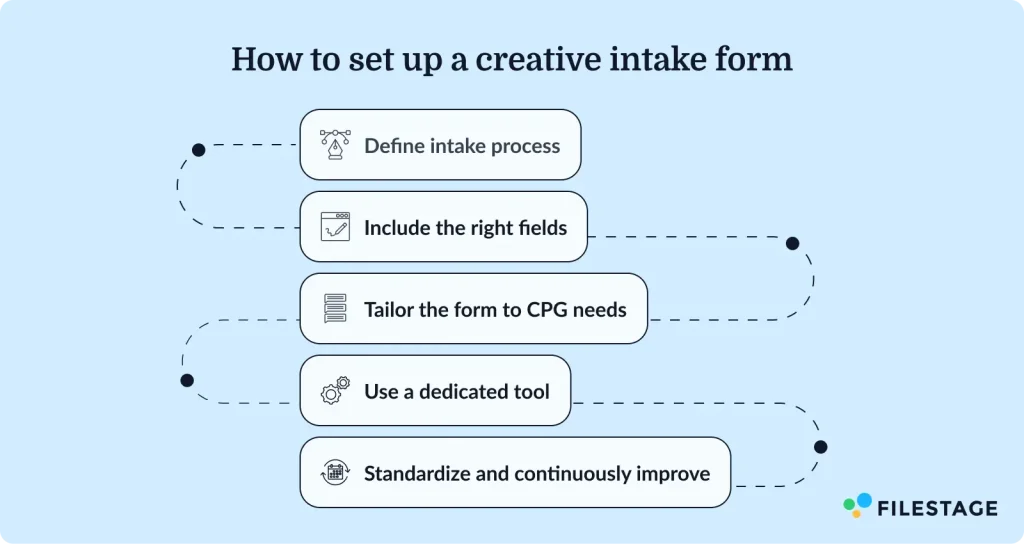
Follow this simple five-step process to set up your own creative intake form specifically tailored to CPG brands.
Step 1. Define the intake process and ownership
Start by creating one entry point for all creative requests.
Every new project, whether it comes from an internal brand team, an external client, or a regional marketing manager, should go through the same intake process. Consistency is what makes the system work.
Then, assign a person or team to own it. They’re responsible for reviewing submissions and routing them into the right workflow, flagging anything incomplete along the way.
The simplest rule you can set: no intake form, no work starts. That’s what makes the process stick across your organization.
Step 2. Include the right fields (without overloading the form)
A strong intake form captures enough detail to start work immediately, without overwhelming the people filling it in. An overly long form leads to incomplete submissions and low adoption.
Focus on collecting the essential information:
- Project overview – objectives, description, and success metrics
- Product details – SKU, format, region, and key constraints
- Target audience – demographics, psychographics, and competitive landscape context
- Channels and deliverables – where the content will appear and what needs to be created
- Brand assets and style guidelines – logos, fonts, tone of voice, and the reference examples that capture the creative vision
- Budget – allocated spend and any financial constraints
- Timeline and milestones – deadlines, key stages, and launch date
- Stakeholders and approvals – who reviews what, and when
Mandatory fields help clarify constraints early and prevent scope creep. Including a field for business criticality also helps your team identify and prioritize high-impact projects across a busy pipeline.
Establishing clear deliverables and technical specifications at this stage is critical to project feasibility.
Step 3. Tailor the form to CPG needs
Generic intake forms weren’t designed for the complexity of CPG creative production. Customize yours for the types of projects your team handles most.
This is also where your intake process starts to connect with the broader creative approval workflow, because the fields you capture here will directly inform how review rounds are structured downstream.
Add CPG-specific fields based on the project type:
- Packaging projects – dimensions, materials, dieline specs, print finish, and substrate requirements
- Compliance and regulatory – ingredient claims, labeling requirements, regional restrictions
- Retail channel requirements – specs for in-store displays, Amazon, DTC, or other channels
- Localization – market adaptations, language versions, and regional brand variations
Organize questions into clearly labeled sections rather than presenting users with a single long list. Grouping by category improves the experience and makes it easier for clients to provide accurate details without missing critical fields.
A well-organized form template also simplifies onboarding for new team members and external partners, giving everyone a clear process to follow from day one.
Step 4. Use the right tools to manage intake and workflows
Basic tools like Google Forms let you capture requests quickly. But as your creative workflow grows, you need a system that connects intake to your broader project management and execution.
Filestage lets you do exactly that. With Filestage’s intake forms, you can:
- Collect project details and files from clients and stakeholders in one go
- Build custom form templates tailored to each project type
- Automatically create review workflows for new form submissions
- Manage all assets, comments, and approvals in one place, from intake through to sign-off
This removes the manual handoffs that slow CPG teams down and gives everyone, from brand managers to external agencies, a clear view of where each project stands.

Step 5. Standardize and continuously improve
Once your intake form is live, treat it as a process you actively manage, not a static template.
Create form templates for recurring project types: packaging refreshes and seasonal campaigns being the obvious starting points. Analyze common bottlenecks and update fields based on feedback from your creative team.
Consistent questions across submissions also make it easier to filter, sort, and organize requests, helping you identify patterns and improve how you plan and allocate resources over time.
Cut feedback and approval time by 30%
Share content, get feedback, and manage approvals with Filestage.
Example of a creative intake form for CPG brands
Here’s how this works in practice.
A CPG brand is refreshing the packaging for one of its core product lines. The project involves new visual design and updated ingredient claims, with retail-specific variants needed for three markets.
Without an intake form, the brief arrives in pieces: some via email, some in a Slack message, and some verbally in a kickoff call. The design team starts work and discovers halfway through that the UK variant has different labeling requirements. The whole project stalls.
With a structured intake form, the brand manager submits everything upfront. Here’s what that form for a packaging refresh could look like:

Once submitted, the request flows directly into Filestage:
- Intake — the brand manager submits the form with all project details and supporting files
- Production — the creative team starts work immediately using the provided inputs
- Review — stakeholders leave precise creative feedback directly on packaging files
- Approval — regional reviewers sign off using a complete artwork approval audit trail
- Delivery — final assets are ready for print production
No chasing. No missing compliance information. No surprises three weeks in.

How creative intake forms improve speed-to-market for CPG brands
Speed-to-market is a competitive advantage in CPG. A new product that hits shelf three weeks late isn’t just an operational problem: it can mean missed promotional windows, lost distribution, and wasted money.
Creative intake forms help reduce project delivery timelines at every stage of the creative process.
They eliminate missing information at the start, which is the most common cause of mid-project delays. They also enable parallel workflows: design, compliance review, and production planning can all begin at the same time, rather than waiting sequentially for details.
By reducing manual routing and centralizing communication, intake forms shorten overall project timelines. They also make global scalability manageable. Standardized forms mean a brand manager in Germany submits the same structured information as one in the US, making localization and campaign adaptation faster and more consistent.
Most importantly, intake connects directly to the full creative process:
Intake → Creation → Review → Approval → Production
When that workflow runs smoothly, CPG brands can launch campaigns and products faster, with fewer errors, and with less pressure on creative teams.
Try Filestage’s creative intake forms for faster approvals
Creative intake forms bring structure to one of the messiest parts of CPG marketing: the moment a project begins.
They standardize how requests are submitted, improve alignment across marketing, design, and packaging teams, and reduce the delays that push timelines and frustrate everyone involved.
If your current process relies on scattered emails and verbal briefs, a structured intake form is one of the simplest, highest-impact changes your team can make.
Start your free trial of Filestage and see how intake forms can streamline your creative production from day one.
FAQ
What is the purpose of a creative intake form?
A creative intake form collects all essential project details before work begins. It standardizes how requests are submitted, reduces back-and-forth, and helps creative teams start new projects faster and with fewer gaps.
What should a CPG creative intake form include?
At minimum, a CPG creative form should include project objectives, product details, target audience, deliverables, brand assets, budget, compliance requirements, timeline, and stakeholder contacts. CPG-specific forms should also capture packaging specs, regional regulatory requirements, and retail channel information.
How is a creative intake form different from a creative brief?
An intake form is the entry point: it collects the raw project information. A creative brief refines that information into a clear direction for the creative team. Both serve different stages of the same process.
How can creative teams ensure the adoption of intake forms?
Keep the form simple and well-organized. Group questions into clear sections. And make the intake process mandatory for all new project requests, connecting it directly to the tools your team uses for creative approval so there’s a visible benefit to using it.