

TL;DR
- Marketing compliance ensures adherence to legal and ethical standards, and using a checklist helps build consumer trust and enhance brand reputation
- A marketing compliance checklist turns pre-publish review from an ad-hoc, person-dependent scramble into a repeatable step every asset goes through
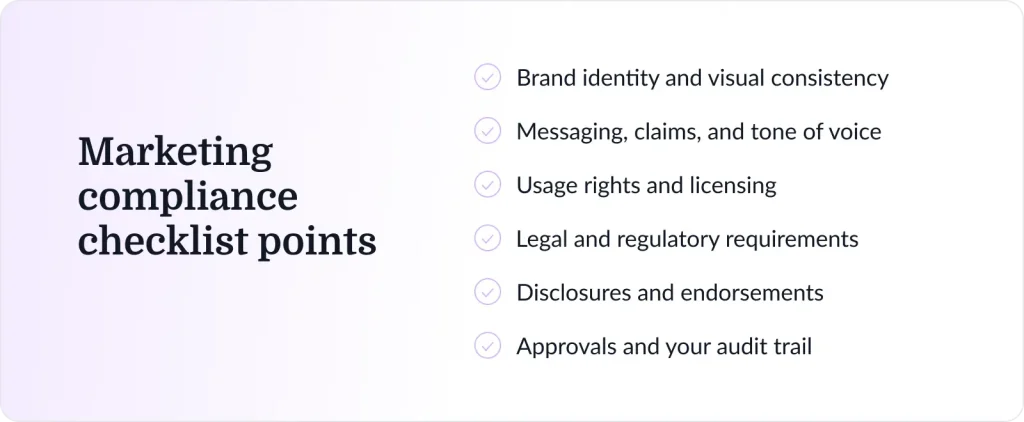
- The six checkpoint groups cover brand identity, messaging and claims, usage rights, legal and privacy requirements, disclosures, and approvals
- Used well, it lowers your compliance risk and cuts the chance of non-compliance slipping into a live campaign
- Give every check an owner so nothing ships with an omitted disclosure or an unapproved claim
- Build the compliance checklist into your approval process so it runs on every review, with an audit trail for each sign-off
Why your team should use a marketing compliance checklist
One ad with a misleading claim can trigger real legal risks. One missing disclosure can force an expensive reprint or dent a brand reputation that took years to build. A marketing compliance checklist is the pre-publish safety net that keeps small oversights from turning into costly ones.
It gives marketing teams and creative teams one shared, brand- and content-focused list to run every asset through before it goes live, which matters more as digital marketing spreads across more channels.
Regulators like the Federal Trade Commission expect every claim to be truthful and backed by evidence. For what the rules actually require, see our guide to what marketing compliance is and the regulations behind it.
Knowing why marketing compliance is important is one thing, but a checklist is what makes it happen the same way on every asset.
- Everyone reviews against the same standard, so approvals don’t swing with whoever’s on shift
- Reviewers know exactly what to check, so each round of review moves faster
- You catch claims and licensing issues before publish, which keeps your marketing efforts out of trouble
- Documented checks and sign-offs leave an audit trail, so any decision can be defended later
- Built-in checks make regulatory compliance a habit instead of a last-minute rush
What should you include in a marketing compliance checklist?
The checks below fall into six groups, and together they answer one practical question: you have an asset in front of you, so what exactly do you check before you approve it?
A good marketing compliance checklist does the translation for you. It turns the key marketing compliance regulations that govern your work into plain checks, so critical regulations and legal standards become something you simply tick off instead of memorize. That’s how you catch everyday compliance issues across your marketing activities while staying aligned with the ethical practices your audience expects.
Here’s each group and what to look for.
1. Check brand identity and visual consistency
Before anything else, confirm the asset looks like it came from you. Visual consistency is the most visible form of brand compliance, and it’s the easiest thing for a rushed reviewer to wave through. Check each element against your brand guidelines and the rest of your approved marketing materials.
- Logo usage – the correct version, with proper clear space and no distortion
- Color palette – on-brand hex values, not a close-enough approximation
- Typography – approved fonts, weights, and sizes
- Imagery style – photography and illustration that fit your visual language
- Template and layout adherence – grids, margins, and spacing that follow the master file
- Co-branding and partner marks – partner logos sized and placed per the agreement
- Trademark usage – ® and ™ symbols applied wherever they are required
2. Check messaging, claims, and tone of voice
Next, read the words as carefully as you looked at the design. This is the heart of content compliance: every claim has to be accurate and defensible, with no misleading claims and every required disclosure in place. Your marketing messages should say only what you can prove.
- Approved messaging and terminology – language that matches your latest brand or product sign-off
- Claims and supporting evidence – every performance or superiority claim backed by data you can produce on request
- Facts, statistics, and sources – numbers that trace to a named, current source
- Pricing, promotions, and offer terms – discounts and expiry dates that are correct and clearly stated
- Tone of voice and readability – copy that sounds like your brand tone of voice and that a real person can follow
- Localization and translations – regional versions reviewed by someone fluent, not just run through a tool
- AI-generated copy reviewed by a human – nothing published straight from a model without a person checking it
- Forbidden or restricted terms checked – words that trigger extra rules, like “guaranteed” or health language, flagged early

3. Check usage rights and licensing
Every image, clip, font, and track in the asset needs to be there legally. Licensing problems are easy to miss because the asset looks finished, but a stock photo used past its term or outside its region is still a breach. That now includes anything AI-generated, which needs to be checked against your own internal AI-use policy before it goes out.
- Images, video, music, fonts, and other assets are licensed for the intended use
- Licenses cover the relevant channels, territories, and duration
- Licenses and permissions have not expired
- Model, talent, and contributor releases are documented
- AI-generated assets have been checked for usage and intellectual property risks
- AI-generated assets have been correctly labeled in accordance with the EU AI Act
4. Check legal and regulatory requirements
A few legal and data privacy checks belong on every reviewer’s radar, even when legal signs off separately. You’re not interpreting the law here. You’re confirming the asset carries the disclaimers, consent language, and privacy notices it needs to stay ahead of common data privacy concerns.
Different channels answer to different rules, so email and other electronic communications fall under laws like the CAN-SPAM Act and the Telephone Consumer Protection Act, while the California Consumer Privacy Act and California Privacy Rights Act shape what you collect and disclose.
- Industry-specific disclaimers included where required
- Privacy and consent statements present and current, with explicit opt-in consent for any data collection
- Cookie and opt-out controls that work and are easy to find
- Data-handling practices and access controls that match what you tell people you do
- Accessibility requirements met, including alt text, captions, and color contrast
5. Check disclosures and endorsements
If money, product, or a relationship changed hands, your audience has to know. This matters most in social media compliance, where influencer and creator content moves fast and disclosures get dropped. The rule of thumb: a disclosure has to be clear and conspicuous, not buried in fine print or a wall of hashtags. These required disclosures protect both the audience and you.
- Influencer #ad and #sponsored labels that are present and easy to see
- Affiliate-link disclosure wherever you earn on a click
- Employee and ambassador endorsements disclosed as connected to the brand
- Incentivized reviews and user-generated content labeled as such
- Testimonials that are accurate, authorized, and appropriately qualified
6. Check approvals and your audit trail
The last group is the one that’s hardest to prove after the fact. Spreadsheets and email threads fall apart the moment someone asks who approved a specific version, and when. This is exactly the part a review and approval platform automates, replacing manual review with a tracked compliance process.
- Reviewers have been assigned to the asset
- Feedback has been collected and resolved, with nothing left open
- All required reviewers have approved the current version
- The approval history and file versions are documented
- The file you publish matches the approved final version, not an earlier cut
This is where Filestage does the heavy lifting. You assign reviewers and due dates to each step, and every comment and version is tracked automatically as the work moves. Approvals are captured with a one-click sign-off, so you end up with a complete, timestamped review report, the kind of audit trails you can hand to an auditor without reconstructing anything.
Compliance software helps you mitigate risks and keep internal policies enforced, and a review and approval platform like Filestage brings that same discipline to your workflow without chasing people by hand.

Supercharge your marketing reviews
Share, review, and approve all your content in one place with Filestage.
Who should check what? Marketing compliance roles and responsibilities
A checklist only works if someone owns each part of it. Without clear roles and documented decisions, even a careful team can ship an asset with a dropped disclosure or an unapproved claim, usually because everyone assumed someone else had checked.
The fix is a small, cross-functional compliance team where each person knows what they sign off, and when. Backed by employee training and written internal policies, that turns scattered compliance efforts into a real compliance program.
- The content owner drafts the asset and owns the first-pass checks.
- A brand manager reviews visuals, tone, and naming.
- A legal or compliance reviewer verifies claims, disclosures, and regulatory language on anything new or high-risk. That legal review is where risky claims get caught before they run.
- A final approver then authorizes publishing, so nothing goes live on assumption.
Meeting your compliance requirements and maintaining compliance over time depends on these roles being filled, not just named. A documented compliance process and clear records are how you make sure compliance continues even as people change.
| Role | Responsibility | When to sign off |
| Content owner (designer, copywriter, content writer) | Drafts and owns the asset | Every asset |
| Brand manager | Checks visuals, tone, and naming | Every asset |
| Legal / compliance reviewer | Verifies claims, disclosures, and regulatory language | New campaigns and high-risk content |
| Final approver (Head of Marketing, CEO) | Authorizes publishing | Before any asset goes live |
Free marketing compliance checklist template
We have some good news! You don’t have to build this from scratch. There are two easy ways to put this marketing compliance checklist to work.
Grab the free template.
Download the full six checkpoint groups as tick-boxes, plus the roles table, in a printable and copyable format you can adapt to your brand. Download the checklist.
Build it into your reviews with Filestage.
Filestage lets you turn any compliance checklist into a reusable template and attach it to a reviewer group, so every review in that group shows the same checks. Reviewers tick each item as done, and Filestage logs who checked it and when, so the record lives inside the review instead of a side spreadsheet.

How to make marketing compliance part of your approval process
Your checklist works best when it’s built into how you already review and publish. These compliance best practices turn it into a habit and keep your compliance program running as the rules change:
- Define which checks apply to which content types – match each type of asset to its checklist, so a quick social post isn’t held to the same bar as a regulated product page
- Assign an owner for each check – put a name next to every item, so nothing falls into the gap between people
- Build the checks into your review stages – add them to the steps in your workflow so they show up automatically, not from memory
- Set approval requirements before publishing – decide which sign-offs are mandatory and block publishing until they’re done
- Keep feedback, versions, and decisions in one place – pull them into a single tool so the record stays intact and nothing gets lost in email
- Review and update the checklist as requirements change – run regular audits so new rules and channels make it onto the list
As your volume grows, a dedicated approval or content governance tool makes these steps automatic and gives you an audit trail.
Make marketing compliance part of every review
A marketing compliance checklist is only as good as the number of times it actually gets used. Make it part of every review and give each check a clear owner, and compliance stops being something you worry about after publishing. It becomes a quiet step the whole team trusts, one that helps you maintain consumer trust and keeps customer relationships intact on every asset.
Ready to build it into your workflow? Start your free trial of Filestage.
Frequently asked questions
When should you run a marketing compliance check?
Run it right before an asset goes live, as the final step of your approval process. That’s the sweet spot, when the copy and design are close to final but there’s still time to fix a problem. For high-risk work like regulated claims or paid campaigns, run an earlier check too.
Who is responsible for marketing compliance?
It’s shared. The content owner runs first-pass checks, a brand manager reviews visuals and tone, and a legal or compliance reviewer verifies claims and disclosures against key regulations like the General Data Protection Regulation and the California Consumer Privacy Act. A final approver signs off before anything ships.
How often should you update your marketing compliance checklist?
Review it at least once a year, and again whenever a regulatory change, a rebrand, or a new channel changes what you publish. Privacy rules are constantly evolving, so don’t wait for the annual review if something big shifts. Treat every major update, and every batch of regulatory changes, as a reason to revisit the list.
Can marketing compliance checks be automated?
Parts of them can. You can automate the workflow around the checks, from assigning reviewers to routing approvals and logging every sign-off. But the judgment calls, like whether a claim is properly supported, still need a person. The best setup pairs automation with human review.
How should you review AI-generated marketing content for compliance?
Treat it like any other draft, then add a few extra checks. Have someone review every AI-generated asset before it runs, confirming the claims and sources hold up and the usage rights are clear. AI can invent statistics and lean on unlicensed material, so the checklist matters even more. Check out our guide on AI marketing compliance to learn more.
What are the risks of non-compliance in marketing?
Non-compliance can carry real legal consequences, from financial penalties to formal legal action, and repeat slip-ups tend to invite increasing regulatory scrutiny. The quieter cost is trust, since one public mistake can undo years of goodwill. A checklist is a cheap way to avoid severe financial penalties and the kind of regulatory scrutiny you don’t want.