Teamwork makes the dream work when it comes to running a successful business. But only if those teams are given the management software they need to thrive.
According to Gallup’s 2026 State of the Global Workplace report, only 20% of employees worldwide are engaged at work, costing the global economy an estimated $10 trillion in lost productivity. Giving teams the right tools is one of the most direct ways to address that gap.
The right team management software brings together task assignment, deadline tracking, and collaboration in one place, so your team members can focus on work that actually moves the needle.
In this article, we’ll help you choose the best team management software for every project type and team size.
TL;DR
- The best team management software gives teams one place to assign tasks, track progress, and automate workflows
- This guide compares 10 tools across project management, content approval, communication, knowledge management, and time tracking
- Nine of the 10 tools offer a free plan
- Pricing ranges from free to $249/month flat, with most per-user plans starting under $12/month
- For teams managing content reviews and approvals, our tool Filestage is the standout choice
Manage every approval in one place
Request approval without sending a single email with Filestage.
How we chose these tools
Choosing the right team management software means looking at more than just the feature list. Here’s what we evaluated when building this list.
Core features
Does the tool cover the essentials like task management, deadline tracking, progress reporting, and the ability to automate workflows? We looked for tools that help teams save time and stay organized across complex projects.
Team size fit
Some tools work best for small teams; others scale comfortably to large enterprises. We’ve flagged the best fit for each tool.
Integrations
The best management software connects to the tools your team already uses. We looked at how well each platform integrates with Google Drive, Slack, Microsoft Teams, and other tools in the typical team stack.
Pricing and free plans
Many team management tools offer free plans or trials so you can test the software before committing to a paid plan. We noted which tools offer free access, what the entry-level paid plan costs, and whether the pricing model is per-user or flat-rate.
Comparison table: the 10 best team management tools
| Tool | Best for | Free plan | Paid plans from | Key integrations | Team size |
|---|---|---|---|---|---|
| Asana | Complex workflows | ✓ | $10.99/user per month | Slack, Google Drive, Teams | Any |
| Basecamp | Small teams | ✓ (1 project) | $15/user per month or $299/month flat | Zapier, Harvest, Slack | Small–mid |
| monday.com | Workflow planning | ✓ | $9/user per month | Google Drive, Teams, Zoom | Any |
| ClickUp | Workflow automation | ✓ | $7/user per month | Slack, Google Drive, GitHub | Any |
| Trello | Visual workflows | ✓ | $5/user per month | Slack, Google Drive, Zapier | Small–mid |
| Notion | Knowledge organization | ✓ | $10/user per month | Google Drive, Slack, GitHub | Any |
| Filestage | Content approval | ✓ | $199/month | Dropbox, Slack, Teams | Small–large |
| Slack | Team communication | ✓ | $8.75/user per month | 2,600+ apps | Any |
| Helpjuice | Knowledge bases | X (14-day trial) | $249/month | Slack, Zendesk | Mid-large |
| Clockify | Time tracking | ✓ | $3.99/user per month | QuickBooks, Asana, Trello | Any |
Project management tools
Project management software helps teams plan tasks, track progress, and keep complex projects moving on schedule. These are the five best project management tools for teams of different sizes.
1. Asana – top tool for task management
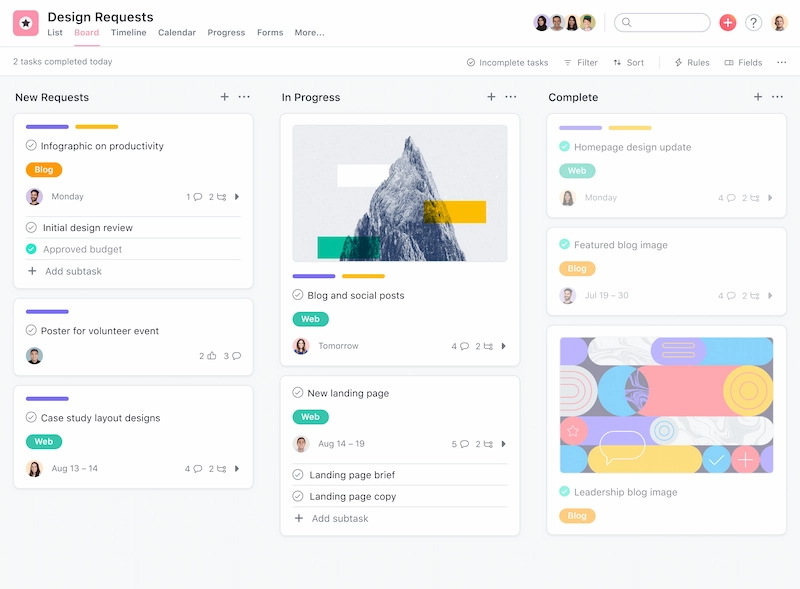
Asana helps project managers and teammates alike stay on top of their workload and get projects done on time.
This popular project management tool offers a wide range of features designed to take teams from project plan to completion. Asana is particularly strong for managing complex, multi-stakeholder workflows, with the ability to link daily tasks directly to strategic company goals.
With Asana, you can assign tasks to different team members, set due dates, and track progress across all your projects. Once a task is complete, it moves to the next stage, like a virtual production line with full visibility for everyone involved.
Key features
- Task assignment, subtasks, and dependencies
- Gantt charts (Timeline view), Kanban boards, and multiple project views
- Unlimited automation rules to handle repetitive tasks
- Reporting dashboards to track work and progress across projects
- Sprint planning and workload management
- Integrations with Slack, Google Drive, Microsoft Teams, and Salesforce
Who it’s for
Teams of any size that need to manage complex projects with clear ownership and automated workflows. Asana’s free plan covers up to two users; paid plans start at $10.99/user per month.
2. Basecamp – top tool for managing small teams
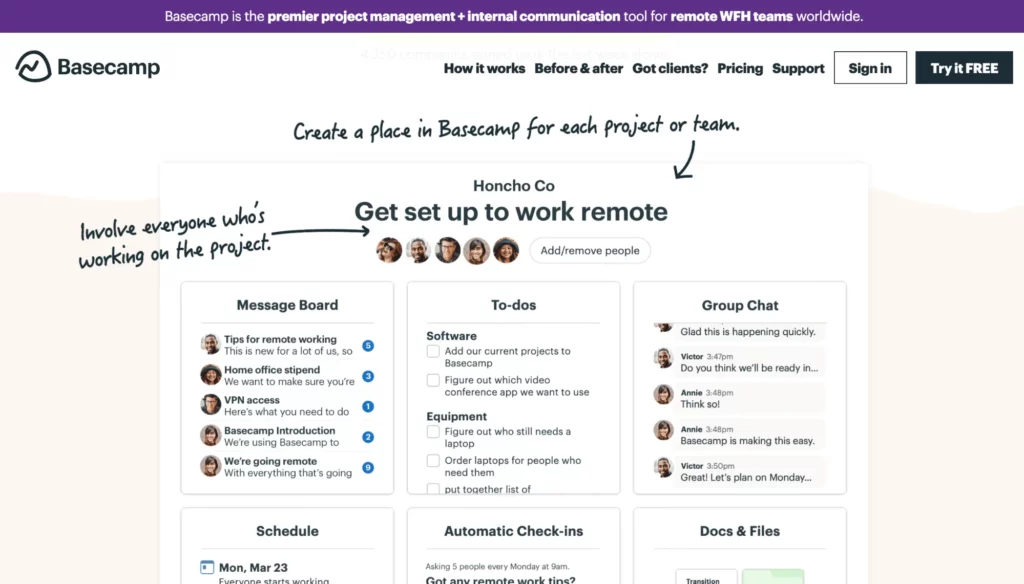
Basecamp is a team management tool that champions simplicity by combining creative project management, collaboration, and communication into one user-friendly platform. This makes it the perfect tool for smaller teams or those that want a reliable tool without all the bells and whistles.
The real beauty of Basecamp is that it eliminates the need for multiple different platforms and lengthy email chains. It acts as a centralized hub for all things related to team collaboration, letting members communicate both publicly and privately, share files, create to-do lists, and track project progress.
Unlike tools like Jira or Wrike, which can have steep learning curves, Basecamp is designed to see higher daily usage by keeping things intuitive and accessible.
Key features
- Message boards, to-do lists, and group campfire chat
- File sharing and document collaboration
- Project schedules and hill charts for tracking progress
- Guest access for clients and contractors at no extra cost
- Unlimited users on the Pro Unlimited plan
- Integrations with Zapier, Harvest, Clockify, and Slack
Who it’s for
Small to mid-sized teams that want straightforward team coordination without complex setup. Basecamp’s free plan covers one project; the Plus plan costs $15/user per month, and Pro Unlimited is $299/month flat for unlimited users.
3. monday.com – top tool for planning team workflows
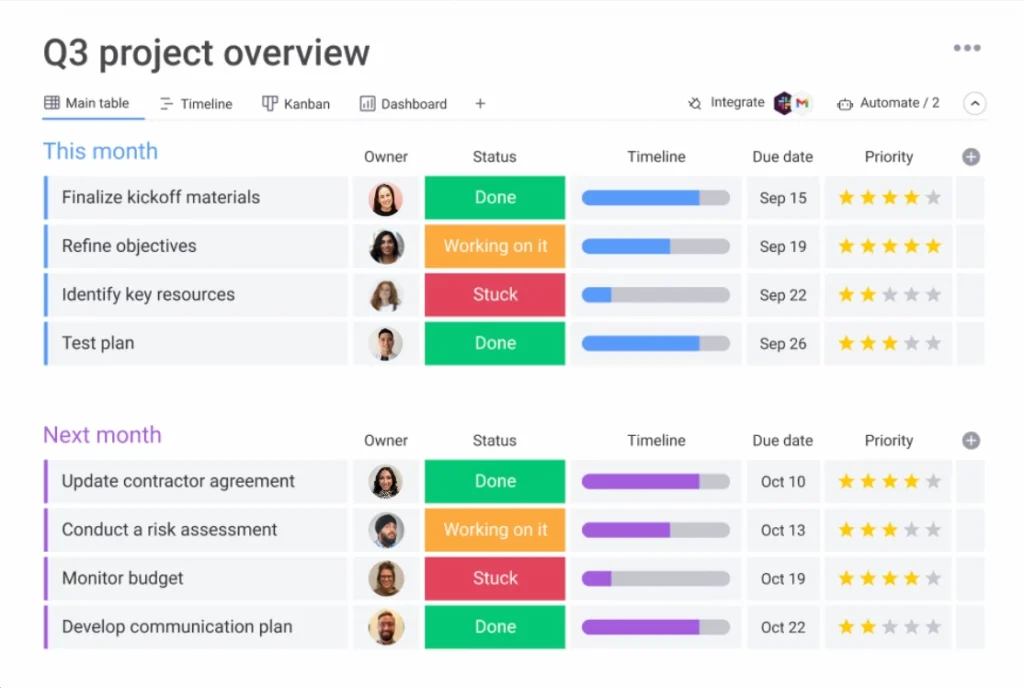
monday.com work management is a market-leading platform that helps organizations plan and manage project workflows, with 200+ preset templates to choose from.
monday.com’s user-friendly interface simplifies the process of creating and customizing workflows. Teams can design and modify project workflows with drag-and-drop tools, custom boards, and flexible task structures. Its open API and 200+ native integrations, including two-way sync with Jira, Salesforce, and Google Drive, make it easy to build connected workflows across your existing tools.
You can also use the platform to communicate, share feedback, and help teams collaborate in one shared space. This level of clarity helps everyone stay informed and aligned throughout the project lifecycle.
Key features
- Visual workflow boards with 200+ customizable templates
- Custom workflows, Gantt charts, and calendar views
- Automation for repetitive tasks and status updates
- Sprint planning and workload tracking
- Dashboards for tracking project details and team performance
- Integrations with Google Drive, Microsoft Teams, Zoom, and 200+ other tools
Who it’s for
Cross-functional teams of any size that need a flexible platform for planning and managing workflows across departments. Free plan covers up to two users; paid plans start at $9/user per month.
4. ClickUp – top tool for workflow automation

ClickUp consolidates tasks, docs, goals, and time tracking into a single customizable platform, making it one of the most feature-dense team management tools available.
With its highly customizable workspace, teams can decide which tasks to automate workflows around and make adjustments based on specific project requirements. ClickUp also offers 15+ views, including Gantt charts and Kanban boards, and its AI assistant ClickUp Brain can summarize updates, draft briefs, and automate documentation, which is useful for software teams and agencies managing multiple projects at once.
ClickUp also comes with a selection of ready-to-go templates for agency management, content creation, budget reports, and brainstorming, saving time across every team in your business.
Key features
- Tasks, subtasks, and custom statuses
- Workflow automation to reduce repetitive tasks
- Gantt charts, Kanban boards, and 15+ project views
- Built-in time tracking and goal tracking
- Custom workflows and AI writing with ClickUp Brain
- Integrations with Slack, Google Drive, GitHub, and Zoom
Who it’s for
Startups, agencies, and software development teams that want an all-in-one platform to organize projects, automate workflows, and track work. Free plan available; paid plans from $7/user per month.
5. Trello – best tool for visualizing workflows
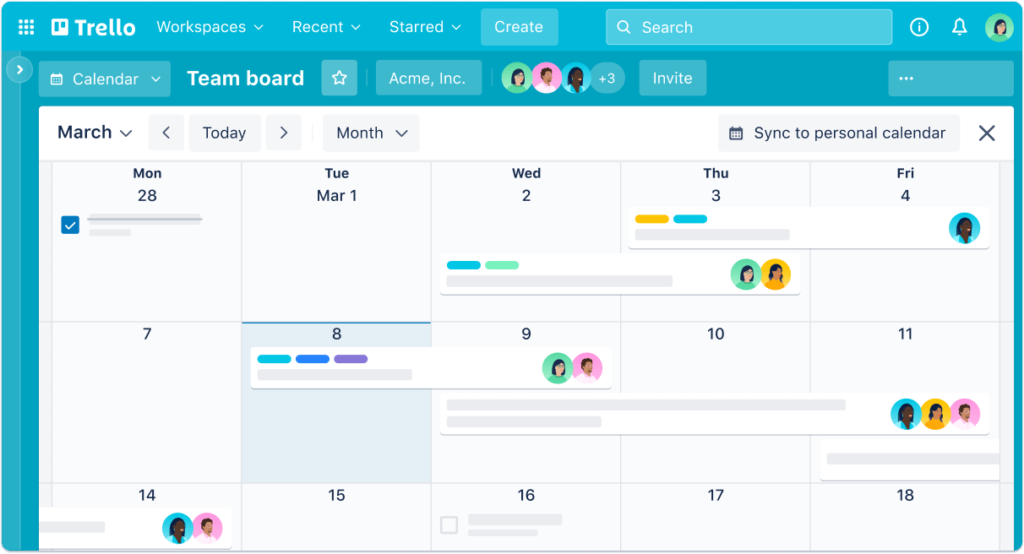
Trello is an intuitive, card-based system ideal for simple Kanban workflows. It helps teams visualize and manage work without any complex setup.
This team management tool is super simple to use, making it easy for teams to collaborate and stay on top of their work. Create boards to represent different timelines or workflows for tasks, then add lists within each board to break tasks down into steps. Trello is particularly well-optimized for mobile, making it a strong choice for teams that need to manage work on the go.
Labels, due dates, attachments, and comments can all be added to each task with just a couple of clicks. Trello also integrates with over 200 popular apps (known as Power-Ups) and connects to tools like Zapier and Slack to help teams stay organized.
Key features
- Drag-and-drop Kanban boards with unlimited cards
- Butler automation for routine tasks
- Timeline and calendar views on paid plans
- 200+ Power-Up integrations, unlimited on all plans
- Guest access and team visibility controls
- Integrations with Slack, Google Drive, Jira, and Zapier
Who it’s for
Small to mid-sized teams with simple, visual project management needs. Its free plan is genuinely useful; the Standard plan costs $5/user per month, and Premium is $10/user per month.
6. Notion – top tool for documentation and project management

Notion is a flexible workspace that combines notes, wikis, databases, and kanban boards in one platform. It’s particularly well-suited to teams that need to manage structured work and large amounts of documentation in the same place, without juggling multiple tools.
Built-in AI can summarize documents, extract action items from meeting notes, and query your entire workspace. Teams on the Business plan can also build custom AI agents to automate specific internal workflows.
Where Notion stands out from other project management tools is its flexibility. You can build anything from a simple task list to a full company wiki, and connect it all in one workspace. This makes it a popular choice for teams that want a single source of truth across projects and documentation.
Key features
- Flexible pages, databases, and wikis in one platform
- AI writing, document summarization, and workspace Q&A (Business plan)
- Custom AI agents for automating team workflows
- Kanban boards, calendars, and timeline views
- Notion Pages for public-facing documentation
- Integrations with Google Drive, Slack, and GitHub
Who it’s for
Teams that manage both structured work and large amounts of documentation, and want AI built into their workflows. Free plan available; paid plans from $10/user per month (full AI requires the Business plan at $20/user per month).
Content review and approval
7. Filestage – top tool for approving content
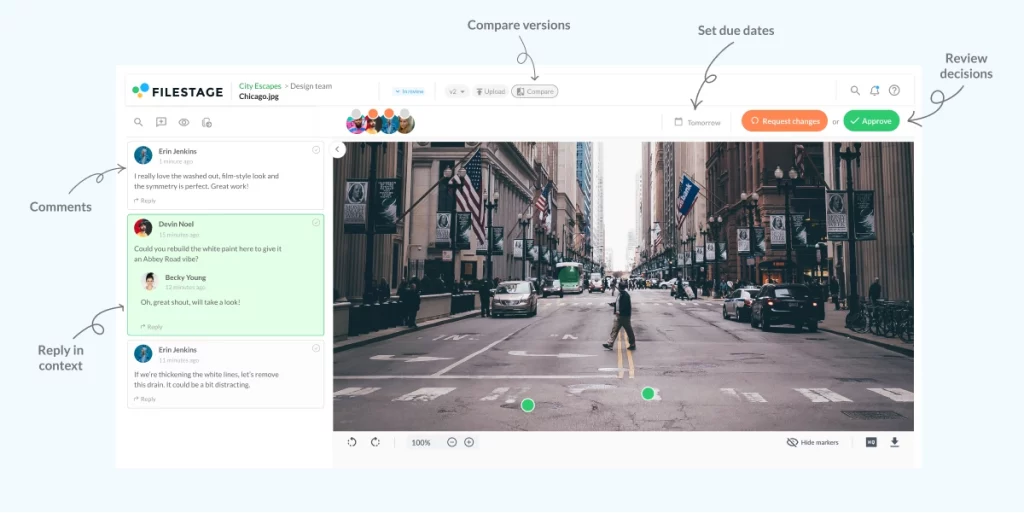
Nothing creates chaos faster than a faulty review and approval process. Going back and forth between different platforms. Getting caught in lengthy email chains. Mixing up file versions. All these little glitches make every job more complex and time-consuming than it needs to be.
Filestage is a team collaboration tool designed to streamline the way you share, review, and give feedback on content. By giving you a single, centralized space for all your content reviews, Filestage improves collaboration both within your team and between different departments and other stakeholders, too.
Key features
- Invite unlimited teammates and clients to review and give feedback
- Review all the popular file formats with one tool (documents, designs, videos, audio, HTMLs, PDFs, live websites)
- Add due dates to keep your projects on track and help your team meet deadlines
- Create reviewer groups to make sure files get approved by the right teammates at the right stage
- Comment directly on the file for clearer feedback that shows up in real time
- Turn comments into to-do lists so your team knows exactly what they need to do next
- Version history helps your team keep track of previous comments and changes
- Automate workflows to speed up your content reviews
- Project dashboards help you track what needs to be done and who’s yet to provide feedback
- Integrations with Dropbox, Google Drive, Slack, Microsoft Teams, and more
How to proof and approve projects with Filestage
- Sign up to Filestage for free
- Upload your files and add a due date
- Invite reviewers or send them a link
- Let collaborators add feedback and discuss ideas in the comments
- Upload new versions until all team members are happy
Who it’s for
Marketing teams, creative agencies, and anyone managing content approvals across multiple stakeholders and file types. Filestage offers a free plan for small teams; paid plans start at $199/month.
Manage every approval in one place
Request approval without sending a single email with Filestage.
Communication tools
8. Slack – best tool for team communication

Your team will struggle to make great work without quick, clear communication. Which is one of the many reasons why modern businesses use virtual collaboration tools that specialize in communication, with Slack being one of the most popular picks.
Slack excels at centralizing team conversations and integrates with over 2,600 other apps, making it the most connected team communication platform available. You can create channels for different projects and internal departments, share files, start video calls, and keep everyone in the loop about project and company updates.
Slack’s direct messages, thread replies, and Slack Connect (for working with external partners) make it easy to keep communication organized at any team size. While Slack is particularly useful for hybrid and remote teams working across different time zones, it works well in every kind of work environment.
Key features
- Organized channels for projects, teams, and departments
- Direct messages and threaded conversations
- Video and voice huddles with screen sharing
- File sharing and Clips for async screen recordings
- Slack Connect for communicating with external collaborators
- 2,600+ app integrations including Trello, Asana, and Google Drive
- AI-powered message summaries and search (included in paid plans)
Who it’s for
Teams of any size that need a centralized communication tool. Free plan available; paid plans from $8.75/user per month.
Knowledge management tools
9. Helpjuice – top tool for creating shared knowledge bases
Having a shared, searchable place to store and access information is an important part of team management. Helpjuice is one of the best tools available for building that kind of centralized knowledge base.
With Helpjuice, teams can come together to collaboratively create and share knowledge bases for quick access and faster workflows. The platform offers an impressive range of formatting and integration features so you can customize how you display and share information based on your team’s preferences.
Once you’ve created and saved your knowledge base, you can add to it at any time. Helpjuice’s powerful search engine indexes content inside PDFs and articles, so your team can find exactly what they need fast.
Key features
- Collaborative knowledge base creation and editing
- Intelligent search that indexes content inside PDFs
- Advanced analytics to understand how articles are used
- AI-powered writing, search, and chatbot (AI Suite plan and above)
- Free custom design service to match your brand
- Multi-language support with AI translation across 40+ languages
- Integrations with Slack and Zendesk
Who it’s for
Mid-to-large organizations that need a polished, searchable knowledge base for customer support or internal documentation. No free plan; 14-day free trial available. Plans start at $249/month for up to 30 users.
Time tracking tools
10. Clockify – top tool for time management
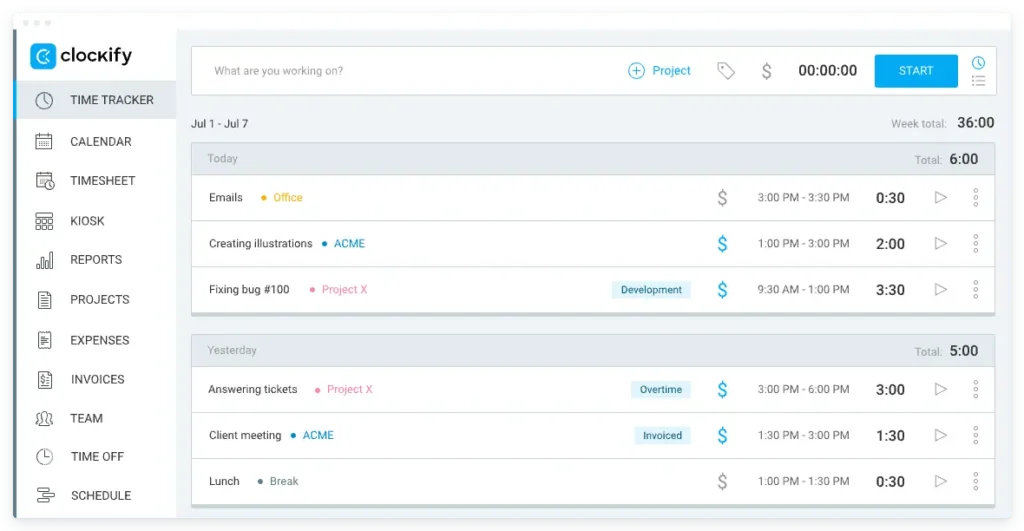
Time management is important for any business that wants to increase productivity while keeping chaos at bay. If your organization is regularly scrambling to meet deadlines or track work across a growing team, Clockify could be the right addition.
Clockify’s free plan has unlimited time tracking. Businesses can use it to track the time team members spend on tasks and projects, create project timelines, and generate reports on billable hours.
Once you’re relying on time tracking day to day, the paid plans unlock time approvals, invoicing, and project budget tracking, all the features that help agencies and consultancies keep their work profitable.
Key features
- Time tracking across tasks, projects, and clients
- Timesheets, time approvals, and billable hours tracking
- Project budget and resource management
- Reporting and data exports
- Mobile apps for tracking work on the go
- Integrations with QuickBooks, Asana, Trello, and other tools
Who it’s for
Freelancers, agencies, and teams of any size that need to track work and manage resources. Free plan covers up to five users; paid plans from $3.99/user per month.
Five reasons to use a team management tool
There are a lot of moving parts in any project, from making sure team members know what they’re working on, to tracking progress and keeping complex projects on schedule. Which is why so many businesses rely on management software to take some of the time and stress out of day-to-day team coordination.
Here are five reasons why organizations should consider working with a team management tool.
1. Efficient collaboration
Team management tools work by giving all team members a centralized platform where they can communicate, share files, assign tasks, and collaborate on projects in real time. This creates space for better teamwork by keeping everyone on the same page and making it easy to access the information they need to get the job done. That’s super important for remote and hybrid teams working across different time zones.
2. Enhanced productivity
The best team management software comes kitted out with features like task assignment, deadline management, and progress tracking. Together, these help teams stay organized and keep teammates accountable, which reduces the risk of tasks falling through the cracks.
Effective team management increases productivity by automating repetitive tasks and optimizing workflows, allowing teams to focus on more critical activities. That’s what the right work management tools are built to deliver.
3. Effective team communication
Team management tools typically come with a range of team communication features like chats, comments, and notifications, that make it easier for team members to communicate clearly without relying on lengthy email threads or scattered direct messages across different platforms.
In this way, team communication tools reduce misunderstandings and ensure that everyone stays in the loop.
4. Greater accountability and initiative
For teams to really succeed, each member needs to take ownership of their individual role. Team and project management tools help build accountability by letting everyone see exactly who is responsible for what and track progress on each project. This transparency also creates more opportunities for teammates to step in and help each other out during busy periods.
5. Continuous improvement
Some team collaboration software gives project managers and team leaders insight into timings, project workflows, and resource management. By analyzing this data, businesses can spot bottlenecks, optimize processes, and improve efficiency over time.
Final thoughts
Managing one or more teams can be overwhelming, with a lot to consider at every stage. But the right team management software solutions can make it a whole lot easier.
From faster task management to workflow automation, we hope this article has helped you find the right tool for your team’s needs. And if you’d like to see for yourself how Filestage can improve the way your teams review and approve content, start your free trial today.
Frequently asked questions
What is team management software?
Team management software is a category of work management tools designed to help teams plan, coordinate, and track their work. These platforms typically include features like task management, deadline tracking, communication, and reporting, all in one place.
What’s the difference between team management tools and project management software?
The terms are often used interchangeably. In practice, team management tools tend to focus on the people side of work like communication, accountability, and team coordination. On the other hand, project management software focuses more on project plans, timelines, and resource management. Most popular project management tools on this list cover both.
Which team management tools offer a free plan?
Most tools on this list offer a free plan: Asana, Filestage, Basecamp, monday.com, ClickUp, Slack, Clockify, Trello, and Notion all have free tiers. Many team management tools also offer free plans or trials so you can test the software before committing to a paid plan. Helpjuice is the exception, offering a 14-day free trial instead.
What should I look for when choosing team management software?
Look for tools that fit your team size, support the way you work (Kanban boards, Gantt charts, or simple task lists), integrate with the other tools in your stack, and offer a free plan so you can test before committing. If your team manages creative content, you’ll also want a dedicated review and approval tool like Filestage alongside your project management platform.
Is Asana better than monday.com?
Both are popular project management tools with overlapping features. Asana is best for managing complex, multi-stakeholder workflows and linking daily tasks to strategic goals. monday.com is better suited to teams that need a flexible, visual platform for planning workflows across departments. Both offer free plans so you can test each against your team’s needs before committing to a paid plan.
Which team management tool is best for remote teams?
Slack is the go-to choice for remote team communication. For project management, ClickUp, Asana, and monday.com are all well-suited to remote teams. If your remote team works with creative content, Filestage helps eliminate the back-and-forth of email-based reviews, helping teams stay organized and get to approval faster.