

A campaign is ready to launch. Then legal spots an unsupported claim, compliance flags a missing disclaimer, and brand catches inconsistent language. A few rounds later, nobody’s sure which version is actually approved. A compliance content review platform can catch issues earlier, bringing automated checks, version management, human review, and documented approvals into one workflow.
The Federal Trade Commission (FTC) doesn’t care whether it was an honest mistake. Its advertising substantiation policy requires a reasonable basis for a claim before it goes out, not after, or it counts as deceptive.
This guide is for marketing, compliance, and legal professionals who want faster content approvals and less regulatory risk. We cover what compliance content review is, how AI-powered checks work, where human judgment matters, how the workflow helps marketing teams, and five platforms worth considering.
What is a compliance content review platform?
A compliance content review platform helps teams check, review, approve, and document marketing content against regulatory requirements, internal policies, and brand standards before publication. Depending on the platform, it combines automated compliance checks with human review, version management, approval workflows, and audit trails.
Marketing compliance teams rely on platforms that are built around one job: reviewing content before it goes live.
A few things worth understanding upfront:
- Review happens before final approval, not after issues surface in the wild
- Automated checks flag potential problems, but don’t make the final compliance decision
- Human reviewers assess flagged issues, leave contextual feedback, and approve or request changes
- The platform keeps a record of every version, comment, decision, and approval
Automated scanning is one capability, not the definition of the whole category. A content review platform that only scans for keywords handles the first pass. Real compliance content review still needs the human steps that follow.
How does compliance content review work?
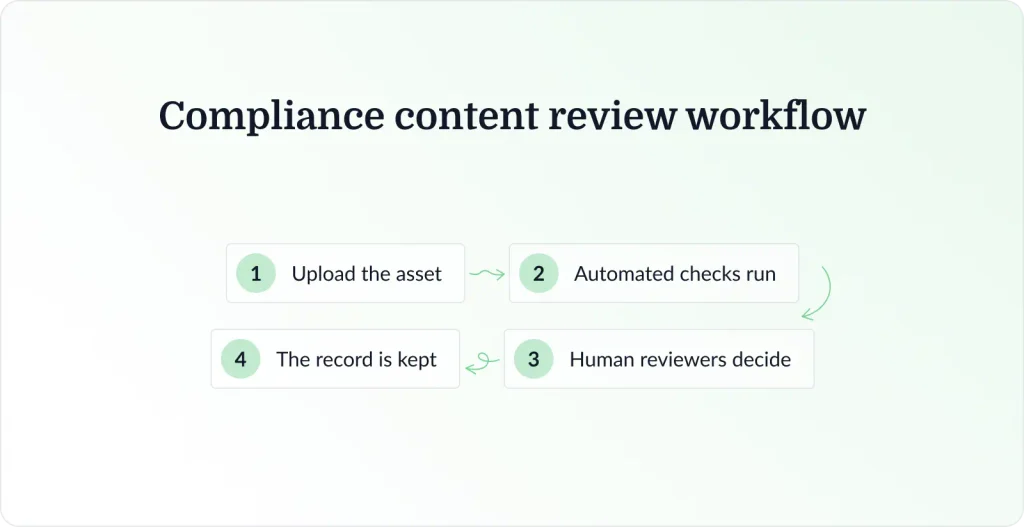
The workflow runs in four steps, and it’s worth treating as a cycle rather than a straight line, since assets often move between review and revision more than once before final approval.
- Upload the asset – documents, ads, social posts, video, packaging artwork, web content, or other marketing materials
- Automated checks run – configured rules and/or AI analyze the content and flag potential compliance, regulatory, or brand issues before a reviewer starts their assessment
- Human reviewers decide – legal, regulatory, compliance, and brand reviewers assess flagged issues, comment directly on the content, and approve it or request changes
- The record is kept – every version, comment, and approval is timestamped
| Traditional review | Compliance content review platform |
| Reviewer searches for issues | Software pre-flags potential issues |
| Feedback across email/PDF/chat | Feedback attached to the asset |
| Manual version tracking | Centralized version history |
| Approval may be hard to prove | Timestamped approval record |
| Same checks repeated manually | Repeatable rules and checks |
The goal isn’t to remove reviewers from the process. It’s to reduce repetitive work and give reviewers better information when making decisions.
For compliance professionals juggling several processes at once, the backlog you were dealing with becomes something manageable. It also makes compliance reporting easier, because the record builds itself as you go instead of being assembled after the fact.
Automated and AI-powered compliance review: what can actually be checked?
Two different things get lumped together under “AI compliance”:
- Rules-based automation checks content against predefined requirements, such as whether a mandatory disclaimer is present or an expired date appears in an asset.
- AI-assisted compliance review goes further, using machine learning and natural language processing to spot patterns that don’t reduce to yes or no.
Used together, they shift reviewers from reading every asset line by line to assessing a shorter, pre-flagged list, which is exactly what AI tools that automate content compliance review are built to do. Neither approach can determine whether content is legally compliant.
What automated compliance checks can identify
Rules-based checks are well suited to anything fixed and repeatable:
- Missing disclaimers and disclosures
- Disclaimer placement and prominence
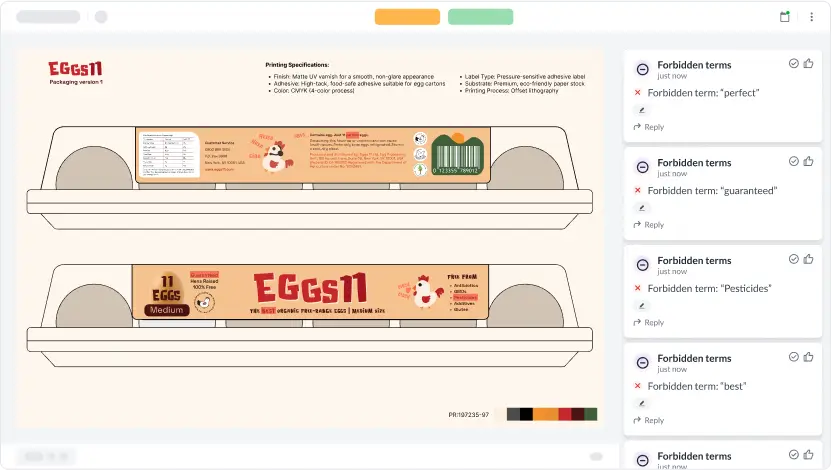
- Prohibited or high-risk phrasing, like “best”, “guaranteed”, or “risk-free”
- Numerical, currency, and percentage formatting errors
- Expired promotions, offers, and outdated pricing
- Required terminology or product information
- Accessibility and readability thresholds
What AI-assisted content review can identify
Depending on the platform, AI models can help surface more contextual or pattern-based issues:
- Claims that may require substantiation
- Potentially misleading or risky wording
- Off-brand language or tone
- Inconsistent terminology
- Imagery that may conflict with brand compliance guidelines
- Logo and visual guideline violations
- Similar issues previously identified in approved or rejected content
An AI-generated flag is something for a reviewer to investigate, not proof that the content is compliant or non-compliant.

Where human compliance review is still essential
The workflow runs as: AI identifies, humans interpret, named reviewers approve. Four areas where human judgment stays essential, regardless of how good the automated layer gets:
- Claim substantiation – an AI system might flag “clinically proven”, but a reviewer has to confirm the evidence actually supports that specific claim
- Jurisdiction and context – a “no fee” claim might be accurate in one market but misleading in another where a different fee still applies. Same wording, different regulatory answer
- Ambiguous and novel claims – an AI-generated product demo doesn’t map neatly to an existing disclosure rule, so someone has to decide how the rule should apply before a check can even be written for it
- Exceptions and risk decisions – a flagged phrase might technically trigger a banned-word rule while being a factual, non-promotional use of that word in context. A human decides whether the exception holds
A “was $120, now $60” discount claim is a good test case: rules-based automation flags the price-comparison format instantly, AI-assisted review flags that a reference price needs evidence behind it, and a compliance reviewer checks the item was actually sold at $120 before the ad goes out.
That decision gets recorded against the specific asset version, so accountability sits with a named person rather than an AI making the call unsupervised. The EU AI Act points the same way: it requires human oversight for high-risk AI systems and transparency around certain AI-generated content.
Most marketing review tools won’t count as high-risk, but “AI flags, humans decide” is a sensible standard to design for anyway. Good AI content governance keeps AI systems advisory, with responsible AI built in from the start.
How compliance content review helps marketing teams

The value isn’t simply “being compliant.” A better review workflow is a form of creative workflow automation that reduces repetitive work, shortens feedback loops, and makes the approval process easier to manage as volume grows.
It also changes how risk management works day to day: teams surface risks at upload instead of catching them after launch. That covers everything from a missing disclosure or a partner-supplied asset that slipped past third-party risk management, to a vendor risk or enterprise risk issue that would otherwise wait for a quarterly review.
It shows up in five specific ways:
Catch compliance issues before they reach reviewers
Automated checks identify common problems the moment an asset is uploaded, instead of relying on a reviewer to manually spot every routine issue. For marketing teams, that means obvious problems get fixed earlier, before a review round gets burned on something a rule could have caught, like a missing risk disclaimer. The payoff grows with volume, so compliance leaders running compliance workflows at scale feel it most.
Give reviewers fewer issues to check manually
Pre-flagging rules-based issues, like a missing logo or an expired promo code, frees legal teams, regulatory specialists, and brand reviewers to spend their time on judgment calls that actually need it. Human reviewers stay in the loop. What changes is where their attention goes, and that’s how compliance officers scale compliance work without scaling headcount at the same rate.
Reduce feedback loops and duplicate work
Contextual comments, centralized versions, and earlier issue detection cut down on the back-and-forth between marketing, creative, legal, and compliance teams, since nobody’s chasing context across five different email threads. Sensitive data handled carefully in that same workflow, rather than pasted into random chat threads, is a smaller but real benefit too.
Create one approval record across every version
Having versions, feedback, decisions, and final approval in one place beats reconstructing the process from email and chat history after the fact, like proving which version a client actually signed off on months later. This matters directly for audits and internal governance, not just convenience.
Apply the same review standards across markets and channels
Configurable rules and centralized review let teams apply common standards across campaigns, channels, and regions. Market-specific requirements still get their own treatment where they actually differ, without rewriting internal policies for every new market a company enters, like adding one country’s disclaimer wording without touching the rest.
Five compliance content review platforms
Compliance platforms don’t all solve the same problem. Some focus on marketing and creative review, while others specialize in serving financial services firms, security teams, or asset managers.
AI compliance has become the marketing term of choice for most compliance software vendors. So it’s worth reading past the AI compliance tools label to see which compliance programs and workflows the software actually lets teams run.
The best content compliance review tools combine both layers, automation and human oversight, rather than leaning on one alone.
| Platform | Best suited for | Content review | Automated/AI checks | Audit trail |
| Filestage | Marketing and creative teams in regulated industries | Yes | Yes (Review Agents) | Yes (audit logs on Enterprise) |
| Drata | Organizational security and compliance certification | No (not content-focused) | Yes (control monitoring) | Yes |
| Hadrius | SEC/FINRA-regulated investment advisers and broker-dealers | Yes (marketing materials) | Yes | Yes |
| Luthor | Financial services marketing compliance | Yes | Yes | Yes |
| IntelligenceBank | Brand and digital asset management (DAM) teams needing compliance checks | Yes | Yes | Yes |
Note: Filestage is our own product. We’ve evaluated it the same way as every other tool on this list.
Filestage – compliance review for marketing and creative content

Filestage is a review and approval platform for marketing, creative, and agency teams working with brand, legal, and compliance stakeholders. Reviewers comment directly on files, compare versions side by side, and approve or request changes, with every decision recorded.
Its Review Agents run automated checks on uploaded assets, including a CLP Compliance Agent that reviews files against the context documents you provide, plus checks for forbidden terms, mandatory images, and barcodes. Enterprise adds audit logs and verified approval for teams working to FDA 21 CFR Part 11 and EU Annex 11.
Filestage’s review features are built with EU AI Act requirements in mind, and the platform integrates with Slack, Microsoft Teams, Jira, Google Drive, and Adobe apps like Photoshop and InDesign.
Pricing: Free plan available, Starter $199/month, Business $329/month (includes Review Agents), Enterprise custom.
Deliver compliant content with confidence
Set up a consistent and compliant marketing review process with Filestage.
Drata – security and governance compliance
Source: Drata
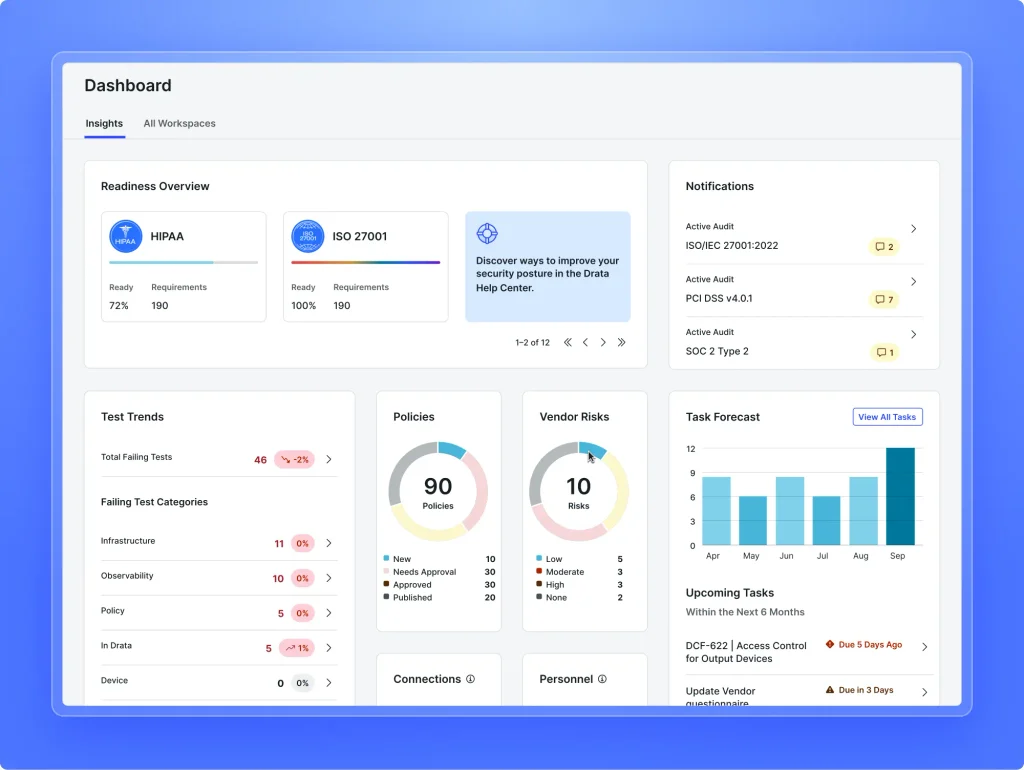
Drata is a different category of tool entirely: a governance, risk, and compliance (GRC) automation platform built around continuous control monitoring of an organization’s security posture and compliance programs. It collects audit evidence for frameworks including SOC 2, ISO 27001, HIPAA, and GDPR, and tracks the security and sensitive data controls each one requires.
It connects to hundreds of tools across cloud infrastructure, identity providers, and HR systems, including AWS, Slack, and Jira.
Drata doesn’t review marketing content. Its job is helping a company pass a security audit, so it’s worth knowing about if your need is organizational certification rather than reviewing what marketing publishes.
Pricing: custom, contact sales.
Hadrius – SEC and FINRA-focused marketing compliance

Source: Hadrius
Hadrius is an AI-powered compliance platform built for SEC- and FINRA-regulated registered investment advisers (RIAs), broker-dealers, and financial firms. It automates review of marketing materials, and separately handles communications archiving and audit preparation.
Hadrius is built around the SEC Marketing Rule, which sets specific requirements for performance advertising, and FINRA Rule 2210. It scans firms’ email, Slack, and social media channels for review, and connects with the CRM and trading platforms already in place.
Pricing: custom, contact sales.
Luthor – financial services marketing compliance

Source: Luthor
Luthor is an AI-native compliance platform for asset managers, RIAs, banks, lenders, and credit unions keeping up with constant regulatory changes. Teams upload content and get it checked against federal, state, and international regulations, company policies, and approved disclosures, with suggestions drawn from past approvals. Everything then sits in one place for review, approval, and audit.
Luthor positions itself as working alongside the tools firms already use, so confirm specific integrations with its team before you buy.
Pricing: custom, contact sales.
IntelligenceBank – DAM with marketing compliance capabilities

Source: IntelligenceBank
IntelligenceBank combines digital asset management with brand governance and a dedicated marketing compliance layer, which is what makes it content governance software as much as a compliance tool. AI-powered Content Risk Reviews check assets before approval, while Web and Ad Risk Reviews monitor live web pages and Google Ads after launch.
It suits teams who need brand asset management and compliance checks in the same system, rather than a standalone tool bolted onto a separate DAM. It connects natively with Adobe Creative Cloud apps, Figma, Canva, and Microsoft and Google document tools, and its Slack app lets reviewers approve content without leaving Slack.
Pricing: custom, contact sales (marketing compliance package).
How to choose compliance content review software
Use these four questions as a buying framework rather than a feature checklist. The market for compliance management software splits into marketing compliance software, financial-services-specific AI compliance tools, and broader compliance tools built for security rather than content.
1. What content can it review?
Documents, PDFs, images, video, websites, social media content, packaging, and whatever other formats your team produces. A platform that reviews PDFs well but can’t touch video leaves a real gap if half your output is video.
2. What can it check automatically?
Ask if you can configure your own compliance and brand rules, or if you’re stuck with preset checks. Does it support rules-based automation, AI-assisted review, or both? Can rules differ by brand, market, product, or campaign? And how are false positives handled, since a tool that flags everything gets ignored fast.
3. How does human review and approval work?
Look at review stages, reviewer permissions, comments and annotations, version comparison, and approval decisions. Check if external reviewers, like a client or outside counsel, can participate easily, and whether it integrates with your internal systems.
4. What evidence does it retain?
Confirm every approval is tied to a named reviewer, comments and decisions are timestamped, previous versions are retained, and the audit trail can be exported in a form that meets your audit requirements.
Beyond those four, it’s also worthwhile factoring in implementation time, security requirements, integrations, user management, jurisdiction support, scalability, and total cost, not just the sticker price.
Make compliance review faster, not less rigorous
Compliance content review platforms automate approval processes for marketing materials, help make sure content meets legal and regulatory requirements, and centralize policy management to maintain compliance across all communications.
Automation should reduce the amount of repetitive checking a human has to do. It shouldn’t reduce the judgment or accountability behind the final decision. Done right, the workflow gets faster and the record gets more defensible, not one at the other’s expense.
Start your free trial of Filestage and see how automated checks, human review, and documented approvals work together on your own content.
Frequently asked questions
What is the difference between compliance content review and marketing compliance software?
They overlap heavily and are often used interchangeably. Compliance content review describes the workflow: checking, reviewing, approving, and documenting content before it goes live. Marketing compliance software is the broader product category, which often bundles that workflow with DAM, brand governance, or campaign management features.
Can AI approve marketing content for compliance?
No, not on its own. Artificial intelligence can flag potential issues (missing disclaimers, risky phrasing, off-brand language), but a named human reviewer makes the actual compliance decision and is accountable for it. Treating an AI flag as a final answer is exactly the mistake these platforms are built to prevent.
What types of marketing content can compliance software review?
Most platforms cover documents, images, video, web pages, and social media posts, with some extending to packaging, print, and live websites after publication. Coverage varies by tool, so check file-format support against what your team actually produces before you commit.
What should a compliance audit trail include?
A named reviewer for every approval, timestamps on every comment and decision, retained previous versions, and an export option that satisfies internal or external audit requirements. Missing any of those four, and it’s not really an audit trail, just a history log.
Can compliance review software check video and creative assets?
Some can, but not all. Rules-based checks are easier to apply across formats. AI-assisted review of video and imagery is less mature than text-based review, so verify actual video capabilities rather than assuming “AI-powered” covers every asset type. Human error creeps back in fastest wherever that gap sits.