

Marketing campaign governance gets harder with every market and agency you add. This guide is for marketing leaders, campaign managers, and marketing operations teams running work across multiple channels.
You’ll learn how to set ownership, standards, risk tiers, approvals, compliance checks, and audit rules that keep everyone accountable without piling on bureaucracy.
What is marketing campaign governance?
Marketing campaign governance is the framework of roles, decision rights, standards, processes, and controls that decides how campaigns get planned, created, reviewed, approved, launched, and evaluated.
It settles the questions that come before the work: who owns the campaign, which rules apply, how much oversight it needs, and what proof you keep.
The Federal Trade Commission (FTC) already expects some of this structure. Its guidance on endorsements says advertisers need reasonable programs to train and monitor the people promoting their products, scaled to the risk involved.
Many teams already handle content governance at the asset level. Campaign governance sits one level up and covers the entire campaign lifecycle.
Marketing campaign governance vs. marketing campaign management
Marketing campaign governance sets the rules.
Marketing campaign management runs the campaign within them, covering campaign planning, budgets, timelines, and execution, as our guide to campaign management explains.
Campaign approval workflows control how each individual asset gets reviewed and signed off.
So governance decides who signs off on a regulated claim, and marketing campaign management makes sure that person sees it before launch.
Why campaign governance matters as marketing output scales
Informal governance works when one team runs a handful of campaigns. People know who decides what because they sit next to each other.
That stops working once you add markets, agencies, and stakeholders, and run work across multiple channels. When a regional team adapts messaging or an agency subcontracts a freelancer, nobody’s sure who signs off, and a claim can reach legal after it’s already live. Add stricter regulatory requirements, and those gaps get expensive.
Delegating doesn’t shift accountability either. The same FTC guidance is clear that handing promotion to an outside firm doesn’t relieve the brand of responsibility for it.
A governance framework gives marketing teams a way to protect speed, consistent brand messaging, marketing compliance, and accountability as the number of active campaigns grows, without adding checkpoints for their own sake.
How to build a marketing campaign governance framework in six steps
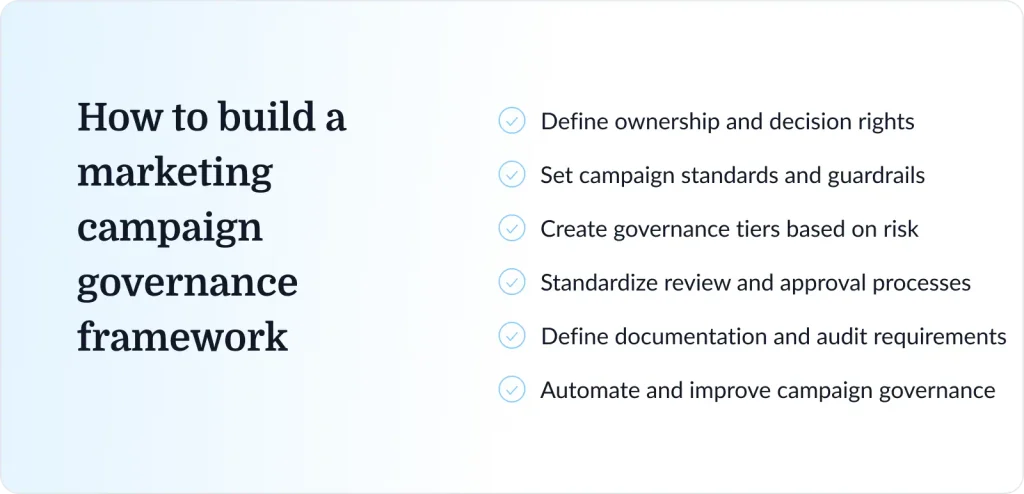
Each step below is a decision you make once and reuse on every campaign. They build on each other, so work through them in order.
1. Define campaign ownership and decision rights
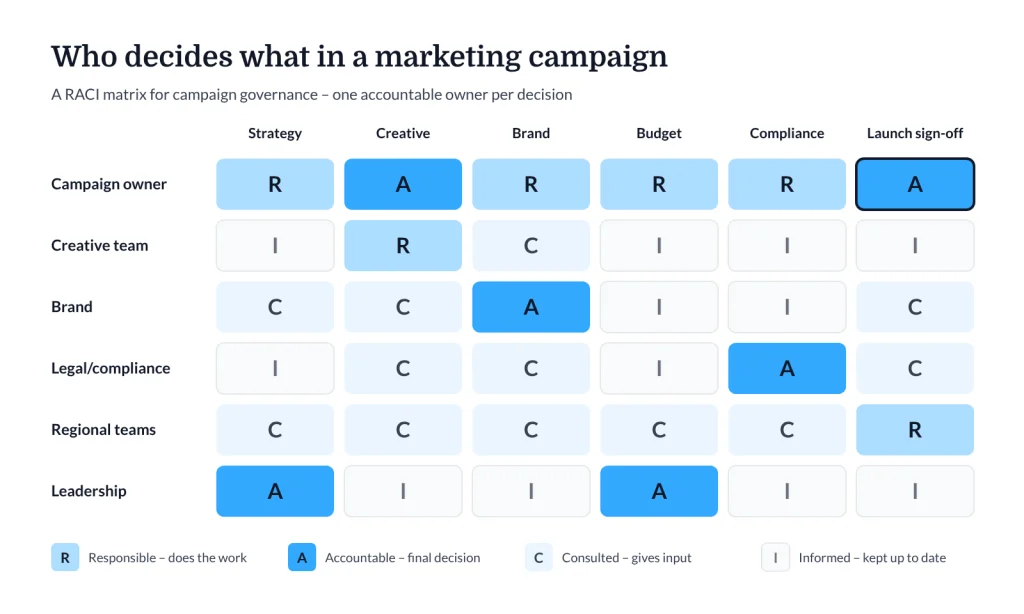
Start with who decides what. Every marketing campaign needs one named owner, but owning a campaign doesn’t mean having the final word on everything. Brand owns brand standards. Legal owns compliance. Senior management may own budget allocation once a campaign budget passes a set threshold.
| Role | Strategy | Creative | Brand | Budget | Compliance | Launch sign-off |
| Campaign owner | R | A | R | R | R | A |
| Creative team | I | R | C | I | I | I |
| Brand | C | C | A | I | I | C |
| Legal/compliance | I | C | C | I | A | C |
| Regional teams | C | C | C | C | C | R |
| Leadership | A | I | I | A | I | I |
A RACI matrix makes this visible. R is responsible, A is accountable (one person per decision), C is consulted, and I is informed.
Check the launch sign-off column first. It should have exactly one A, and everyone in the table should know who it is.
2. Set campaign standards and guardrails
Once you know who decides, write down what every campaign must follow and what teams can decide for themselves.
Central rules (non-negotiable)
- Brand and messaging standards
- A signed-off campaign brief with clear campaign objectives before work starts
- Approved claims only, with substantiation on file
- Channel and localization rules, including required disclosures
Team decisions
- Creative concepts within brand standards
- Localized copy and imagery within approved claims
The first list is where marketing campaign compliance lives, and a marketing compliance checklist helps reviewers check against it. The second list matters just as much. When teams know where their freedom is, they stop escalating decisions that are already theirs.
3. Create governance tiers based on campaign risk
Your owners and standards apply to every campaign, but the level of oversight shouldn’t. Routine social media posts and email campaigns don’t need the same process as a regulated launch, so sort campaigns into tiers and let the highest risk trigger set the tier.
| Factor | Low | Medium | High |
| Regulatory exposure | None | Offers or comparative claims | Regulated products, or health or financial claims |
| Markets | One | Two to four | Five or more |
| Ad spend | Under your threshold | Above your threshold | Requires leadership approval |
| Audience reach | Existing followers | Paid audiences | High-profile placements |
| Reputational risk | Routine messaging | New messaging | Sensitive topics or partnerships |
| Required reviewers | Campaign owner | Owner, brand, and legal for any claim | Owner, brand, legal, regional teams, and leadership |
| Key controls | Brand templates | Staged sign-off | Mandatory legal review and a full audit trail |
Treat these thresholds as a starting point and set your own. A global marketing campaign will usually land in the top tier on market count alone. Assign the tier at intake, before campaign creation begins, and record who made the call.
4. Standardize review and approval processes
Now turn the first three steps into rules each tier follows. For every tier, define:
- The required review stages, in order
- Which roles review at each stage
- The final approver, taken from your RACI
- A deadline for each stage
- The escalation path when a deadline slips, and who can approve an exception
Keep the rules to a page per tier. Exceptions need the most care, so name who can grant one and make them record why.
This step covers the governance rules. For the mechanics of each workflow, see our guide to building a campaign approval workflow.
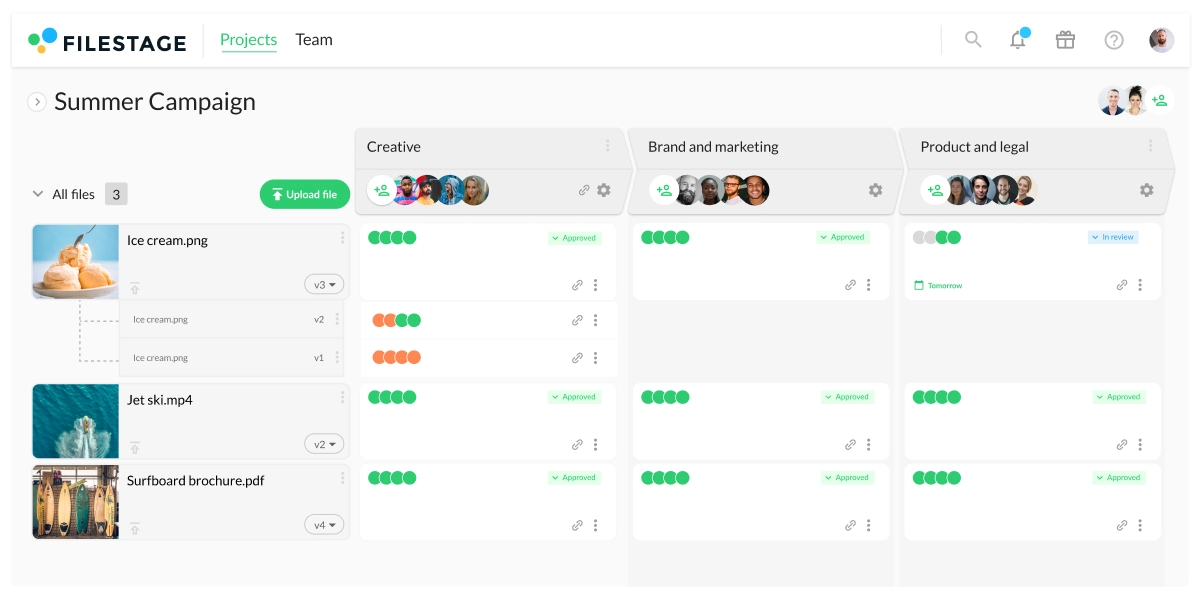
Tools like Filestage let you set each stage up as a review step with its own reviewer group, due date, and approval decision, so the campaign governance process runs the same way for every marketing campaign.
Deliver compliant content with confidence
Set up a consistent and compliant marketing review process with Filestage.
5. Define documentation and audit requirements
Your approval rules only hold if you can show they were followed. Decide what each tier has to keep on record:
- Low risk – the brief, the final approved version, who approved it, and any exceptions
- Medium risk – the above, plus feedback history and who approved each stage
- High risk – all of the above, plus claim substantiation, key decisions, and time stamped sign-offs
Store records where the next team can find them. Approved versions and past decisions make future campaigns faster to brief, and they give you an answer when legal or a regulator asks how something went live.
6. Automate and improve campaign governance
Most marketing teams already measure campaign performance. Once your framework is live, measure it too. Useful governance key performance indicators (KPIs) include:
- Approval turnaround time per tier
- Review rounds per asset
- Exceptions requested and granted
- Compliance issues caught late or after launch
- Stages where work regularly stalls
Review this campaign data every quarter. If low-risk campaigns regularly need four review rounds, that tier is over-governed. If issues keep surfacing after launch, a control is missing.
Then automate what the numbers show is repetitive, such as routing campaign assets to the right reviewers, sending notifications and reminders, moving files to the next stage, and filing approval records.
Each automation should remove manual work while keeping the same level of control.
Campaign governance examples: Low-risk vs. high-risk marketing campaigns
Here’s how the same framework plays out for two different campaigns: an organic social media campaign in one market and a regulated marketing campaign across multiple markets.
| Low risk: organic social media campaigns | High risk: regulated global launch | |
| Ownership | Social media manager owns and approves | Campaign owner, with leadership accountable for marketing strategy |
| Brand review | Covered by templates and brand standards | Formal brand review stage |
| Legal/compliance review | Not required | Mandatory, before final approval |
| Regional involvement | None | Each market reviews its localized versions |
| Leadership approval | Not required | Required for strategy and spend |
| Documentation | Brief and approved social media posts archived | Full audit trail, substantiation, and exceptions |
| Escalation | Campaign owner decides | Named escalation path with deadlines |
How technology supports marketing teams with campaign governance
Software can’t create governance for you. If decision rights and tiers aren’t defined, a tool will only speed up an unclear process. Once they are, the right platform makes the framework easy to follow and hard to skip.
Filestage is a review and approval platform that covers this part of governance. You can:
- Set up a review step for each stage, with separate reviewer groups for each department or market
- Add due dates and automated reminders so stage deadlines hold
- Keep all feedback pinned to the file and compare versions side by side
- Track approval status for every reviewer, backed by an audit trail of comments, version changes, and approval decisions
- Control who can access each project, and who can approve, with role-based permissions
For regulated industries, verified approvals on the Enterprise plan add legally traceable sign-offs.

Build campaign governance that scales with your content
Effective campaign governance comes down to clear ownership, written guardrails, risk-based controls, and repeatable processes rather than extra approval layers. With those in place, marketing teams can move faster without putting brand consistency or compliance at risk.
Treat your framework as a working document. Revisit tiers and rules as you expand into new markets and marketing channels or take on new regulatory requirements, and let your governance metrics show you where to loosen or tighten.
Ready to put your governance framework into practice? Set up structured review stages and approvers in Filestage, and give every campaign the same clear path to sign-off. Start your free trial of Filestage
FAQ about marketing campaign governance
Who is responsible for marketing campaign governance?
A marketing leader or the marketing operations team usually owns the framework. Campaign managers apply it day to day, while brand, legal, regional teams, and leadership own the specific decisions your RACI assigns to them.
What’s the difference between campaign governance and campaign approval?
Governance defines the rules, responsibilities, standards, controls, and accountability for every campaign. Campaign approval is one way to enforce those rules, by making sure the right people sign off on each asset before launch.
How can campaign governance work without slowing marketing down?
Match oversight to risk. Low-risk campaigns get a light process, pre-approved templates and claims cut the volume that needs full review, and a clear exception process stops urgent work from stalling.